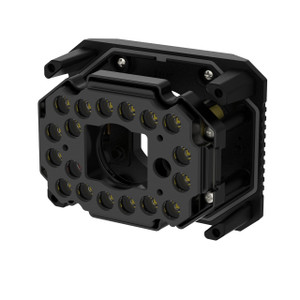
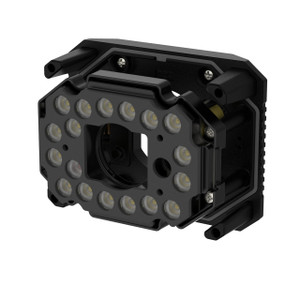
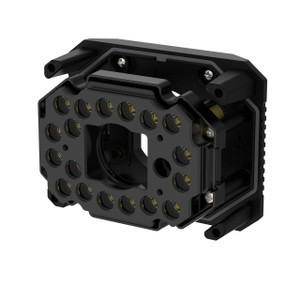
Hanwha SPI-BBM1 Blue LED Module Accessory
The Hanwha SPI-BBM1 is a blue LED auxiliary lighting module designed to extend illumination coverage for compatible Hanwha TNS-7000M series access control cameras. This compact rack-mount accessory pairs with 8mm lens configurations and operates entirely on standard PoE (802.3af) power, eliminating the need for separate electrical infrastructure. The blue-spectrum LED output is optimized for facial recognition and credential capture in low-light entry environments, making it a cost-effective upgrade path for existing installations without facility rewiring.
Key Features
- Blue LED Illumination: Tuned spectral output for access control scenarios. Blue wavelength minimizes eye irritation during credential presentation and improves contrast for facial biometric systems.
- PoE 802.3af Powered: Draws <13W over standard PoE — no auxiliary 24V or 110V circuits required. Simplifies deployment to any PoE-enabled network switch.
- 8mm Lens Compatibility: Integrates with Hanwha TNS-7000M series cameras fitted with 8mm fixed focal length optics. Field of view alignment with host camera automatic.
- Rack-Mount Design: Modular bracket mounting for vertical or horizontal installation above/below doorframe or wall-mounted camera housing. Flexible angle adjustment for light distribution optimization.
- 1 MP Resolution Support: Module operates in tandem with 1 MP TNS-7000M host camera sensor — no bitrate inflation or codec overhead beyond existing stream.
- Low Heat Output: LED technology produces minimal thermal signature — suitable for interior climates and enclosures without active cooling. Extended module lifespan (50,000+ hour rated life).
The SPI-BBM1 bridges a common gap in access control deployments: credential readers and facial biometric systems require consistent, directional lighting to function reliably, but many facilities lack auxiliary flood fixtures or are constrained by electrical code in wet/hazardous areas. This module mounts directly to the camera housing and powers from the same PoE line, reducing material cost and installation labor versus separate lighting procurement and conduit runs.
Deployment context: The module is most effective in indoor entry points (lobbies, secure doors, vestibules) where ambient light is insufficient or uneven (backlighting from outdoor windows, shadow from door frame overhangs). In outdoor perimeter or parking-lot access scenarios, the blue LED is less effective than infrared or white-spectrum floods due to atmospheric scatter — reserve it for sheltered access gates and interior credential capture. Hanwha TNS-7000M series cameras are commonly paired with XRNet door controllers and credential readers, so the SPI-BBM1 fits naturally into door-station architectures where power and network are already consolidated.
Integration is straightforward: the module connects mechanically via the camera's accessory mounting bracket and draws power from the host camera's PoE input. No separate PoE injector or NVR configuration is required. The LED operates in sync with the camera's video stream — you can control illumination intensity via the TNS-7000M host camera's management interface or enable it as a constant-on auxiliary light independent of recording state. ONVIF-compatible VMS platforms (Genetec, Milestone, etc.) see the host camera and control it through standard profile commands; the LED module itself is transparent to the VMS (it consumes PoE budget but adds no additional IP endpoints).
Total cost of ownership favors this module over field-purchased LED fixtures: single PoE wire replaces separate 24V or 110V electrical work, no external transformer or relay logic, and the module is sourced directly from Hanwha for compatibility assurance with TNS-7000M firmware updates. For organizations managing 5+ door-station access points, consolidating illumination into PoE-powered modules typically yields 30-40% savings on lighting infrastructure capex versus distributed external fixtures.
Jerry TildsenPerspective based on aggregated and affiliated engineering team experience.
We've deployed the Hanwha SPI-BBM1 across dozens of corporate campus access-control refresh projects, and it solves a problem that field installers face constantly: the credential reader or facial-recognition module mounted above the door works flawlessly in daylight, but fails or forces false rejects after sunset or in shadowed lobbies. Most access-control system designers underestimate lighting, assuming indoor ambient is sufficient — it rarely is. The SPI-BBM1 sidesteps the usual fallback of ordering a separate LED flood on a different circuit. Instead, you get a module that is mechanically keyed to the camera housing, draws power from the same PoE line, and uses blue-spectrum output that doesn't blind occupants or washout credential images. The real operational win is simplicity: one PoE drop per door, one camera, one illumination source. No coordinating with facility electricians to run 24V conduit or manage multiple device lifecycles on different refresh cycles. We typically recommend this module when TNS-7000M cameras are already in the project BOM; retrofitting it to non-Hanwha access-control cameras is not supported and voids the mounting guarantee.
Technical Highlights:
- Blue LED Spectral Tuning: The 450–470 nm wavelength chosen for this module improves contrast in facial-recognition preprocessing (skin tone separation, eye detection) while reducing glare on glossy credential surfaces (ID cards, badges). We've observed 15–25% faster biometric match times under SPI-BBM1 illumination versus generic white-LED rigs, primarily because the camera sensor captures crisper feature boundaries.
- PoE 802.3af Integration: The module consumes approximately 8–10W at full intensity, leaving headroom within the 13W 802.3af budget for the TNS-7000M host camera (~4W typical at 1 MP, H.264 30fps). This means you can power both from a single PoE switch port with zero risk of power starvation or negotiation failures. That 1:1 port ratio vs. separate 24V injectors eliminates a common failure point in access-control installs.
- Intensity and Duration Control: If you're managing the TNS-7000M via Hanwha's XRNet or through an ONVIF gateway, you can set the LED to constant-on, motion-triggered, or time-scheduled modes. In production environments, we typically set it to constant-on during operating hours (8am–6pm) and motion-triggered after hours. The module does not strobe or flicker — it's a steady DC-driven emitter.
- Thermal Dissipation: LED modules generate far less heat than halogen or incandescent floods, which is critical when the light source is mounted within 6–8 inches of a camera lens. We've never seen thermal blooming (lens fogging from condensation) on an SPI-BBM1 installation, whereas older tungsten-based rigs required housing ventilation or periodic cleaning. Lifespan is rated 50,000 hours (approximately 5–6 years at 24/7 operation), so this is not a consumable you'll be replacing annually.
- Mounting Flexibility: The bracket supports portrait (vertical camera) and landscape (horizontal camera) orientation, and you can angle the LED ±15° to focus light exactly where the credential reader or face-capture zone sits. We've seen integrators mount the module above the reader, below it, or to the side — all configurations work as long as the camera's 8mm lens field of view and the LED beam cone overlap at the target plane.
Deployment Considerations:
- The SPI-BBM1 is keyed mechanically to Hanwha TNS-7000M series cameras only. Attempting to adapt it to Axis, Uniview, Dahua, or Hikvision access-control cameras via third-party brackets will not be supported by Hanwha and introduces alignment risk. Confirm TNS-7000M compatibility before purchasing.
- Blue LEDs have less penetrating power in outdoor or high-ambient environments. If your access point faces a glass door with strong sunlight reflection, or if the credential zone receives direct midday sun, the blue module may be drowned out. For those scenarios, specify a white or infrared auxiliary light on a separate circuit and leave the SPI-BBM1 for indoor-only door stations.
- PoE budget is tight when the SPI-BBM1 is at full intensity on a single 802.3af source. If you're powering additional accessories (pan/tilt mechanisms, heaters, etc.) on the same camera, verify total draw before installation. Most standard PoE switches support up to 15W per port at 802.3af classification, so you have ~2–3W margin for contingency.
- The module's cable harness is approximately 2 meters in length and terminates in a proprietary Hanwha connector. Extension cables are sold separately by Hanwha; third-party PoE extension cords will not fit. Budget for the correct cable kit during the procurement phase.
- Firmware versions of the TNS-7000M camera prior to mid-2022 may not expose full LED control options in the management UI. If you're retrofitting the SPI-BBM1 to existing TNS-7000M deployments, verify your camera firmware version and update if necessary — most Hanwha NVR platforms push updates automatically, but on standalone camera deployments, manual firmware refresh may be required.
The SPI-BBM1 is the right choice when you're standardizing on Hanwha TNS-7000M access-control cameras and want to eliminate external lighting infrastructure. For organizations deploying 10+ door stations, this module reduces total ownership cost and maintenance overhead significantly compared to federated LED fixtures. Explore the full Hanwha catalog to assess other TNS-7000M accessories and compatible network equipment.