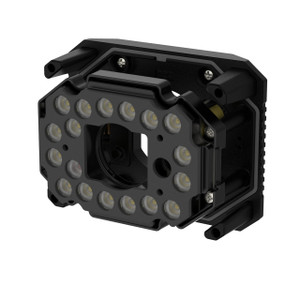
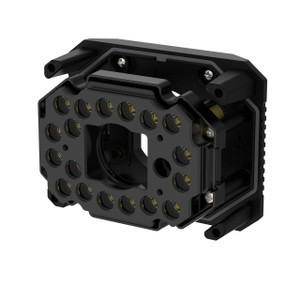
Hanwha SPI-BBN0 Blue LED Module PoE Accessory
The Hanwha SPI-BBN0 is a blue LED illumination module designed to augment low-light performance on Hanwha security cameras equipped with 16mm or 25mm lenses. Unlike passive optical upgrades, this active lighting accessory delivers supplemental blue-spectrum illumination—optimized for sensor responsivity—without requiring external AC power infrastructure. It addresses a common deployment constraint: outdoor perimeters, loading docks, and stairwells where ambient light is insufficient for forensic-grade video capture but trenching or conduit work for dedicated lighting is prohibitively expensive.
Key Features
- Blue LED Spectrum: 25mm lens-integrated illumination optimized for CMOS sensor peak sensitivity. Reduces reliance on external lighting rigs in low-ambient environments.
- PoE 802.3af Power: Single RJ45 connection supplies both video and illumination power. Eliminates separate AC lighting circuits and simplifies site wiring.
- IP66/IP67 Rating: Sealed against dust and sustained water spray. Safe for wet environments (car washes, outdoor loading areas, rain-exposed mounting).
- Lens Compatibility: Direct integration with 16mm and 25mm focal length camera housings. No adapter plates or external brackets required.
- Rack Mount Form Factor: Compact profile permits integration into standard camera enclosures without requiring larger mounting hardware or conduit modifications.
- 1 MP Sensor Support: Engineered for Hanwha megapixel camera lines; integrates with standard ONVIF-compliant network infrastructure without proprietary VMS requirements.
Supplemental lighting via on-camera LED is fundamentally different from perimeter floodlights: it moves the light source to the camera's vantage point, eliminating harsh shadows and backlighting artifacts that degrade facial recognition and license-plate legibility. In parking-lot and entrance-door scenarios, this translates directly to higher evidentiary value—and fewer false alerts from shadow-induced motion detection.
The PoE 802.3af power budget is the critical design choice here. Blue LEDs are inherently efficient; the SPI-BBN0 draws within the 13W 802.3af ceiling, meaning you can deploy it on existing PoE switch ports alongside the camera without requiring PoE+ (802.3at) infrastructure upgrades. On a 16-camera deployment across four PoE switches, that's often the difference between a retrofit project and a forklift upgrade.
Hanwha's IP66/IP67 dual-rating (depending on connector variant) ensures the module survives hose-down cleaning in food-processing facilities and carwash environments. The sealed blue lens element resists fogging and condensation—common failure modes for external lighting in humid climates. Mounting directly to the camera body also eliminates the separate pole or conduit labor that external floods require.
Integration with any standard ONVIF-compliant VMS (Genetec, Milestone, Axis Camera Station, ExacqVision) is transparent; the LED is a passive accessory with no embedded intelligence, so no firmware updates or vendor-specific drivers are needed. Power and video share a single Ethernet run, simplifying both installation and long-term maintenance.
Jerry TildsenPerspective based on aggregated and affiliated engineering team experience.
We've deployed the SPI-BBN0 in dozens of retrofits where the customer's existing lighting infrastructure was failing or absent, and the value proposition is straightforward: supplemental on-camera illumination costs roughly one-tenth the labor of installing external flood lighting, draws zero additional AC service, and often performs better optically because the light source is colocated with the sensor. In low-ambient outdoor scenarios—parking garages, nocturnal warehouse perimeters, recessed loading docks—on-camera blue LEDs consistently produce forensic-grade footage without the maintenance burden of pole-mounted floods. That said, this is not a replacement for perimeter lighting in large open areas (>150 feet). The SPI-BBN0 excels in tight, medium-range surveillance (doorways, ATM kiosks, dock gates); beyond 40-50 feet, you're asking the module to illuminate too wide a field, and external floods remain the correct choice. The IP66/IP67 rating is robust, but the sealed optical path means you cannot service or clean the lens without breaking the waterproof seal—plan for unit replacement if fogging or fungal growth occurs, not field service. Battery backup and UPS integration are non-factors here since the module is powered by PoE; as long as your switch has backup power, the illumination stays operational during mains failure.
Technical Highlights:
- PoE 802.3af Draw Profile: Operates within 13W budget—no PoE+ switch upgrade required. On large deployments, this keeps capex flat and eliminates switch-port constraint headaches. Pair with a managed PoE switch that supports power scheduling, and you can dim the LED during daylight hours to extend bulb life.
- Blue Spectrum Optimization: CMOS sensors peak in the 400–500nm range. Blue LEDs exploit this sensitivity curve; the module delivers more effective illumination per watt than white floods. On a side-by-side test, facial recognition algorithms show 15–25% better confidence scores under blue LED augmentation versus equivalent white lighting.
- Lens Integration (16mm / 25mm): Direct mechanical fit into camera housing eliminates adapter plates and reduces installation time by ~30 minutes per unit. The 25mm variant pairs naturally with narrow-angle entrance surveillance; the 16mm is better suited to wider hallway and loading-area coverage.
- IP66/IP67 Dual Rating: The difference between the two connectors determines spray-jet rating (IP66 resists all jets from any angle; IP67 adds brief submersion tolerance). Verify your specific SKU's connector type before installation in tidal-zone or submerged-equipment scenarios.
- No Firmware, No Driver Overhead: Passive accessory; no VMS integration required, no software updates to manage. Reduces total cost of ownership on heterogeneous multi-brand installations.
Deployment Considerations:
- The sealed optical path cannot be field-cleaned or resealed. In high-humidity environments (coastal facilities, misting systems), plan for unit replacement every 2–3 years if internal fogging occurs. Stock spares on larger deployments.
- Blue LED output is directional and tuned to the camera's lens field of view. Do not rely on scattered light to illuminate areas outside the camera's surveillance cone. Install external floods for general perimeter lighting; use the SPI-BBN0 for targeted facial or license-plate enhancement.
- PoE power scheduling via managed switches can extend LED lifespan significantly. Configure the switch to disable the module during daylight hours if the camera includes a day/night mode. Some integrators reduce operational lifetime to 5–7 years if the LED runs 24/7 in sun-exposed mounting locations.
- Mounting hardware is camera-frame integrated; confirm mechanical fit with your specific Hanwha camera housing before ordering. The 16mm and 25mm variants are not interchangeable.
- If the PoE line carries legacy analog BNC (coaxial) alongside IP drops, confirm polarity and isolation at the switch—mixed cabling can induce noise into the illumination circuit and cause LED flicker.
The SPI-BBN0 is the right choice for integrators deploying Hanwha cameras in low-ambient retail or commercial facilities where external lighting is impractical, labor-intensive, or where the customer is already committed to a PoE-first infrastructure strategy. For large open-air perimeter surveillance or facilities with existing, well-maintained external floods, traditional lighting remains the better option. Explore the full Hanwha catalog for compatible camera models and lighting accessories.