
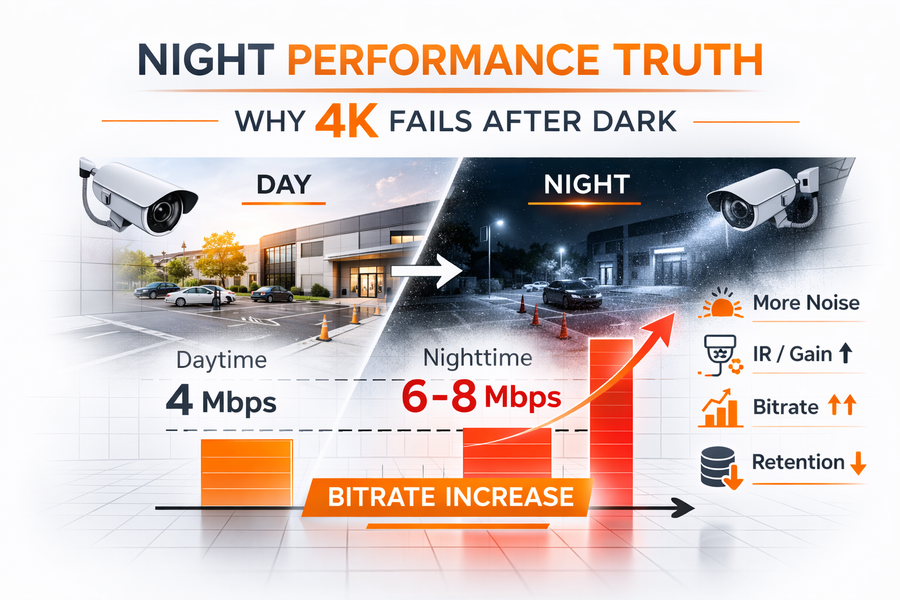
Why Your 4K Camera Fails at Night (And It’s Not the Resolution)
4K sounds powerful. Higher resolution. More detail. Better evidence.
But at night, many 4K cameras perform worse than lower-resolution models — not because they’re defective, but because physics takes over.
- Resolution does not equal low-light performance.
- Smaller pixels collect less light.
- Noise increases bitrate dramatically at night.
- Improper WDR tuning can reduce usable identification detail.
The Real Problem: Pixel Size vs Light
Higher resolution sensors divide the same sensor area into more pixels. More pixels means smaller pixel sites. Smaller pixel sites collect less light.
Less light per pixel = more noise. Noise forces the encoder to work harder. That increases bitrate.
Which means your retention math breaks at night.
Noise → Bitrate Inflation → Retention Collapse
At night:
- IR engages
- Gain increases
- Noise increases
- Compression efficiency drops
The result? Your 4 Mbps daytime stream becomes 6–8 Mbps at night.
Quick Night Bitrate Impact Calculator
WDR Can Hurt Identification If Misused
Wide Dynamic Range helps balance bright and dark areas. But aggressive WDR can:
- Introduce ghosting
- Reduce contrast
- Increase motion blur
For identification zones, careful tuning matters more than headline WDR numbers.
How This Connects to the Full Stack
- Noise increases bitrate → breaks retention
- Higher bitrate increases power draw → stresses PoE
- Improper shutter settings reduce usable identification → undermines DORI
Where This Fits in a Deployment Program
- Commercial Surveillance Solutions
- Construction Site Security Systems
- Education and Campus Security Systems
Tell us the environment (urban, low-light, parking lot, warehouse), camera model, and retention target. We’ll help you validate low-light performance before deployment.
Get Recommendations