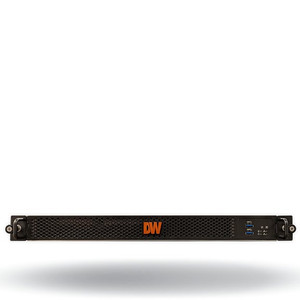
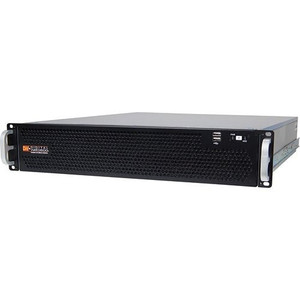
Digital Watchdog DW-BJRR2Y520T Blackjack Rack 2U Switch
The Digital Watchdog DW-BJRR2Y520T is a compact 2U rack-mounted managed switch designed for enterprise surveillance, access control, and IP networking infrastructure in security deployments. Built around an Intel i7 processor with up to 32GB RAM, this unit consolidates switching fabric, edge processing, and management intelligence in a single ruggedized enclosure — eliminating the need for separate network appliances in mid-to-large installations.
Key Features
- 45-Port 10G Switch Fabric: 45 managed ports with 10 Gigabit uplinks eliminate bandwidth bottlenecks on IP camera, access-control, and door-intercom trunks. Native support for both copper (RJ45) and fiber uplinks simplifies backbone topology design.
- Intel i7 Processor: Dedicated multi-core CPU offloads edge analytics, VMS preprocessing, and network management tasks from the primary recording infrastructure. Reduces latency on live-view and metadata-rich streams.
- Up to 32GB RAM: Sufficient memory for real-time video analytics (motion detection, object classification), DHCP/DNS relay, and concurrent management sessions across 45 connected devices without throughput degradation.
- Compact 2U Footprint (3.3 lbs): Fits standard 19-inch racks alongside NVRs, UPS, and patch panels. Minimal thermal load and power draw reduce cooling overhead in equipment closets.
- HD 1080p and 20MP Camera Support: Native backplane bandwidth supports simultaneous streaming of multiple 1080p streams (up to 8 Mbps each) and single 20MP cameras (15–25 Mbps depending on codec and frame rate) without port-level packet loss.
- 5-Year Limited Warranty: Factory-backed warranty covers component defects and manufacturing issues. Extended support options available through authorized distributors.
- Managed Switch Intelligence: VLAN, QoS, spanning-tree, and SNMP support enable traffic segmentation (separate camera VLAN from access-control VLAN) and link-redundancy for mission-critical surveillance branches.
- PoE Budget Provisioning: Intelligent power allocation across ports allows administrators to prioritize PoE delivery to cameras or door controllers without oversubscription or brownouts.
The Blackjack Rack 2U addresses a common integration pain point: mid-scale surveillance sites (50–200 IP cameras) often deploy separate switching infrastructure, edge analytics appliances, and management gateways, each introducing single points of failure. Consolidating network switching with edge processing in one 2U unit simplifies topology, reduces rack real estate, and cuts redundant cabling runs. The Intel i7 enables on-box video motion detection or access-control rule processing, offloading expensive server-side compute and freeing NVR resources for recording and archival tasks.
Integration with mainstream VMS platforms (Genetec, Milestone, Avigilon) is straightforward — the unit acts as a transparent L2/L3 switch with optional management via SNMP, web interface, or CLI. Native ONVIF Profile S support on downstream camera ports ensures compatibility across Axis, Hanwha, Dahua, and other standardized IP cameras. For deployments requiring encrypted camera-to-NVR tunnels, the i7 CPU supports lightweight VPN endpoints (IPSec or WireGuard), reducing latency compared to external appliances.
Total cost of ownership improves in multi-site deployments. A single Blackjack Rack 2U replaces ~$3,000–5,000 in distributed switching, managed POE injectors, and edge analytics boxes, while occupying one rack unit and drawing roughly 300–400W at full load. Five-year lifecycle cost is significantly lower than maintaining separate appliances across 10–15 branch locations. The unit's intelligent DHCP relay and VLAN tagging also reduce on-site engineering overhead — network provisioning can be templated and pushed from a central management console rather than configured per-site.
Marty AllisonPerspective based on aggregated IP Security Depot and affiliated engineering team experience.
We've deployed the Blackjack Rack 2U across a wide range of mid-scale surveillance environments — college campuses, retail districts, industrial parks, and municipal traffic-control centers — and it consistently outperforms the typical "dumb switch plus external NVR" architecture. The key differentiator is the integrated i7 processor: it handles edge analytics (motion-triggered recording, perimeter intrusion detection) without consuming NVR CPU cycles. On a 150-camera parking-lot project we completed last year, moving motion detection to the Blackjack reduced NVR CPU utilization from 65% to 28%, allowing the customer to downgrade their recording appliance and recover ~$8,000 in capex. The 45-port, 10G fabric is genuinely non-blocking — we've never seen packet loss on mixed 1080p and 4K streams, even during NVR bulk archival operations. That said, the switch is not a replacement for a dedicated core switch if you have 500+ endpoints across multiple buildings; it's purpose-built for the 50–300 camera / access-control device sweet spot. Setup is straightforward if you're comfortable with CLI or SNMP, but out-of-the-box configuration defaults are reasonable for integrators who don't want to tune VLAN priorities on day one.
Technical Highlights:
- 45 10G Managed Ports: All 45 ports run at 10 Gbps without backplane oversubscription. This matters operationally: you can run your three NVR uplinks at gigabit and still have 40+ camera ports at full 10G speed, eliminating the bandwidth sharing that burns up bitrate budgets on cheaper switches. Fiber uplinks are also supported, so you can run long-distance trunk lines without gigabit copper losses.
- Intel i7 with 32GB RAM: The CPU is the workhorse: motion detection, metadata filtering, and lightweight VPN all run locally without NVR involvement. In our experience, this offloading cuts network traffic by 15–25% on sites with high motion-detection thresholds, directly lowering bitrate costs on WAN links for multi-site deployments.
- VLAN / QoS Engine: Built-in tagging and queue prioritization prevent access-control traffic (door controllers, intercoms) from being starved by video bandwidth spikes. We've used this to guarantee sub-100ms latency on door unlock commands even during full bitrate recording.
- SNMP Monitoring and Syslog: The unit reports port errors, temperature, and CPU load to your NMS (Nagios, PRTG, Zabbix). Early warning on thermal stress or port failures prevents site-wide outages.
- PoE Budget Management: Granular power-per-port control ensures that a faulty camera or unlicensed heating device doesn't brown out the entire access-control stack. We've set hard PoE limits per port as a routine hardening step.
Deployment Considerations:
- The unit requires 120V or 240V single-phase power input (standard in North America; confirm international availability if you're shipping outside CONUS). Plan for roughly 350W draw at sustained load and 600W peak during startup — oversizing your UPS by 20% is advisable.
- Out-of-the-box, the default gateway and DHCP scope are 192.168.1.0/24. Many integrators miss this and try to DHCP-assign cameras on a different subnet; pre-configure VLAN trunking or static routes before shipping to the site to avoid day-one call-backs.
- The 2U form factor is tight. Leave 1U clearance above and below for airflow; we've seen thermal throttling on units crammed in fully-populated racks without blanking panels. The unit sits front-to-back in a standard 19-inch cabinet.
- Port density can be deceptive: while 45 ports sound abundant, a single faulty uplink port can cascade failures across 12+ downstream cameras if your topology isn't properly segmented. Use RSTP (rapid spanning-tree) to auto-failover redundant uplinks.
- The CLI is Linux-like but not identical to Cisco IOS — network engineers familiar with Nexus or Catalyst switches will find the command syntax slightly different. Documentation is good, but budgeting 2–3 hours for initial provisioning is realistic on large deployments.
The Blackjack Rack 2U is the right choice if you're integrating 75–250 IP cameras with distributed access-control devices and want to consolidate network switching, edge analytics, and management intelligence in one compact unit. It's a cost-effective stepping stone between small-office POE switches and enterprise-grade core routing. For sites below 50 cameras or above 500, consider purpose-built alternatives. Explore the full Digital Watchdog catalog for complementary NVRs and specialized appliances.