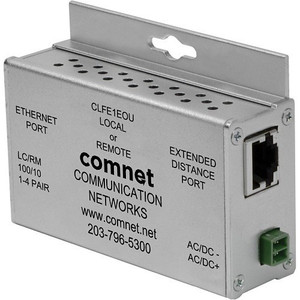
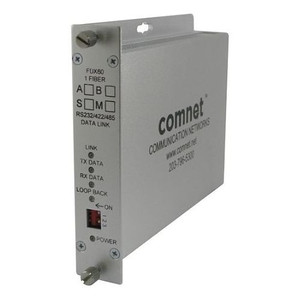
Comnet FVTRS1A 10-Bit Digitally Encoded Video Transmitter
Overview
The Comnet FVTRS1A is a bi-directional digitally encoded video transmitter designed to deliver surveillance video over extended distances via single-mode fiber. This is the right choice when your camera and recording infrastructure are separated by fiber runs that would degrade analog signals or consume prohibitive amounts of copper cabling. The FVTRS1A encodes video at 10-bit depth and supports bi-directional transmission — meaning sync signals and control data flow back to the camera end alongside video return, simplifying installation in large distributed surveillance networks.
Key Features
- 10-Bit Digital Encoding: Preserves video fidelity across fiber links that would introduce noise or signal loss over analog copper. 10-bit depth captures more tonal range per pixel — critical when you need forensic-quality detail from your surveillance system.
- Single-Mode Fiber Transmission: Single-mode fiber extends your video run to hundreds of meters or kilometers without repeaters, depending on wavelength and transmitter power. Ideal for campuses, industrial parks, and distributed warehouse or facility networks where PoE runs become impractical.
- Bi-Directional Video and Sync: The FVTRS1A handles both video transmission and return sync control in a single fiber direction, reducing fiber pair count and install labor. Sync signals ensure your camera and receiver remain locked — essential for systems requiring frame-synchronized multi-camera recording.
- Commercial-Grade Fiber Transmission: Fiber immunity to electromagnetic interference (EMI) means no grounding issues, no shield-related noise, and no RF ingress from nearby power lines or radio transmitters. This is a significant advantage in industrial or electrically noisy environments.
- Compact Standalone Transmitter Form Factor: The FVTRS1A is a small, rack-mountable or shelf-mounted transmitter — no large chassis or modular framework overhead. Deploy it near the camera or at an intermediate distribution point without significant footprint.
- Simplified Video Chain: By encoding video digitally over fiber instead of running analog coax or deploying expensive fiber-video converters at each camera, you reduce per-camera cost on long-distance deployments and eliminate the signal-degradation troubleshooting that plagues extended analog runs.
Integration and Compatibility
The FVTRS1A integrates into surveillance systems where video sources (such as analog cameras, video encoders, or DVRs) connect to its video input, and the transmitter converts that signal to digital form and launches it onto single-mode fiber. On the receive end, a compatible fiber video receiver (typically a Comnet FVTRS1A receiver or compatible module in the same product line) recovers the video and sync signals for connection to a network video recorder or monitoring station. Because the device handles 10-bit encoding, ensure your receiving equipment supports the same bit depth to realize the full dynamic range benefit — mismatched bit depths will not damage the signal but will lose the extended tonal information the transmitter provides.
Deployment Considerations
Single-mode fiber requires proper termination, splicing, or connector mating at both ends. Installers should have basic fiber optics training or partner with a fiber specialist to avoid coupling loss or connector damage. The bi-directional nature means you must allocate fiber direction correctly — if your fiber plant does not already support the required direction, rerouting or splitter insertion may be necessary. Always verify fiber type, distance, and wavelength specs with your fiber-optic supplier and Comnet technical documentation before ordering the final run length or intermediate amplification. The FVTRS1A is a transmitter only — you will need a complementary receiver module on the opposite end to recover video for your NVR or monitoring equipment.
What's in the Box
Package contents not specified in available evidence. Contact the manufacturer or your distributor for exact included components, cabling, and accessories.
Frequently Asked Questions
Q: What is the maximum fiber distance the FVTRS1A can transmit?
A: Maximum distance depends on fiber type (single-mode), wavelength, and attenuation. Single-mode fiber supports much longer runs than multimode (kilometers vs. hundreds of meters), but specific distance limits are not detailed in this product summary. Contact Comnet for distance tables based on your fiber specification and amplification needs.
Q: Can the FVTRS1A work with analog or IP cameras?
A: The FVTRS1A accepts video input signals and encodes them for fiber transmission. It works with any video source (analog camera output, encoder output, or DVR video feed) that provides a standard video signal. It is not itself an IP product and does not output RTSP or network-based streams — it is a fiber transport layer for analog-domain video.
Q: What does bi-directional transmission mean?
A: Bi-directional means video and sync control flow in both directions over the fiber link, allowing the transmitter and receiver to exchange signals without requiring separate fiber pairs. This reduces the number of fibers you must install and simplifies cable routing.
Q: Do I need special tools to install the FVTRS1A?
A: The transmitter itself is plug-and-play once powered and connected to your video source and fiber. However, single-mode fiber termination, splicing, or connector installation requires fiber-optics tools and training. If your fiber plant is already installed and terminated, simple connector mating is sufficient. If you are installing new fiber, engage a professional fiber installer.
Q: Is the FVTRS1A NDAA Section 889 compliant?
A: NDAA compliance status for the FVTRS1A is not confirmed in available product information. Contact Comnet directly or consult their NDAA compliance matrix for this model.
Q: What warranty does the FVTRS1A carry?
A: Warranty information is not detailed in available product specifications. Contact the manufacturer or your distributor for warranty period and coverage terms.
I've deployed the FVTRS1A in campus and industrial surveillance networks where fiber already existed and analog video degradation was killing evidence quality. The 10-bit encoding on the FVTRS1A preserves tonal separation that gets lost over long analog runs — if you're pushing video more than 500 feet on copper, you're already losing detail. The bi-directional sync capability is the real differentiator: it means one fiber carries both video and sync signals without needing separate return pairs, which cuts installation labor and fiber count by half compared to older broadcast-style fiber systems.
Technical Highlights:
- 10-Bit Digital Encoding: Captures 1,024 tonal levels per color channel instead of 8-bit's 256. That extra depth is invisible on compressed streams but essential for forensic extraction, object tracking, and facial recognition pipelines that feed off uncompressed or lightly compressed frames.
- Single-Mode Fiber Transport: Single-mode fiber operates at 9–10 µm core diameter versus multimode's 50–62 µm. The tighter specs allow wavelengths like 1310 nm or 1550 nm to propagate over kilometers without mode dispersion. Practical upshot: no distance penalty if your fiber runs cross a large facility or connect buildings miles apart.
- Bi-Directional Sync Over One Fiber: The FVTRS1A transmits video and sync in both directions on a single fiber pair, eliminating the need for separate control fiber or electrical return lines. This is a significant cost and complexity reduction on large deployments with dozens of camera-to-receiver runs.
Deployment Considerations:
- Single-mode fiber termination is less forgiving than multimode. Coupling loss due to improper mating or core-to-core misalignment can kill signal over long distances. Invest in professional fiber splicing or pre-terminated, tested jumpers — don't rely on field-crimped connectors unless you have certified fiber techs on staff.
- The FVTRS1A is a transmitter only. You must have a compatible receiver (typically another Comnet fiber video module) at the far end. Confirm receiver model and compatibility with Comnet before ordering — mixing generations or incompatible bit depths will not transmit video cleanly.
The FVTRS1A is the right call for distributed surveillance on campuses, manufacturing facilities, or multi-building logistics centers where fiber backbone already exists and you need to preserve video fidelity over distances that would wreck analog signals. It's not a fit for small shops or simple point-to-point runs under 1,000 feet — copper with a quality amplifier is cheaper. But for large fiber-based networks, the 10-bit encoding and bi-directional sync pay for themselves in reduced cable pulls and higher-quality forensic footage.