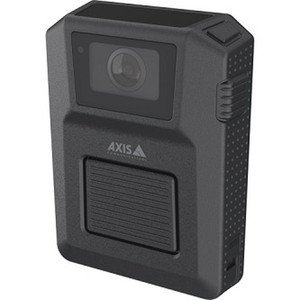
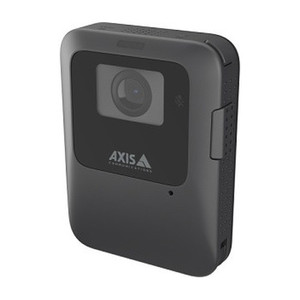
Axis 02786-004 2MP Body Worn Camera
The Axis 02786-004 is a professional body worn camera designed for law enforcement, security personnel, and field operatives who document incidents in harsh outdoor conditions. This wired 2MP unit captures 1920×1080 H.264 video at 30fps with a 137° horizontal field of view—wide enough from a chest-mounted position to capture peripheral context that narrower lenses miss, reducing the need for camera repositioning during active operations.
Key Features
- 2MP 1/2.9" sensor with 1920×1080 H.264 recording at 30fps: Delivers forensic-quality video suitable for evidence admissibility; H.264 codec is widely supported across VMS platforms and doesn't require transcoding for archival or courtroom playback.
- 137° horizontal field of view with 76° vertical coverage: Captures scene context from chest or shoulder position without blind spots—critical when documenting multi-person encounters or tactical movements where peripheral awareness determines investigative outcome.
- IP67 environmental rating—dust and water immersion protection to 1 meter for 30 minutes: Camera survives submersion, heavy rain, and dusty environments without operational degradation. Drop into water, mud, or sand without equipment loss.
- Operating temperature -20 to 55°C (-4 to 131°F): Performs in arctic patrol conditions and desert heat without thermal shutdown or image degradation. No seasonal equipment rotation needed.
- 0.1 lux minimum illumination with Wide Dynamic Range (WDR): Captures usable detail in dim indoor spaces and strong backlighting (e.g., sunset interviews, indoor detention facility lighting). WDR balances bright windows against dark interior walls in single frames.
- Integrated multi-constellation GNSS (GPS, GLONASS, Galileo, BeiDou): Embeds geographic coordinates and timestamps in every frame—essential for chain-of-custody documentation, incident reconstruction, and jurisdictional verification without reliance on GPS alone.
- Built-in accelerometer and gyroscope: Logs motion patterns and camera orientation; detects when the camera is stationary versus moving, aiding evidence review and activity classification in investigations.
- Axis Zipstream H.264 compression: Reduces file sizes without quality loss compared to standard H.264, lowering bandwidth and long-term storage costs for multi-unit deployments.
- Built-in microphone and audio support: Synchronized audio capture links verbal statements, environmental sounds, and radio communications directly to video—avoiding separate audio recording workflows.
- PoE (Power over Ethernet) connectivity: Single cable delivers both data and power; no external power supply required. Integrates directly into standard network infrastructure and battery-backed PoE injectors for continuous operation during power loss.
- HTTPS encryption: Secures all data transmission to recording devices; meets CJIS and evidence-handling compliance requirements for law enforcement agencies.
Integration & Compatibility
The 02786-004 supports wireless 802.11a/b/g/n/ac connectivity for flexible network provisioning on-site. Wired PoE connection ensures consistent power and bandwidth; wireless bridges allow deployment in areas without hardwired network drops. H.264 codec output is compatible with major VMS platforms (Axis Camera Station, Milestone, generic ONVIF systems), so video integrates into existing surveillance infrastructure without proprietary software lock-in.
When to Choose a Different Model
If your use case requires wireless autonomy with on-board battery for 8+ hour continuous operations, evaluate a different body-worn variant in the Axis lineup with extended battery and wireless-only connectivity. If you need thermal or infrared imaging for nighttime tactical operations in pitch-black environments, the 02786-004's visible-light sensor and 0.1 lux sensitivity won't suffice—step up to a thermal body camera. If mounting constraints require a smaller form factor, confirm physical dimensions against your tactical gear before purchase.
Frequently Asked Questions
Q: Is the Axis 02786-004 waterproof for saltwater environments?
A: The IP67 rating covers freshwater immersion up to 1 meter for 30 minutes. Saltwater (coastal or marine operations) can corrode connectors and seals over time; rinse the camera with fresh water immediately after saltwater exposure to extend service life.
Q: Does the 02786-004 require a separate power supply or battery pack?
A: No. PoE (Power over Ethernet) delivers power through the network cable. A standard 802.3af PoE injector or PoE-enabled network switch powers the camera. For portable use, connect the PoE cable to a battery-backed PoE injector or mobile recording unit with built-in PoE output.
Q: What's the maximum record time on internal storage?
A: The 02786-004 does not have built-in storage. Video streams via PoE to an external NVR, laptop, or mobile recording device. Storage duration depends on your recording appliance, network bandwidth, and bitrate configuration.
Q: Does the built-in GPS work indoors?
A: GNSS (GPS, GLONASS, Galileo, BeiDou) requires direct or clear line of sight to satellites. Indoors, satellite signals are weak or blocked. GPS accuracy drops significantly inside buildings; use it for outdoor deployments and check signal strength before relying on indoor positioning metadata.
Q: Is the 02786-004 compatible with Milestone XProtect or other third-party VMS platforms?
A: Yes. The camera outputs H.264 via ONVIF-compliant streaming, compatible with any ONVIF Profile S/T/G-capable VMS. Integration requires standard RTSP URL configuration; no proprietary plugins needed.
Q: What happens if the camera is dropped or struck during use?
A: The IP67 rating and rugged housing withstand impacts and falls typical of law enforcement work. Confirm lens clarity and connector integrity post-impact before resuming recording; physical damage to the lens or PoE connector may require replacement but won't destroy the sensor or electronics.
Ted PerryPerspective based on aggregated IP Security Depot and affiliated engineering team experience.
The Axis 02786-004 prioritizes durability and forensic metadata over wireless autonomy or thermal imaging. The IP67 rating and -20 to 55°C temperature range are the standout durability specs—this unit will survive submersion, extreme cold, and high heat without operational failure. The 137° field of view is intentionally wide for body-worn mounting; it captures peripheral context that narrower chest cameras miss, reducing investigative blind spots during multi-person encounters.
Technical Highlights:
- WDR + 0.1 lux sensitivity: Handles daylight backlighting and dim indoor spaces without frame loss or exposure compensation delays—critical for rapid-deployment scenarios where lighting is unpredictable.
- Multi-constellation GNSS (GPS, GLONASS, Galileo, BeiDou): Redundant satellite acquisition ensures coordinate embedding even in urban canyon environments where single-constellation GPS loses signal; chain-of-custody metadata is embedded, not added in post-processing.
- PoE power delivery: Eliminates battery dependency during wired recording sessions; integrates directly into existing network infrastructure or mobile recording units without proprietary chargers or power modules.
- H.264 Zipstream compression: Reduces bitrate 20–40% versus standard H.264 without quality loss—measurable savings on bandwidth and long-term storage for multi-officer deployments.
- Built-in accelerometer/gyroscope: Logs motion state and orientation; detects stationary periods (e.g., during interviews) separate from active movement, aiding evidence timeline reconstruction.
Deployment Considerations:
- Wired PoE requirement means the camera is tethered to a recording device or network drop—wireless 802.11 is supported, but power still comes via PoE cable. Not suitable for 8+ hour autonomous patrols without mobile recording appliance.
- No IR illumination: 0.1 lux low-light sensitivity handles dim interiors and twilight, but pitch-black tactical environments require separate thermal body cameras or external lighting.
- GPS is satellite-dependent; expect signal loss indoors and accuracy degradation near tall buildings. Verify GNSS acquisition in your deployment environment before relying on GPS metadata.
Best fit: law enforcement agencies, correctional facilities, and loss-prevention operations where outdoor/semi-outdoor documented encounters are the norm, wired tether to a mobile NVR is acceptable, and chain-of-custody metadata (GPS, timestamps, audio) is mission-critical. Skip this model if you need untethered 12-hour battery autonomy or thermal imaging for nighttime tactical work.