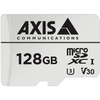
Axis 01678-001 Surveillance Card 128GB microSDXC 10-Pack
The Axis 01678-001 is a bulk-purchase storage bundle: ten 128GB microSDXC cards purpose-built for continuous video recording in Axis camera deployments. This 10-pack delivers 1.28 TB of total on-camera storage capacity, addressing a practical headache in scaled surveillance networks — managing spare cards, standardizing inventory, and ensuring adequate local recording capacity without sprawling purchase orders.
Key Features
- High-Endurance Design for Video Recording: These cards are engineered specifically for 24/7 sequential write workloads that typical consumer-grade microSD cards cannot sustain. This matters because consumer cards often throttle or fail under continuous recording; Axis Surveillance Cards maintain consistent write performance across the lifespan of the card, reducing risk of silent recording gaps.
- 128GB Capacity Per Card: A single card holds roughly 8–12 hours of 1080p video (depending on bitrate and compression), or 2–4 hours of 4K. For edge recording or failover backup, this gives you a reasonable window before requiring manual card swaps or network recovery — useful if your central recorder goes offline.
- Health Status Monitoring: Integrated firmware in compatible Axis cameras can query card health and report degradation in real-time via the camera web interface or management software. This enables predictive maintenance: you can replace a aging card before it fails, rather than discovering a dead card during a forensic review.
- 10-Pack Bundle (1.28 TB Total): Consolidating ten cards in a single SKU simplifies procurement, reduces per-unit cost, and gives you a standardized inventory for a 10-camera network or as spares for a larger deployment. Instead of juggling separate part numbers, you order once and distribute cards across your infrastructure.
- microSDXC Form Factor: Physically compact. All modern Axis cameras with local storage support the microSD/microSDXC slot — no adapters or proprietary connectors. Card insertion is straightforward, and swapping cards in the field requires only a few seconds per camera.
- Seamless Axis Ecosystem Integration: These cards are validated against Axis camera firmware and designed to work with Axis management platforms. Compatibility with third-party cameras or IP cameras from other vendors is not guaranteed; verify your specific camera model supports microSDXC before deployment.
When to Choose This Product
Deploy the Axis 01678-001 when you are rolling out 10 or more Axis cameras with local storage requirements and need a unified purchasing approach. Common scenarios include retail chains standardizing edge recording across multiple locations, warehouse automation systems requiring on-camera failover storage, and hospitality deployments where central NVR connectivity may be intermittent. The 10-pack format eliminates the friction of ordering single cards repeatedly.
If you are building a network video recorder (NVR)-based system with centralized storage, local camera cards serve as a secondary safeguard: if the NVR or network connection fails, the camera continues recording locally, and you recover footage from the card once connectivity is restored. The health monitoring feature is valuable in distributed installations where physical access to cameras is limited and you want to know card status without climbing a ladder.
When to Choose a Different Model
If you need significantly higher capacity (e.g., 256GB or 512GB per card) for long-term on-camera archival, check whether Axis offers higher-capacity variants in the same product line. If your cameras do not include a microSDXC slot, these cards are not applicable — consult your camera's datasheet to confirm local storage support. If you require only 1 or 2 spare cards, purchasing the 10-pack is wasteful; order individual cards instead (if available through your supplier). If your deployment relies entirely on a centralized storage and retention strategy with no offline or failover requirements, local camera storage may not be a priority.
Integration & Compatibility
The Axis 01678-001 works with any Axis camera model that includes a microSDXC card slot. Compatibility extends to both wired and wireless Axis cameras, domes, bullets, and specialty form factors, provided the device supports local recording. Before large-scale deployment, verify your specific camera firmware version supports the Surveillance Card health monitoring feature; older firmware may recognize the card but not report health status. Integration with third-party video management software (Milestone, Genetec, etc.) is indirect: the card itself stores video; the VMS accesses that video only if the camera exports recordings or if the card is physically removed and reviewed separately.
Deployment Considerations
Plan card replacement cycles. Even high-endurance cards have finite write cycles; expect 3–5 years of typical 24/7 operation before capacity or performance degrades. Leverage the health monitoring feature to flag cards nearing end-of-life, and maintain a rotation of spares. Store extra cards in a cool, dry environment away from static discharge. If you are managing 50+ cameras, consider a card lifecycle spreadsheet to track installation dates and next replacement windows — this prevents surprise failures.
Frequently Asked Questions
Q: How long will a 128GB card record at 1080p?
A: Recording time depends on video bitrate and compression. Typical deployments see 8–12 hours of continuous 1080p video per 128GB card. High-bitrate or uncompressed streams may yield 4–6 hours. Consult your camera's bitrate settings to calculate precisely for your use case.
Q: Do these cards work with non-Axis cameras?
A: The Axis 01678-001 is optimized for Axis cameras. While the physical microSDXC form factor is standard, the health monitoring integration and write-cycle performance tuning are specific to Axis firmware. Compatibility with third-party IP cameras is not assured. Check your camera manufacturer's documentation before deployment.
Q: Can I use a standard (non-surveillance) microSDXC card instead?
A: Technically, a standard microSDXC card will fit and may record initially. However, consumer-grade cards are not engineered for continuous, sequential write workloads and often throttle or degrade under 24/7 video recording. The Axis Surveillance Card is rated for sustained video use; standard cards are not. Use surveillance-grade cards to avoid unpredictable failures.
Q: How does the health monitoring feature work?
A: Compatible Axis cameras monitor card health metrics (write performance, error rates, remaining lifespan) and expose this data in the camera's web interface or via ONVIF/API calls. If health degrades, the camera will alert administrators, enabling proactive card replacement before failure impacts recording.
Q: What is the total storage capacity of a 10-pack?
A: A full 10-pack (Axis 01678-001) contains 1.28 TB of total usable capacity. This is sufficient for a 10-camera network with 8–12 hours of local failover storage per camera, depending on bitrate and compression settings.
Q: Are cards included in a single package or shipped separately?
A: The Axis 01678-001 is a 10-pack supplied as a single order. All ten cards ship together; you do not receive individual shipments.
The 10-pack format of the Axis 01678-001 solves a real procurement and logistics headache in mid-to-large surveillance networks. Instead of ordering single cards repeatedly and managing fragmented inventory, a single SKU provides 1.28 TB of standardized, validated storage. This approach reduces part-number clutter in your supply chain and cuts per-unit cost compared to single-card purchases.
Technical Highlights:
- High-Endurance Write Performance: These cards are optimized for sequential, sustained writes — the workload pattern of 24/7 video recording. A standard microSD card will degrade or throttle under this load; the Axis Surveillance Card is tuned to handle it. If your cameras record continuously, this difference means years of reliable operation versus months of unpredictable failures.
- Health Status Monitoring: The firmware integration allows Axis cameras to report card wear and performance degradation in real-time. In distributed deployments where you cannot physically inspect every camera weekly, this feature is invaluable — you get an alert before the card fails, not after you discover a gap in recordings.
- 128GB Per-Card Capacity: At typical bitrates and compression, one card holds 8–12 hours of video. For edge failover or offline-site recording, this window is sufficient to bridge network or NVR outages. For long-term on-camera archival, you may need higher capacity or rotating card strategies.
Deployment Considerations:
- Verify your camera firmware supports Surveillance Card health monitoring before rolling out across your fleet. Older Axis firmware may recognize the card but not expose health data, limiting your ability to do predictive maintenance.
- Plan a replacement schedule. Even endurance-rated cards have finite write cycles; 3–5 years is typical under continuous operation. Use the health monitoring feature to flag cards approaching end-of-life, and maintain a rotation of spare cards in inventory.
- The 10-pack is cost-efficient for deployments of 10+ cameras. If you need only 1 or 2 spares, ordering the full pack wastes capital; check whether individual cards are available from your supplier.
The Axis 01678-001 is best positioned for warehouse automation systems, retail chains, or hospitality networks where cameras are distributed across multiple sites and edge recording is a critical failover mechanism. If your architecture relies entirely on a centralized NVR with no offline requirements, local storage is a nice-to-have, not essential — but for resilience, it is hard to beat the simplicity and cost of on-camera backup cards.