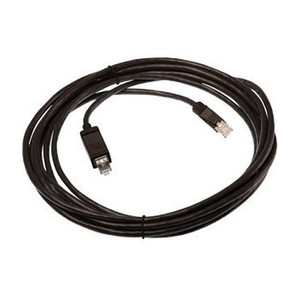
Axis 5504-731 Outdoor 15 Meter RJ45 Cable
The Axis 5504-731 is a purpose-built outdoor Ethernet cable designed for PTZ and panoramic camera deployments where environmental durability and signal integrity cannot be compromised. At 15 meters (50 feet), this CAT6 cable bridges the gap between outdoor mounted cameras and indoor network infrastructure without requiring intermediate active equipment or signal repeaters.
Overview
Outdoor camera installations face constant exposure to rain, UV radiation, temperature swings, and salt spray in coastal environments. Standard office-grade Ethernet cables degrade rapidly in these conditions — connectors corrode, jackets crack, and signal loss accumulates over distance. The 5504-731 eliminates this problem by pairing a weather-sealed IP66-rated outdoor connector on one end with a standard IP20 RJ45 on the camera end, allowing you to locate the transition point where you control environmental protection rather than where the camera happens to be mounted.
CAT6 twisted-pair construction supports both video streaming and Power over Ethernet (PoE) delivery in a single run, reducing installation complexity and cable clutter on facades and perimeter mounts. The black jacket blends into most outdoor surfaces without requiring additional conduit.
Key Features
- IP66 Outdoor Connector (Male Push-Pull): Rated IP66, the field-end connector resists direct rain, spray, and dust ingress. This rating means water from powerful jets won't penetrate the connector seal — critical for rooftop, building edge, and high-pressure washdown environments. If your installation faces constant submersion or direct hose application, you'll need IP67 or higher; for typical outdoor conditions, IP66 is the practical standard.
- IP20 Camera Connector (Male RJ45): The camera-end connector is rated IP20, sufficient to prevent dust and light particulates from entering the jack on the camera body. This asymmetric design reflects real-world deployment: the outdoor end bears environmental stress; the camera end sits in a controlled mounting location.
- 15-Meter (50-Foot) Length: This distance covers most building facades, perimeter runs, and multi-story installations without loss of signal quality over CAT6. Longer runs (75+ meters) degrade signal and power delivery; shorter runs under-utilize cabling cost.
- CAT6 Twisted-Pair Ethernet: Supports gigabit-class data rates (up to 1 Gbps over 100 meters per standard). For 4K video at 30 fps and PoE delivery over 15 meters, CAT6 provides ample bandwidth and power capacity. You won't hit bandwidth limits on single-camera runs; the constraint is typically PoE budget on your switch, not cable capacity.
- Black Jacket: Low-visibility color reduces visual impact in installations where aesthetics matter to building owners or architects. If you need high-visibility cable for safety or traceability, this is not the choice.
- Connector Type (Push-Pull): The male push-pull design on the outdoor end offers faster connection and disconnection than standard screw-down RJ45 connectors, reducing field installation time. Push-pull connectors also resist accidental disconnection due to cable snag or vibration.
Integration & Compatibility
The 5504-731 is engineered for Axis PTZ and panoramic camera lines. It pairs directly with any Axis outdoor camera featuring a standard RJ45 input jack. If you're integrating into a mixed-vendor environment (e.g., combining Axis cameras with non-Axis network switches or PoE injectors), confirm that your switch or power source supports the PoE class required by your specific camera model — the cable itself is passive and hardware-agnostic once connectors are seated.
Frequently Asked Questions
Q: Can I use the 5504-731 with non-Axis cameras?
A: Yes, provided the camera has a standard RJ45 input jack and your network infrastructure supports PoE at the required class. The cable is passive; connector compatibility is the only constraint.
Q: What is the maximum PoE power the 5504-731 can deliver?
A: CAT6 supports standard PoE (802.3af, 15.4W) and PoE+ (802.3at, 30W) without power loss over 15 meters. Your switch's power budget and the camera's draw determine actual delivery; the cable does not limit either.
Q: Is the 5504-731 suitable for submersion or constant spray applications?
A: IP66 handles rain and high-pressure spray (e.g., building washdown). Full submersion or constant underwater exposure requires IP67 or IP68 connectors — contact Axis for marine-grade alternatives.
Q: Can I shorten the 5504-731 in the field?
A: Yes. Standard RJ45 crimping tools and connectors work on CAT6; ensure you maintain proper twisted-pair sequence and strain relief to avoid crosstalk or signal degradation.
Q: Does the cable support both video and PoE simultaneously?
A: Yes. CAT6 twisted pairs are designed to carry simultaneous video (differential pair) and power (two pairs) without cross-talk. This is the standard architecture for all Ethernet PoE cameras.
Q: What's the operating temperature range?
A: Consult the datasheet for exact range. Typical outdoor-grade cables operate -40°C to +60°C; confirm against your climate zone if deploying in Arctic or high-temperature industrial environments.
James EverettPerspective based on aggregated IPSD and affiliated engineering team experience.
The Axis 5504-731 solves a specific and common problem: outdoor PTZ and panoramic cameras mounted on building edges or perimeter poles need to run Ethernet back to an indoor switch or PoE injector, and that run is often exposed to weather. Standard off-the-shelf CAT6 cabling will corrode and fail within one to two seasons in most climates. The 5504-731 pairs an IP66 weather-sealed connector on the field end with a standard RJ45 on the camera end, giving you control over where the environmental transition point sits. That matters because it lets you terminate the outdoor connector in a weather-protected junction box or enclosure while keeping the camera jack in its natural mounting location.
Technical Highlights:
- IP66 Outdoor Connector: Rated for direct spray and rain without water ingress. Most outdoor installations face rain, wind-driven spray, and UV exposure — IP66 is the practical floor. If you're deploying in a marine environment with salt spray or high-pressure wash zones (e.g., food processing facilities), verify with Axis whether an IP67 variant exists.
- 15-Meter Length: This distance is engineered to support both video stream and PoE delivery without signal degradation or voltage drop. Longer runs (beyond 50–75 meters) require active repeaters or separate power injection. Shorter runs are costlier per meter and limit flexibility in future camera repositioning.
- CAT6 Twisted Pair: Carries gigabit-class bandwidth (1 Gbps) and supports simultaneous video and PoE without crosstalk. For a single PTZ or panoramic camera, you won't saturate the pipe; the constraint is your switch's PoE budget (typically 15.4W per port for standard 802.3af, 30W for 802.3at PoE+), not the cable.
Deployment Considerations:
- Connector Asymmetry Is Intentional: The outdoor end is IP66 (weather-sealed); the camera end is IP20 (dust protection). This reflects real installations: the field connector bears the weather stress; the camera jack sits in a controlled mounting bracket or dome housing. Do not expect both ends to be equally weather-sealed.
- Temperature Extremes: Outdoor cables must survive thermal cycling (-40°C to +60°C in most climates). Verify the operating range from the datasheet if you're deploying in polar or high-altitude regions where temperatures drop below -30°C or in industrial zones where ambient can exceed 50°C.
- Strain Relief and Routing: Push-pull connectors resist accidental disconnection from vibration or cable snag, but proper strain relief at both ends (loops, clips, or conduit) prevents mechanical stress on the connector itself. A 15-meter run is long enough that tension and weight from the cable bundle can crack a badly-routed connector in high-wind areas.
The 5504-731 is the right choice for outdoor PTZ or panoramic camera runs of 15 meters or less, where the environmental transition needs to happen at a fixed junction point (rooftop enclosure, wall-mounted power injector, or rack-mounted switch) rather than at the camera itself. If you're deploying dozens of cameras across a large perimeter or campus and need to minimize cable inventory, standardizing on this length simplifies stock management and reduces the likelihood of using unsuitable indoor-grade cables in the field.