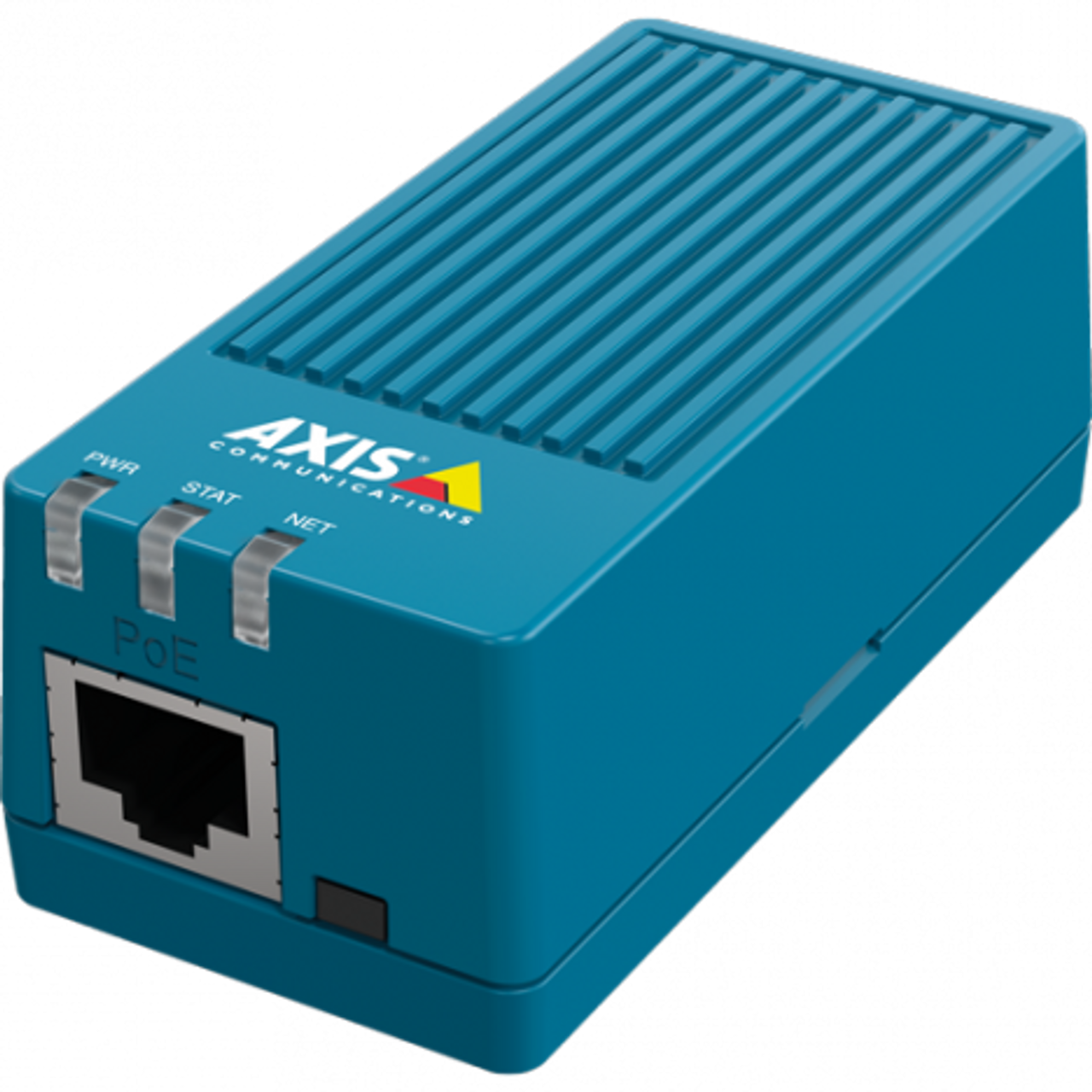
Axis 0764-001 Single-Channel Video Encoder
Overview
The Axis M7011 (0764-001) is a single-channel video encoder designed to bring analog cameras into an IP network infrastructure without replacing existing coax-based hardware. If you have a working analog camera investment that you want to extend — not rip out — this encoder is the practical bridge. It accepts a composite video signal and outputs H.264 or Motion JPEG over Ethernet, letting you integrate legacy footage into a modern network video recorder or VMS platform. The 0764-001 (often searched as 0764 001) draws power over standard PoE, so you can mount it at the camera end of a coax run and eliminate the need for a separate power supply at that location.
This is a single-channel device — one analog input, one network output. That's the right architecture when you're migrating cameras one at a time or placing encoders at distributed edge locations where a multi-channel rack-mounted unit would be overkill. It fits into the broader Axis Communications ecosystem and integrates with Axis Camera Station and any ONVIF-compatible VMS.
Key Features
- H.264 High/Main/Base Profile Compression: H.264 significantly reduces bandwidth and storage compared to uncompressed or Motion JPEG streams — on a 24/7 recording scenario, the difference between H.264 and raw analog capture can mean half the storage cost or more. High Profile squeezes the most efficiency; Base Profile ensures compatibility with older decoders or display systems that can't handle the full codec feature set.
- Motion JPEG Fallback: MJPEG provides a universally compatible stream for legacy viewers, basic web clients, or forensic review tools that don't support H.264 decoding. Useful when you need a secondary stream for a browser-based interface running alongside the primary recorded H.264 stream.
- PoE (IEEE 802.3af) Power: Standard 802.3af PoE keeps the installation clean — run a single Cat5e or Cat6 cable from your PoE switch to the encoder location, and you've handled both data and power. No separate 12V or 24VAC run to the encoder. This matters most in retrofit scenarios where pulling additional power wiring is expensive or disruptive. Check that your PoE switch port budget can accommodate the encoder's draw.
- microSDHC Local Storage: On-board microSD card support means the encoder can buffer or record locally if the network path to your NAS or NVR is interrupted. This edge recording capability is a meaningful reliability layer in environments with spotty network uptime — retail kiosks, remote buildings, or locations on wireless backhaul. Card capacity is determined by the microSDHC class you insert; the slot does not support SDXC.
- NAS Storage Option: In addition to local card storage, the M7011 can write directly to a NAS share. This is useful in smaller deployments where a full NVR isn't warranted but you want network-accessible recordings without a PC running VMS software.
- Single-Channel Architecture: One encoder, one camera. This keeps cost proportional to the number of cameras you're migrating and avoids shared-resource constraints. In a multi-channel encoder, all cameras compete for the device's processing budget; here, the M7011 is dedicated to a single analog input, which simplifies troubleshooting and stream management.
- Compact White Housing: The M7011's small form factor allows placement at or near the camera — in a junction box, on a wall shelf, or behind a monitor panel. The white housing blends into office and retail ceiling environments more cleanly than rack-mounted industrial encoders.
Integration and Compatibility
The M7011 connects to any VMS or NVR platform that accepts RTSP streams or ONVIF-compatible devices. It works with Axis Camera Station for organizations already standardized on the Axis ecosystem. For broader VMS environments — Milestone, Genetec, Avigilon, or others — confirm ONVIF compatibility with your specific VMS version before deployment. The device outputs over standard Ethernet, so switch and infrastructure requirements are no different from any other IP camera on your network. Review the video management software compatibility matrix for your platform to confirm driver or profile support for Axis encoders. For storage planning, factor in the H.264 stream bitrate you configure against your available NAS or microSDHC capacity — a retention and storage planning guide is a useful reference before sizing media.
Frequently Asked Questions
Q: What type of analog input does the Axis M7011 0764-001 accept?
A: The M7011 accepts a composite video input from an analog camera. It does not support HD-TVI, HD-CVI, AHD, or other HD analog formats — it is designed specifically for standard-definition composite (CVBS) signals.
Q: Does the 0764-001 support edge recording if the network goes down?
A: Yes. The M7011 supports local recording to a microSDHC card inserted into the device. If connectivity to your NAS or VMS is lost, the encoder can continue buffering footage locally. Note that the slot supports microSDHC, not the higher-capacity SDXC standard.
Q: What PoE standard does the Axis M7011 require?
A: The M7011 draws power via IEEE 802.3af (standard PoE). This is the baseline PoE class supported by virtually all managed and unmanaged PoE switches, so no PoE+ (802.3at) or PoE++ (802.3bt) switch is required.
Q: Can the M7011 stream both H.264 and Motion JPEG simultaneously?
A: The M7011 supports H.264 (High, Main, and Base profiles) and Motion JPEG compression. Whether simultaneous dual-stream output is supported should be confirmed against the Axis product datasheet, as this depends on firmware and device capability details not fully documented in the available evidence.
Q: Is the Axis M7011 compatible with third-party VMS platforms like Milestone or Genetec?
A: The M7011 is compatible with VMS platforms that support ONVIF or Axis-native integration. Confirm your specific VMS version's support for Axis encoders in that platform's device compatibility list before deployment.
Q: Does the 0764-001 support direct NAS recording without a separate NVR?
A: Yes. The M7011 supports recording to a NAS in addition to local microSDHC storage, making it viable for small deployments where a full NVR is unnecessary.
The Axis 0764-001 M7011 is a device I reach for when a site has perfectly functional analog cameras that a client doesn't want to abandon, but the VMS and recording infrastructure has already moved to IP. The single-channel PoE architecture is what makes it deployable at scale without a centralized encoder rack — you put one encoder per camera, power it from the nearest PoE port, and the analog camera looks like any other ONVIF device on the network.
Technical Highlights:
- H.264 High Profile: The most compression-efficient profile the M7011 offers — relevant when you're running this encoder 24/7 and storage or bandwidth is constrained. High Profile can cut bitrate meaningfully compared to Main or Base at equivalent quality settings.
- microSDHC Edge Storage: Local card buffering means this encoder keeps recording even if the uplink to your NVR or NAS drops. For remote locations on cellular or point-to-point wireless backhaul, that's a genuine continuity layer, not a checkbox feature.
- 802.3af PoE: Standard PoE — no budget surprises on your switch. Every managed PoE switch on the market supports 802.3af, so you're not constrained to a specific switch model or having to budget for PoE+ ports.
Deployment Considerations:
- The M7011 handles standard composite (CVBS) analog signals only — confirm your existing cameras output CVBS before ordering. HD-TVI and AHD cameras are not compatible, and there's no adapter path.
- microSDHC max capacity is capped by the SDHC standard (32GB); if you need longer edge retention buffers, plan accordingly or pair with NAS recording as the primary storage path.
This encoder is the right call for phased IP migration projects — particularly in retail chains or campus environments where analog camera infrastructure is still in good condition and a full forklift to IP cameras isn't in the budget cycle. Deploy the M7011 at the camera, feed into your existing VMS, and migrate camera-by-camera on your own schedule.