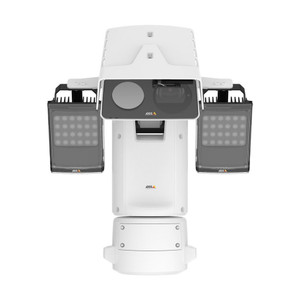
Form Factor:
PTZ
Resolution:
2MP (1920×1080) visual; 640×480 thermal
Lens Type:
35-105 mm (32x optical zoom)
Video Compression:
H.265
Analytics:
Perimeter Defender; VMD
IP Rating:
IP66
Mount Type:
Column
Compatibility:
PoE
WDR:
Forensic WDR up to 120 dB
IR Distance:
Lightfinder 2.0; Thermal sensor; Day/night shift
Frame Rate:
3fps
Storage Capacity:
Local storage support
Features:
TPM module; Axis secure boot; Signed firmware
VMS Compatibility:
ONVIF Profile G/M/S/T, AXIS Camera Station, Third-party VMS
PTZ Range:
Pan 360° infinite; 32x optical zoom
Type:
MkII Thermal PTZ Camera 2MP
Product Type:
PTZ
Warranty:
5 Year(s)
Night Vision:
Thermal
Operating Temperature:
-40° to 65°
Built In IR:
Yes
Day Night:
Yes
Optical Zoom:
3x
Image Stabilization:
Yes
Storage Support:
microSD
Outdoor Ready:
Yes
HTTPS Encryption:
Yes
Depth In:
22.91
Height In:
14.17
Width In:
9.61
Housing Color:
White
Dimensions:
Bo(mm) Ao(mm) Ko(mm) P(mm) t(mm) D(mm)
Compatible With:
perimeter
PoE:
PoE
IP_Rating:
IP66; NEMA 4X
PoE_Power:
PoE
Image Sensor:
CMOS
Thermal Sensitivity (NETD:
< 50 mK
Max Frames Per Second:
30
Thermal Palettes:
Yes
Focal Length:
4.3-137.6 mm
Horizontal Field Of View:
58.5-2.4 °
Vertical Field Of View:
34.9 - 1.3 °
Zipstream:
Yes
H.264:
Baseline, High, Main
Audio Support:
Yes
Audio Detection:
Yes
Alarm Inputs/outputs:
4
Video Motion Detection:
Yes
Signed OS:
Yes
Local Storage (memory Card Slot:
Yes
Variants:
AXIS Q8752-E Mk II 35 mm 8.3 fps AXIS Q8752-E Mk II 35 mm 30 fps AXIS Q8752-E Mk II Zoom 8.3 fps AXIS Q8752-E Mk II Zoom 30 fps
Lens Visual:
Varifocal, 4.3-137.6 mm, F1.4-4.0
Near Focus Distance:
22–195 m (72–640 ft); 31 m (102 ft)
Minimum Illumination Color:
0.06 lux at 50 IRE, F1.4
Minimum Illumination B/W:
0.01 lux at 50 IRE, F1.4
Shutter Speed Visual:
1/66500 s to 2 s
Jerk-free Movements At Low Speed:
±0.01°/s (at 0.05°/s)
Preset Accuracy:
0.05° 256 preset positions, guard tour, control queue, focus window, on-screen directional indicator, de-icing control , dynamic load balancing
Model:
ARTPEC-7
Compute Capabilities:
Deep learning processing unit (DLPU)
Video Streaming:
Multiple, individually configurable streams in H.264, H.265 and Motion JPEG Axis Zipstream technology in H.264 and H.265 Controllable frame rate and bandwidth VBR/ABR/MBR H.264/H.265 Low latency mode
Image Settings Visual:
Saturation, contrast, brightness, sharpness, white balance, day/night threshold, tone mapping, exposure control, exposure zones, defogging, compression, dynamic text and image overlay, 32 individual polygon privacy masks, electronic image stabilizati
Image Settings Thermal:
Compression, brightness, sharpness, contrast, local contrast, exposure control, exposure zones, text and image overlay, electronic image stabilization
Input:
External microphone input or line input
Encoding:
24bit LPCM, AAC-LC 8/16/32/48 kHz, G.711 PCM 8 kHz, G.726 ADPCM 8 kHz, Opus 8/16/48 kHz Configurable bitrate
Network Protocols:
IPv4, IPv6 USGv6, ICMPv4/ICMPv6, HTTP, HTTPS , HTTP/ 2, TLS, QoS Layer 3 DiffServ, FTP, SFTP, CIFS/SMB, SMTP, mDNS (Bonjour), UPnP , SNMP v1/v2c/v3 (MIB-II), DNS/ DNSv6, DDNS, NTP, PTP, NTS, RTSP, RTP, SRTP/RTSPS, TCP, UDP, IGMPv1/v2/v3, RTCP, ICMP,
Application Programming Interface:
Open API for software integration, including VAPIX® and AXIS Camera Application Platform (ACAP); specifications at axis.com/developer-community . One-click cloud connection ONVIF® Profile G, ONVIF® Profile M, ONVIF® Profile S, and ONVIF® Profile T,
Video Management Systems:
Compatible with AXIS Camera Station Edge, AXIS Camera Station Pro, AXIS Camera Station 5, and video management software from Axis’ partners available at axis.com/vms .
Onscreen Controls:
Image stabilization Day/night shift Video streaming indicator IR illumination Privacy masks Media clip Focus recall zone Timed wiper Wiper Heater
Edge-to-edge:
Microphone pairing Speaker pairing
Event Conditions Device Status:
above/below/within operating temperature, IP address blocked/removed, live stream active, network lost, new IP address, PTZ power failure, ring power overcurrent protection, system ready
Event Conditions Digital Audio:
digital signal contains Axis metadata, digital signal has invalid sample rate, digital signal missing, digital signal okay
Event Conditions Edge Storage:
recording ongoing, storage disruption, storage health issues detected
Event Conditions I/O:
digital input is active, manual trigger, virtual input is active
Event Conditions MQTT:
MQTT client connected
Event Conditions PTZ:
PTZ control queue, PTZ malfunctioning, PTZ movement, PTZ preset position reached, PTZ ready
Scheduled And Recurring:
schedule
Event Conditions Video:
average bitrate degradation, day-night mode
Event Actions I/O:
toggle I/O once, toggle I/O while the rule is active
Event Actions Illumination:
use lights, use lights while the rule is active
Event Actions MQTT:
send MQTT publish message
Event Actions Notification:
HTTP, HTTPS, TCP and email Overlay text
Event Actions PTZ:
PTZ preset, start/stop guard tour
Event Actions Recordings:
record audio, record audio while the rule is active
Event Actions Security:
erase configuration
SNMP Trap Messages:
send, send while the rule is active
Images Or Video Clips:
FTP, SFTP, HTTP, HTTPS, network share and email WDR mode
Event Actions Wiper:
use wiper
Built-in Installation Aids:
Pixel counter, level grid
Included:
AXIS Motion Guard, AXIS Fence Guard, AXIS Loitering Guard AXIS Video Motion Detection, Orientation AID PTZ, audio detection, advanced gatekeeper Support for AXIS Camera Application Platform enabling installation of third-party applications, see axis
Product Markings:
UL/cUL, CE, KC, VCCI, RCM
Supply Chain:
TAA compliant
Australia/New Zealand:
RCM AS/NZS CISPR 32 Class A
EMC Canada:
ICES(A)/NMB(A)
EMC Japan:
VCCI Class A
EMC Korea:
KS C 9835, KS C 9832 Class A
EMC USA:
FCC Part 15 Subpart B Class A
EMC Railway:
IEC 62236-4
Safety:
CAN/CSA C22.2 No. 62368-1 ed. 3, IEC/EN/UL 62368-1 ed. 3
Environment:
IEC 60068-2-1, IEC 60068-2-2, IEC 60068-2-6, IEC 60068-2-14, IEC 60068-2-27, IEC 60068-2-78, IEC/EN 60529 IP66, IEC/EN 62262 IK10, NEMA 250 Type 4X, NEMA TS 2 (2.2.7-2.2.9), ISO 12944-6 C5, MIL-STD-810H (Method 501.7, 502.7, 505.7 506.6, 507.6, 509.7
Cybersecurity:
ETSI EN 303 645, BSI IT Security Label, FIPS 140
Edge Security Software:
Signed OS, brute force delay protection, digest authentication and OAuth 2.0 RFC6749 Client Credential Flow/OpenID Authorization Code Flow for centralized ADFS account management, password protection, Axis Cryptographic Module (FIPS 140-2 level 1)
Secure Keystore:
TPM 2.0 (CC EAL4+, FIPS 140-2 Level 2) Secure boot, encrypted filesystem (AES-XTS-Plain64 256bit)
Network Security:
IEEE 802.1X (EAP-TLS, PEAP-MSCHAPv2) , IEEE 802.1AE (MACsec PSK/EAP-TLS), IEEE 802.1AR, HTTPS/HSTS, TLS v1.2/v1.3 , Network Time Security (NTS), X.509 Certificate PKI, host-based firewall
Documentation:
AXIS OS Hardening Guide Axis Vulnerability Management Policy Axis Security Development Model AXIS OS Software Bill of Material (SBOM) To download documents, go to axis.com/support/ cybersecurity/resources To read more about Axis cybersecurity suppor
Casing Color:
white NCS S 1002-B Long-life silicone wiper
Casing Weathershield:
high-impact UV-stabilized thermoplastic This product can be repainted. For repainting instructions, go to the product’s support page. For information about the impact on warranty, go to axis.com/warranty-implication-when-repainting .
Connectors Audio:
3.5 mm mic/line in
Connectors I/O:
6-pin 2.5 mm terminal block for 4 configurable inputs/outputs
Connectors Network:
Shielded RJ45 10BASE-T/100BASE-TX/ 1000BASE-T, SFP slot (SFP module not included)
Connectors Power:
DC input, terminal block Illumination (in upper part of positioning unit)
Start-up Temperature:
-40 °C (-40 °F) Humidity 10-100% RH (condensing)
Operating Conditions:
-40 °C to 60 °C (-40 °F to 140 °F) Maximum temperature according to NEMA TS 2 (2.2.7): 74 C (165 F)
With AXIS PT IR Illuminator Kit C:
40 m/s (90 mph), 52 m/s (116 mph) without weathershield
Maximum Effective Projected Area (epa:
0.121 m
Wind Load When PTZ Operational:
37 m/s (83 mph) , 45 m/s (100 mph) without weathershield
Storage Conditions Temperature:
-40 °C to 65 °C (-40 °F to 149 °F)
Storage Conditions Humidity:
5–95% RH (non-condensing)
Weight Zoom:
15.3 kg (33.7 lb)
Box Content:
Camera, installation guide, connector kit
Optional Accessories:
AXIS Surveillance Cards, AXIS T94J01A Wall Mount, AXIS T94N01G Pole Mount, AXIS T95A64 Corner Bracket, AXIS Washer Kit B, AXIS Cable 24 V DC/24-240 V AC 22 mh , AXIS T8611 SFP Module LC.LX, AXIS T8612 SFP Module LC.SX, AXIS PT IR Illuminator Kit C, A
System Tools:
AXIS Site Designer, AXIS Device Manager, product selector, accessory selector, lens calculator Available at axis.com
Languages:
English, German, French, Spanish, Italian, Russian, Simplified Chinese, Japanese, Korean, Portuguese, Polish, Traditional Chinese, Dutch, Czech, Swedish, Finnish, Turkish, Thai, Vietnamese
Export Control:
This product is subject to export control regulations, and you should always comply with all applicable national and international export or re-export control regulations.
Part Numbers:
Available at axis.com/products/axis-q8752–e-mk- ii#part-numbers
Substance Control:
PVC free RoHS in accordance with EU RoHS Directive 2011/65/ EU and 2015/863, and standard EN IEC 63000:2018 REACH in accordance with (EC) No 1907/2006. For SCIP UUID, see echa.europa.eu
Materials:
Screened for conflict minerals in accordance with OECD guidelines To read more about sustainability at Axis, go to axis. com/about-axis/sustainability
Environmental Responsibility:
axis.com/environmental-responsibility Axis Communications is a signatory of the UN Global Compact, read more at unglobalcompact.org
Detect:
1.5 pixels
Recognize:
6 pixels
Identify:
12 pixels; 12 pixels AXIS Q8752–E Mk II (35–105 mm lens) Definition
Lightfinder:
The Axis Lightfinder technology delivers high-resolution, full-color video with a minimum of motion blur even in near darkness. Because it strips away noise, Lightfinder makes dark areas in a scene