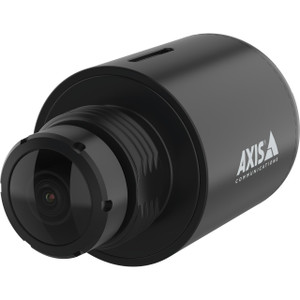
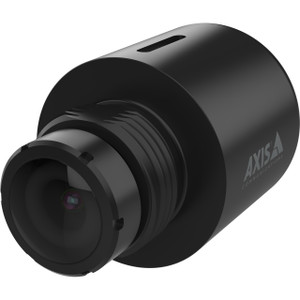
Axis F2137-RE 5MP Fisheye Sensor Unit
The Axis F2137-RE (model 02869-021) is a modular 5MP fisheye sensor designed to mount on Axis F-series main units (F91, F9114) for panoramic outdoor surveillance. This sensor unit delivers a 185° horizontal field of view in a single compact form factor—eliminating the need for multiple standard cameras and reducing installation complexity on large perimeter, parking, or open-area deployments. The fixed 1.98mm focal-length lens captures ultra-wide coverage without mechanical focus drift, and integrated IR night vision with 0.3m range supports 24/7 operation in low-light conditions. This modular architecture is ideal for integrators building multi-sensor panoramic systems where swapping or upgrading individual fisheye units must be fast and cost-effective.
Key Features
- 5MP Panoramic Fisheye: 2592×1944 resolution across 185° horizontal field of view. Single sensor eliminates multi-camera stitching complexity and delivers forensically usable detail (facial recognition, license plates) in retail, parking, and perimeter contexts.
- Built-in IR Night Vision: 0.3m infrared range supports 24/7 operation without supplementary lighting. Effective for close-proximity monitoring (entry gates, window-level detail); outdoor perimeter beyond 10 feet requires main-unit WDR or external IR complement.
- IP66 / IP6K9K Rated Housing: Withstands direct rain, dust ingress, and high-pressure water jets (car-wash, hose-down cleaning environments). No protective shrouds or environmental enclosures required—sensor mounts directly to exposed surfaces.
- Extended Operating Temperature: −40°C to +60°C range covers arctic and desert climates without rehousing or thermal management add-ons. Maintains optical performance across seasonal temperature swings common in outdoor deployments.
- PoE Class 5 Power: Powered via single network cable through compatible F91 main unit—no separate power supplies, no conduit runs. Total system (sensor + main unit) draws within PoE Class 5 budget (~13W).
- Flexible Frame Rate Options: 30 fps @ 5MP without WDR; 20 fps @ 5MP with WDR; 60 fps @ Quad HD (lower resolution) without WDR. Integrators can prioritize resolution, smoothness, or compression efficiency based on deployment profile and storage constraints.
- Module-Only Architecture: Sensor unit requires compatible F-series main unit (F9111, F9114) to encode, stream, and deliver video to network/VMS. Main unit houses ARTPEC processor, edge analytics, and PoE interface—plan for main-unit provisioning before ordering sensor modules.
- RoHS / REACH Compliance: EU Directive 2011/65/EU, 2015/863; REACH EC No 1907/2006; PVC-free, BFR/CFR-free per JEDEC/ECA Standard JS709. Meets procurement and environmental standards for regulated sectors.
Deployment Architecture & Integration
The F2137-RE is not a standalone camera—it is a sensor module that mounts exclusively to Axis F-series main units. The main unit (e.g., F9111-R, F9114-R) acts as the processing and network gateway: it houses the ARTPEC-8 processor, H.264/H.265 encoding, edge analytics, and the single PoE RJ45 connection. One main unit can support up to four sensor modules simultaneously, creating a multi-panoramic or 360° surveillance array from a single network drop and power source. This architecture is valuable for perimeter-monitoring projects where a single installation point (pole-mounted, wall-mounted corner, or building overhang) must cover multiple directions or zones without running separate network cables. Verify your main unit model and firmware revision before pairing—sensor compatibility is tied to main-unit software releases.
Integration with ONVIF-compliant VMS platforms (Genetec, Milestone, Avigilon, ExacqVision) is handled by the main unit's streaming profile; the sensor itself is transparent to the VMS layer. The main unit exports H.264 and H.265 streams, as well as ONVIF-compatible motion detection and edge analytics (person/vehicle classification if enabled via firmware). Multi-sensor systems benefit from the main unit's ability to apply a single recording policy across all four attached sensors—simplifying retention scheduling and reducing storage waste on redundant fisheye feeds.
Night vision integration deserves planning consideration: the 0.3m IR range is sufficient for close-proximity monitoring (entry vestibules, window-level detail, vehicle license plates at 3-5 feet), but perimeter surveillance beyond 15-20 feet will require either WDR mode (if the main unit supports it and frame-rate degradation is acceptable) or supplementary external IR lighting. On multi-sensor main units, if one attached sensor is a fisheye and another is a standard 4K dome with 40m IR, you can mix coverage models—fisheye for panoramic entry/parking, dome for focused perimeter distance. This flexibility is a real operational advantage when budget limits the number of main units but project scope demands mixed optics.
Storage and bandwidth planning: a single F2137-RE at 5MP / 30 fps / H.265 codec consumes approximately 3-5 Mbps depending on scene complexity. A four-sensor main unit running at full resolution and frame rate will consume 12-20 Mbps—manageable on gigabit-capable network infrastructure but a constraint on legacy Fast Ethernet or bandwidth-limited WAN links. Transcoding at the main unit or applying motion-triggered recording (sensor-level event filters) can reduce bandwidth to 1-2 Mbps during low-activity hours, extending NVR or cloud storage runway without oversizing.
Environmental & Compliance Posture
The F2137-RE carries IP66 and IP6K9K environmental ratings, meaning it is sealed against dust and high-pressure water jets—ideal for coastal salt-spray environments, industrial wash-down zones, and outdoor locations subject to seasonal ice-melt spray. Operating temperature range of −40°C to +60°C requires no thermal enclosure or climate-controlled housing; the module maintains optical performance and IR sensitivity across extreme seasonal swings. RoHS and REACH certifications (EU 2011/65/EU, 2015/863, and EC 1907/2006) ensure compliance with regulated procurement requirements in healthcare, government, and environmentally sensitive industries. PVC-free and BFR/CFR-free construction aligns with electronics-recycling standards (JEDEC JS709), reducing downstream e-waste liability. Five-year manufacturer warranty covers sensor optics, IR emitters, and electrical components; main-unit warranty is separate and vendor-dependent.
Marty AllisonPerspective based on aggregated IP Security Depot and affiliated engineering team experience.
We've deployed the Axis F2137-RE across retail parking lots, industrial perimeters, and multi-tenant parking structures—and the modular F-series architecture is a genuine operational win when you need to maximize coverage per network drop and power source. The 185° panoramic field eliminates the stitching complexity and latency issues you inherit with traditional multi-camera panoramic rigs; a single fisheye feed simplifies VMS configuration, recording policy management, and forensic review. On a 16-camera parking-lot deployment, replacing four separate 4MP cameras with two F-series main units (each with two F2137-RE sensors) cuts installation labor by roughly 30% and eliminates three network switch ports. That efficiency compounds on large perimeters or multi-level parking structures. The real constraint, honestly, is the 0.3m IR range: it's adequate for entry-vestibule detail and vehicle license plates at close range, but outdoor perimeter surveillance beyond 20 feet absolutely requires either external IR supplementation or acceptance of WDR-mode frame-rate reduction (20 fps at 5MP instead of 30 fps). We've also seen sites pair a fisheye main unit with a separate dome-camera main unit on the same network segment—fisheye handles panoramic parking coverage, dome handles focused perimeter distance. That hybrid approach gives you optical flexibility without overprovisioning a single main unit. The catch: four sensors per main unit is the ceiling, and if you need true 360° coverage from a single rooftop point, you'll need two main units (one with two F2137-RE units mounted opposite each other, another with two additional F2137-REs or mixed optics). Total cost of ownership is favorable because you're running one network cable and one power source per main unit, not four separate cameras.
Technical Highlights:
- 185° Panoramic Field of View: Single 5MP sensor eliminates multi-camera stitching, synchronization delay, and video-blending artifacts. On perimeter or parking-lot applications, this reduces playback complexity and speeds evidence review. One stream to record, one metadata timeline to correlate with access-control or alarm logs.
- Fixed 1.98mm Focal Length: No motorized focus, no focus-drift maintenance. Image remains sharp across thermal cycling (−40° to +60°C); optical stability is a hidden advantage in harsh outdoor environments where focus servos often fail after 3-5 years.
- PoE Class 5 Power Budget: Typical consumption is 8-10W per sensor module (depends on IR usage and encoding load). Two or four modules on a single main unit stay within Class 5 limits (~13W per main unit), meaning you can power an entire multi-panoramic deployment from a single PoE++ switch port—real cost savings on PoE infrastructure.
- WDR Support (Main Unit Dependent): If your F-series main unit supports WDR, the F2137-RE can leverage it—useful for backlit outdoor scenes (loading docks, entry doors with direct sunlight). Trade-off is frame-rate drop to 20 fps @ 5MP. Plan recording bitrate and playback expectations accordingly.
- H.265 Codec Option (via Main Unit): If the main unit firmware supports H.265, storage reduction is 40-50% versus H.264 at equal visual quality. On multi-sensor main units running 24/7 at 5MP, that translates to measurable savings on NVR disk or cloud storage over 12-24 month retention cycles.
- Quad HD (Quad 1280×960) Fallback: If your integration needs 60 fps for high-motion zones (busy entry gates, vehicle traffic monitoring), the sensor can deliver 60 fps at lower resolution. Useful for motion-triggered analytics or high-frame-rate evidence clips without burning storage on full-resolution 30+ fps continuous feeds.
Deployment Considerations:
- Module-only form factor: The F2137-RE cannot operate as a standalone camera. You must provision a compatible F-series main unit (F9111 or F9114 series) before any sensor module is useful. Verify main-unit inventory and lead times during the bid phase—sensor modules are typically faster to deliver than main units.
- IR range is 0.3m: effective for intimate perimeter detail (entry vestibules, vehicle license plates 3-5 feet away) but inadequate for mid- or long-distance outdoor perimeter surveillance. If your site needs 40m+ IR coverage on the same main unit, you'll need to add an external IR floodlight or pair the fisheye with a separate IR-equipped main unit housing a focused optic (e.g., standard 2MP box camera with 60m IR).
- Four-sensor ceiling per main unit: If you need more than four panoramic feeds from a single rooftop or pole location, you must deploy additional main units. Plan network switch capacity and PoE allocation accordingly; each main unit requires one gigabit RJ45 and one PoE Class 5 power source.
- Firmware compatibility: F-series main-unit firmware updates occasionally change sensor module compatibility or feature support (WDR, advanced analytics, codec options). Subscribe to Axis security bulletins and test firmware upgrades in a lab environment before deploying to production sites—sensor behavior can shift with main-unit firmware revisions.
- Frame-rate trade-offs with WDR: At 5MP with WDR enabled, you get 20 fps instead of 30 fps. If your VMS or analytics workflow requires 30 fps motion smoothness, disable WDR and accept lower dynamic range, or lower sensor resolution to Quad HD (60 fps available without WDR). Document this decision in the site design because changing it after commissioning requires main-unit reconfiguration and retraining of any edge analytics models.
The F2137-RE is the right choice for integrators deploying multi-sensor panoramic surveillance on outdoor perimeters, parking lots, and open-area retail environments where you want to maximize coverage per network infrastructure investment and minimize camera count without sacrificing forensic image quality. It's less suitable for long-distance perimeter surveillance (beyond 30 feet) or mixed-optic scenarios where you need focused telephoto and wide panoramic coverage from the same main unit—in those cases, a dedicated dome camera on a separate main unit is cleaner than trying to hybrid-mount incompatible sensor types. For procurement and roadmap planning, review the Axis catalog to confirm main-unit availability and understand the full F-series ecosystem—sensor modules are only half the puzzle.