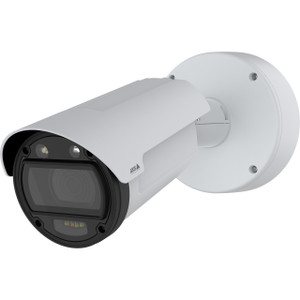
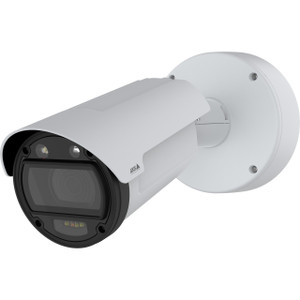
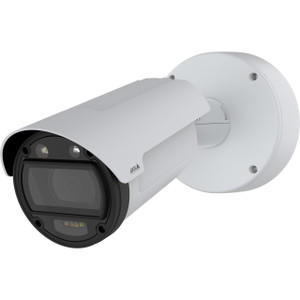
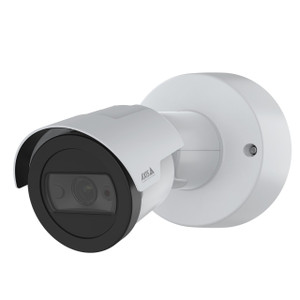
Axis 02508-001 Q1808-LE 10MP Varifocal Bullet Camera
The Axis 02508-001 is a professional outdoor bullet designed for long-range forensic surveillance in demanding environments. This wired, PoE++-powered system captures 10MP resolution (3648 x 2736) with sufficient detail for identification and forensic reconstruction across mid-to-long distance deployments. The motorized varifocal lens (2.8–12mm) allows field adjustment of view without camera repositioning—you dial in coverage after mounting, eliminating repeat site visits to tweak framing. H.265 compression cuts bandwidth and storage cost by 40–60% versus H.264 on identical scenes—material savings when recording 24/7 across multiple cameras. Backward compatibility with H.264 ensures your existing network video recorders and VMS platforms do not mandate an upgrade.
Key Features
- Motorized varifocal lens (2.8–12mm): Remote zoom and focus adjustment delivers actual deployment flexibility. Wide angle covers broader perimeter zones; narrow telephoto isolates detail on specific targets. Switch between them without moving the camera body, reducing installation labor and physical footprint on pole or wall mounts.
- 10MP resolution (3648 x 2736): Ten megapixels provide sufficient pixel density for face identification and vehicle plate reading at 30–50 meters. Not 4K, but deliberate—bandwidth and storage remain manageable on standard Gigabit Ethernet and modest NVR hardware. Matches most outdoor deployments without over-specification.
- OptimizedIR 850nm with Lightfinder technology: Infrared range extends to approximately 1.5 meters in complete darkness. Lightfinder reduces noise and preserves detail in low-light scenes (dusk, dawn, interior loading bays). Day/night auto-switching maintains consistent image quality across 24-hour cycles without manual intervention or separate monochrome/color switching logic.
- Forensic Wide Dynamic Range (WDR): Captures usable detail in both bright and shadowed regions of the same frame—critical when monitoring scenes with glass reflections, mixed sunlight and shadow, or bright backgrounds. Without WDR, highlights blow out or shadows crush to black; with it, a single frame preserves both extremes.
- Deep Learning Processing Unit (DLPU) on-board: Runs object detection and classification at the camera edge, not on the NVR. This reduces false alarms from weather, shadows, and traffic noise, and enables rule-based triggering (alert only on person or vehicle, not swaying branches). Cuts downstream bandwidth and storage for events that do not matter, lowering per-camera load on your network video recorders.
- H.265 with H.264 fallback: Modern codec reduces file size roughly half compared to H.264 on the same quality target. Storage and bandwidth savings compound over months and years on 24/7 recording. Legacy VMS platforms still receive H.264 if H.265 is not supported, ensuring compatibility without codec negotiation.
- PoE++ (802.3bt) Class 4 power: Draws sufficient wattage for full operation—zoom actuation, IR illumination, and edge processing—from a single Gigabit Ethernet run. No separate 12VDC or 24VAC supply required, simplifying installation and reducing single points of failure on remote deployments.
- IP66 / IK10 environmental ratings: IP66 means direct rain and high-pressure wash will not penetrate the housing; IK10 vandal rating resists impact from rocks or tools. Operating range of −40°C to +60°C (−40°F to +140°F) handles arctic winter and desert summer without supplemental climate control—addressing perimeter security, critical infrastructure, and remote site monitoring where environmental extremes are routine.
- microSD card slot with local fallback recording: If the network link drops, the camera buffers video to an onboard microSD card (up to 512GB supported), preserving critical footage until connectivity restores. Useful for remote sites with intermittent broadband or unreliable ethernet.
- ONVIF compliance and two-way audio: Gigabit Ethernet with ONVIF ensures compatibility with IP cameras infrastructure and VMS platforms from multiple vendors—you are not locked into Axis-only ecosystems. Audio input supports two-way talk-back for gate intercom or event annotation.
- Signed firmware and secure boot: Protects against unauthorized modifications. HTTPS encryption safeguards credential transmission and configuration.
Integration and Deployment
Mount the 02508-001 on pole, wall, or pendant hardware; the compact bullet form factor fits standard outdoor camera brackets. Connect via a single Gigabit Ethernet cable to your PoE++ switch or injector—power and data over one run. Pair with any ONVIF-compliant NVR or Axis Camera Station for centralized recording and playback. Edge analytics reduce VMS CPU load when running dozens of cameras; rule-based alerting routes only relevant events to your security team. For sites without reliable network access, microSD fallback ensures you do not lose footage during outages.
When to Choose a Different Model
If your deployment requires higher resolution (e.g., vehicle plate reading beyond 60 meters), consider a 20MP or higher variant in the Axis surveillance line. If you need 360° coverage without repositioning, a PTZ or multi-sensor panoramic model may be more efficient per square meter. If the scene operates primarily indoors with controlled lighting, a lower-cost fixed-lens model without motorized zoom and IR may suffice. For facilities without PoE++ infrastructure and unwilling to upgrade switches, a lower-power PoE+ or 12VDC model reduces wiring complexity, though you sacrifice zoom actuation and IR range.
Frequently Asked Questions
Q: Does the 02508-001 work with my existing VMS?
A: Yes, provided your VMS supports ONVIF Profile S or G. The camera streams H.264 or H.265 via RTSP and ONVIF-compliant APIs. Check your VMS documentation or contact the vendor for explicit support confirmation, but most modern platforms (Milestone XProtect, Genetec, Hanwha, Bosch) support Axis cameras natively.
Q: What is the actual range of the infrared illuminator?
A: OptimizedIR extends to approximately 1.5 meters in complete darkness. In twilight or low-ambient-light conditions (not total darkness), useful IR range can extend further. Test on-site to validate coverage for your specific mounting height and surface reflectivity.
Q: Does the varifocal lens require calibration after installation?
A: No. The motorized lens adjusts focus and zoom via remote commands from your VMS or the Axis web interface. No field adjustment required post-mount, though you may refocus if vibration or temperature shifts occur over months.
Q: Can I record locally if the network goes down?
A: Yes. The microSD card slot supports fallback recording up to 512GB capacity. Video buffers to the card when the Ethernet link drops and resumes network upload when connectivity restores. This is useful for remote sites with intermittent broadband.
Q: What PoE++ switch or injector do I need?
A: Any IEEE 802.3bt Class 4 compliant switch or injector that delivers at least 60W per port. Most modern enterprise PoE++ switches (Cisco, Arista, Juniper, HPE) and purpose-built Axis injectors meet this requirement. See a PoE planning guide for sizing advice.
Q: Is the 02508-001 NDAA Section 889 compliant?
A: Check Axis's current NDAA compliance status directly with the vendor or your authorized integrator, as designations change with supply-chain reviews. Do not assume compliance; verify before federal or sensitive-infrastructure deployments.
James EverettPerspective based on aggregated IP Security Depot and affiliated engineering team experience.
The Axis 02508-001 addresses a specific problem: forensic detail in outdoor scenes across wide temperature and weather swings. The 10MP sensor with 2.8–12mm motorized varifocal lens is not a jack-of-all-trades; it is purpose-built for perimeter security and critical infrastructure where you need to identify people and vehicles at useful range without overprovisioning megapixels that inflate storage and NVR CPU load. The combination of 10MP resolution, H.265 codec, and on-board deep learning analytics means a single camera can handle multiple zones without overwhelming your network or recording infrastructure.
Technical Highlights:
- Motorized 2.8–12mm lens with 4.3x optical zoom: Eliminates the field-of-view compromise between wide perimeter coverage and zoomed detail. You adjust framing remotely—no climber and cherry picker on a 40-foot pole. Real time-saver on sites with budget-conscious install schedules.
- H.265 codec with 40–60% file-size reduction: A single 02508-001 recording 24/7 at moderate bitrate (e.g., 8–12 Mbps) generates roughly 3–4 TB per month. H.265 cuts that to 1.5–2 TB. Over a year, across 8 cameras, that is a 20+ TB difference—meaningful for archived evidence retention and backup costs.
- OptimizedIR 850nm extending to 1.5 meters: Sufficient for most outdoor scenarios (gate, parking lot, loading dock) in complete darkness. Beyond 1.5 meters, twilight ambient light or motion-sensor floodlights become necessary. Do not expect nighttime identification at 100 meters; this is an outdoor workhorse, not a long-range military-grade system.
- Deep Learning (DLPU) edge analytics: Detects and classifies people and vehicles on-camera, eliminating false alerts from rain, wind-blown debris, and shadow flicker. In a 24/7 perimeter with 50+ events per hour from weather alone, edge filtering drops meaningful noise and alerts your team only to genuine intrusions.
- PoE++ (802.3bt) Class 4: Full operational power (zoom, IR, analytics) over a single Gigabit Ethernet cable. No auxiliary 12VDC or 24VAC supplies to route separately. Simpler troubleshooting, fewer points of failure.
Deployment Considerations:
- IR range is 1.5 meters in complete darkness: If your site has ambient light (street lamps, building floods), IR extends further and noise reduces, but do not specify this camera for moonlight-only sites expecting 20+ meter night identification. Test on-site.
- Motorized zoom adds complexity: Lens calibration and autofocus require network connectivity to the camera. If your network is intermittent or unstable, zoom and focus may hunt or lag. Confirm network stability (latency <100 ms round-trip) before wide-scale deployment.
- microSD fallback is local buffer, not redundancy: A 512GB card holds roughly 24–48 hours of 1080p at low bitrate, or 8–16 hours of 10MP. This covers overnight outages, not week-long network failures. Pair with a backup internet uplink or cellular failover if the site cannot tolerate multi-day recording gaps.
The 02508-001 is best suited for outdoor perimeter, gate, and critical infrastructure sites where you need forensic detail, wide-angle to telephoto flexibility, and 24/7 recording without inflating storage or network budgets. It is overkill for a simple warehouse entrance, and undersized for long-range vehicle plate reading beyond 70 meters. Position it as a mid-tier workhorse: more capable than a fixed-lens budget dome, less specialized than a dedicated PTZ or high-megapixel fixed camera.
Key Specifications:
Color: White