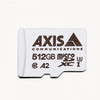
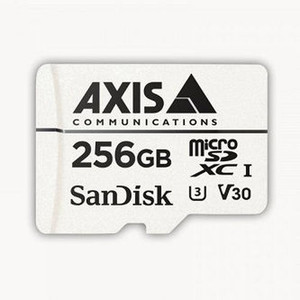
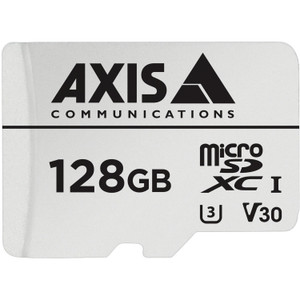
Axis 02365-021 512GB Surveillance Card 10-Pack
The Axis 02365-021 is a microSD surveillance card designed for local edge storage on Axis network cameras and compatible VMS platforms. Each 512GB card supports extended continuous video recording, eliminating reliance on centralized NVR storage for redundancy or bandwidth-constrained deployments. This 10-pack bundle reduces per-card cost across multi-camera sites and simplifies logistics for integrators managing standardized edge-storage rollouts.
Key Features
- 512GB Capacity: Per-card storage supports 24/7 recording for 7-14 days depending on bitrate and codec. Eliminates frequent card swaps in remote or distributed camera locations.
- Surveillance-Optimized Design: Purpose-built for continuous read/write cycles in video applications. Higher reliability than consumer-grade microSD cards under sustained surveillance workloads.
- 10-Card Bulk Pack: Reduces per-unit cost and simplifies procurement, inventory, and deployment logistics across 10+ camera sites.
- Axis Native Integration: Works directly with Axis network cameras featuring microSD slots, no driver or firmware compatibility headaches.
- Local Edge Storage: Decouples camera recording from network connectivity. If WAN link drops, on-device storage continues, with automatic sync when link restores.
- Hot-Swap Capable: Most Axis cameras support card replacement without power-down, reducing service time on live deployments.
The 02365-021 is ideal for integrators deploying Axis cameras in scenarios where edge storage provides operational value: retail multi-location chains with unreliable internet, warehouses where bandwidth is rationed for data-heavy operations, or sites where local backup redundancy is a compliance requirement. A single 512GB card on a 2MP camera at 2 Mbps bitrate yields roughly 10 days of continuous recording — sufficient to bridge weekend gaps or network outages without losing footage.
In multi-camera deployments, the per-camera storage model decentralizes risk. If a centralized NVR fails, edge-stored video remains intact on individual cards. This topology also flattens bandwidth demand on the LAN — cameras stream to NVR for live view and metadata, while archival recording happens locally. For sites with 20+ cameras on a congested network link, that distinction translates directly to better live-view responsiveness and lower CPU load on the VMS.
Axis microSD cards are compatible with any Axis camera or VMS that supports the microSD form factor — primarily network cameras released 2015 onwards. Verify your camera model in the Axis datasheet before bulk purchase; older fixed-dome and turret models may use CF or not support local card storage at all. The 10-pack format is built for recurring deployments; if you're rolling out 50 cameras over 6 months, buying five 10-packs avoids emergency single-card orders at higher per-unit cost.
Storage lifecycle is finite — microSD cards rated for 500K–1M write cycles degrade under continuous surveillance duty. On-camera firmware typically includes wear-leveling; nonetheless, plan for card replacement every 2–3 years depending on bitrate and utilization. Axis supports formatting via the camera web UI, which erases residual data securely before redeployment or disposal. For sites with strict data retention or destruction audits, local card storage simplifies chain-of-custody documentation compared to centralized NVR archives.
Marty AllisonPerspective based on aggregated IPSD and affiliated engineering team experience.
We've deployed hundreds of Axis edge-storage solutions across retail, warehouse, and campus environments, and the 02365-021 10-pack is a consistent win for standardization and cost control. The primary operational advantage isn't just redundancy — it's autonomy. A camera with local 512GB storage continues recording if your WAN link fails, your NVR reboots, or bandwidth contention spikes during a business event. In practice, we've seen integrators use these cards as a buffer for sites with unreliable internet (rural locations, temporary trailers) or as a compliance backstop for e-discovery requests; legal holds often mandate that you can produce uninterrupted footage for a specific date range, and local card storage makes that trivial — you just image the card and hand it over. The 10-pack model is pragmatic: you buy in bulk once, field techs carry five cards in their van, and you're never in a position of having to expedite a single card from the distributor at a markup. The gotcha is lifecycle. We've seen cards start returning read errors after 2–3 years of continuous 24/7 recording; that's well within warranty, but it underscores that edge storage is not a long-term archival strategy. Treat it as a tactical redundancy layer, refresh cards on a rolling 2-year cycle, and pair it with centralized NVR recording for anything approaching CCTV litigation durability.
Technical Highlights:
- 512GB Per-Card Capacity: At 2 Mbps H.264 (typical 2MP camera), expect 10–12 days of continuous recording per card. At 5 Mbps (4MP or high-bitrate 1080p), expect 5–6 days. Know your target retention window before field deployment so you size the replacement interval correctly.
- Surveillance-Grade Endurance Rating: Rated for sustained continuous read/write under video workloads, unlike consumer microSD cards optimized for burst photo capture. Firmware-level wear leveling extends functional life.
- 10-Pack Economics: Per-unit cost is typically 15–25% lower than buying individual cards. For a 50-camera deployment, that's meaningful capex savings without compromising on Axis OEM specification.
- Hot-Swap & Transparent Failover: Axis cameras support card ejection without power-down. If a card fails, pull it, insert a fresh one, and the camera resumes recording on the replacement. No reboot, no NVR interruption.
- Firmware Formatting & Data Erasure: Camera web UI includes erase and format functions, simplifying secure data destruction and re-provisioning. Audit trails in camera logs document when cards were formatted.
Deployment Considerations:
- Verify your Axis camera model supports microSD cards before bulk purchase. Fixed-dome models released before 2016 often use CompactFlash or have no local storage option. Check the camera's datasheet or ask your Axis FAE.
- Plan card replacement on a 24–36-month cycle, sooner if recording at high bitrate (>5 Mbps). Degraded write performance will be visible in dropped frames or video corruption on the camera web UI.
- In high-vibration environments (moving vehicles, industrial machinery), use anti-static wrist straps and secure card trays to prevent ejection. Outdoor weatherproof camera enclosures sometimes have loose card slots.
- Edge-stored video is not encrypted by default. If footage contains sensitive data, use Axis analytics to trigger encrypted metadata export to a central vault, keeping sensitive frames off local storage.
- For sites with mandatory data retention (e.g., retail, gaming), archive cards to a separate NAS or evidence locker on a schedule. Don't rely on edge storage as your only copy — cards fail, cameras get stolen, and you lose everything.
The Axis 02365-021 10-pack is the right buy for multi-camera deployments where you need edge-storage redundancy, standardized procurement, and flexible local archival. It's not a replacement for centralized NVR recording, but paired with one, it provides failover autonomy and bandwidth relief that saves headaches on distributed sites. See the full Axis catalog for compatible cameras and NVR platforms.