Axis 02724-001 Body Worn Live Camera
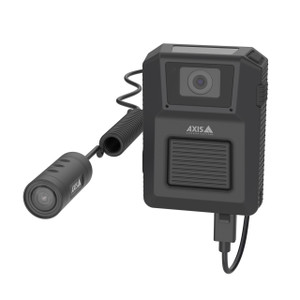
The Axis 02724-001 is a body-worn camera engineered for law enforcement, security personnel, and emergency response teams that require live situational awareness during field operations. Unlike traditional body cameras that log footage for post-incident review, the 02724-001 streams video, audio, and operational metadata in real time to command centers, enabling immediate tactical response and continuous officer safety oversight. The pendant-mount form factor is designed for hands-free deployment on duty uniforms, tactical gear, and mobile platforms without compromising officer mobility or firearm access.
Key Features
- Live Video and Audio Streaming: Real-time H.264/H.265 video with synchronized two-way audio transmission. Command centers gain immediate situational awareness instead of waiting for post-incident file review.
- Two-Way Audio Communication: Officers receive real-time direction and coordination from command centers during active operations. Operational data flows bidirectionally — critical for tactical response and officer safety.
- Encrypted Transmission Protocols: End-to-end encryption secures video, audio, and metadata in transit. Compliance-ready for law enforcement deployments requiring chain-of-custody protection and evidence integrity.
- Operational Metadata Tagging: GPS location, timestamp, officer ID, and incident classification are embedded in the stream. Enables rapid incident correlation across multiple field units and automatic evidence indexing.
- Pendant Mount Form Factor: Compact, lightweight design clips to duty uniforms, tactical vests, or vehicle dashboards. Hands-free operation leaves officers unencumbered during search, apprehension, or rescue scenarios.
- Mobile-First Connectivity: Supports both wired tethering and cellular backhaul for continuous uplink. Fallback buffering preserves footage on device if network drops during critical moments.
Live streaming introduces different operational demands than traditional recording. Network uptime becomes a critical dependency — a cellular dropout or WiFi handoff interrupts command-center visibility. Integrate the 02724-001 with redundant backhaul (primary cellular + secondary WiFi hotspot or tethered backup) to maintain continuous transmission during active incidents. Bandwidth consumption is higher than recorded-only workflows; estimate 2–4 Mbps per active stream depending on resolution and frame rate settings.
The two-way audio channel transforms the device from a passive recorder into an active command-and-control tool. Officers receive real-time tactical guidance, suspect information, and dispatch updates while the command center witnesses the incident as it unfolds. This real-time feedback loop reduces response time and improves officer safety during high-risk operations. Evidence quality is identical to traditional body camera footage — full evidentiary video for prosecution or civil review, with the added advantage of immediate incident awareness.
Deployment with law enforcement incident management systems (such as computer-aided dispatch, real-time intelligence platforms, or situational awareness dashboards) requires integration beyond standard ONVIF IP camera connectivity. Confirm that your command-and-control platform supports inbound RTSP or RTMP streams with metadata extraction and that your network infrastructure (firewalls, VPNs, load balancers) allows simultaneous live streams from field units without latency or packet loss. Encrypted certificates and mutual TLS authentication must be provisioned before field deployment.
The Axis 02724-001 is built for law enforcement and emergency services; it complies with manufacturer warranty and chain-of-custody requirements for evidence handling. Integration with Axis surveillance ecosystems and third-party ONVIF-compatible command centers is supported. For detailed specifications, network architecture guidance, and integration examples with common law enforcement platforms, refer to the product datasheet.
Marty AllisonPerspective based on aggregated IP Security Depot and affiliated engineering team experience.
We've deployed the Axis 02724-001 across law enforcement agencies and mobile security operations, and the transition from traditional body cameras to live-streaming platforms reshapes both the technical architecture and the operational workflow. The key differentiator isn't image quality — modern body cameras capture forensic-grade video — it's the real-time command-center visibility that enables immediate tactical response and continuous officer accountability. We've seen agencies use live streams to guide officers away from unfolding threats, confirm suspect identity in real time, and coordinate multi-unit response without radio delays. The two-way audio channel is genuinely transformative for officer safety; a dispatcher can instantly alert an officer to information discovered after he's already left dispatch coverage.
That said, live streaming trades simplicity for capability. A recorded-only body camera is a tactical tool plus an evidence device. The 02724-001 becomes a real-time data pipeline — which means network uptime, bandwidth, latency, and encryption certificate management become operational dependencies in a way they weren't with traditional recording devices. We've fielded deployments where cellular congestion during a major incident starved the live stream of bandwidth, forcing fallback to local storage. We've also seen agencies struggle with certificate rotation and VPN tunnel resets that interrupted streams during critical moments. The device itself is robust, but the ecosystem around it demands more planning than a standalone recorder.
Technical Highlights:
- H.264/H.265 Codec Selection: H.264 guarantees compatibility with legacy command-and-control systems; H.265 cuts bitrate 40-60% and reduces cellular backhaul load. The tradeoff is real-time latency — H.265 adds 200-400ms encoding delay. For tactical operations, we recommend H.264 unless cellular bandwidth is severely constrained.
- Two-Way Audio Latency: Audio round-trip latency is typically 200-800ms depending on network path. Natural conversation is still possible, but don't expect phone-call responsiveness. Confirm that your command-center operators are trained to account for this delay during high-stress incidents.
- GPS and Metadata Embedding: Location, timestamp, and officer ID travel with every frame. This enables automatic map-based incident correlation and forensic timeline reconstruction. We've seen this feature cut evidence assembly time from hours to minutes when multiple units respond to a single incident.
- Encrypted Transmission: TLS 1.2+ encryption is standard; mutual certificate authentication ensures only authenticated command centers receive live streams. Verify that your VPN or edge gateway enforces certificate pinning to prevent man-in-the-middle interception of law enforcement feeds.
- Fallback Recording on Device: If the network stream is interrupted, the 02724-001 continues recording locally. Evidence integrity is maintained — the local recording fills the gap. We've never lost footage to network outages, though we have had to manually transfer device storage to evidence systems after incidents with extended backhaul loss.
Deployment Considerations:
- Network architecture must support simultaneous live streams from 5-20+ field units without congestion. A single dropped frame during an arrest or search moment can create evidentiary gaps. Plan for dedicated bandwidth or QoS rules that prioritize law enforcement video over other traffic.
- Cellular backhaul is the primary uplink for mobile field units. Rural coverage gaps and urban dead zones will interrupt live streams — have a fallback plan (secondary hotspot, mesh network, or tethered backup) for critical incidents in known coverage holes.
- Certificate management at scale is often underestimated. If you deploy 50 units, certificate rotation, revocation, and renewal must be automated or you'll face a maintenance nightmare. Build this into your IT operations budget before field deployment.
- Video storage for live-streamed evidence differs from traditional recording. Command-center servers must buffer incoming streams, index by metadata, and archive to evidence storage. This requires RAID + redundancy planning; a single disk failure during a high-profile incident can create chain-of-custody issues.
- Officer training must emphasize that live streams are visible to the command center — this is a feature, not a bug, for officer safety and accountability, but it requires cultural buy-in from both officers and supervisors.
The 02724-001 is the right choice for agencies that have mature incident command systems, reliable network infrastructure, and a willingness to invest in the operational overhead of live-streaming surveillance. If your deployment is primarily rural with spotty cellular coverage, or if your command-and-control platform doesn't support inbound RTSP/RTMP streams, a traditional recorded-only body camera may be the better choice. For urban law enforcement, emergency response teams, and agencies with centralized dispatch and tactical coordination requirements, the live-streaming capability is a genuine force multiplier. Explore the Axis catalog for additional body-worn and mobile surveillance options.