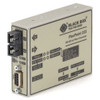
Black Box ME662A-SST Async RS-232 Fiber Extender — ST Single-Mode 30km DB9 Female
Overview
The Black Box ME662A-SST solves a specific problem that copper-based serial runs can't: getting RS-232 asynchronous signals across distances where electrical signaling falls apart. RS-232 was never designed for long runs — standard copper maxes out well under 100 feet before noise and signal degradation become real issues. The ME662A-SST converts that serial signal to fiber optic light and extends it up to 30 kilometers over single-mode glass, making it a practical tool for industrial control systems, access panels, legacy serial devices, and any installation where a serial device lives far from the controlling equipment.
The DB9 female interface on the ME662A-SST connects directly to standard RS-232 serial ports without adapters in most configurations. The ST connector on the fiber side is a field-proven bayonet-style interface common in industrial and campus fiber plants — if your fiber infrastructure already terminates in ST, this unit drops in without a re-termination project. Single-mode glass is the right choice here: it supports the full 30km reach without the multimode distance ceiling, and SM fiber is standard in inter-building and campus backbone runs where this kind of extender gets deployed.
Key Features
- 30km Single-Mode Fiber Reach: At 30 kilometers, the ME662A-SST bridges distances that are completely impractical with copper serial — inter-building campus runs, perimeter control loops, remote gate or barrier controllers. That range covers most enterprise campus and mid-size industrial site layouts end to end.
- RS-232 Async Protocol Support: Asynchronous RS-232 is the common denominator for legacy serial devices — PLCs, access control panels, legacy PTZ camera controllers, weigh scales, badge readers, and industrial sensors all speak it. This extender preserves the async framing, so devices on either end see a transparent serial connection, not a protocol-translated tunnel.
- ST Fiber Connector: The bayonet-lock ST connector is the standard interface in installed fiber plants at manufacturing facilities, utilities, and older campus networks. If your site runs ST-terminated single-mode, you connect and go — no splice, no re-termination, no media converter stack in between.
- DB9 Female Serial Interface: The DB9 female port mates directly with the male DB9 on most RS-232 serial devices and COM port breakouts. That's one fewer adapter in the signal path and one fewer potential failure point in the field.
- Fiber Electrical Isolation: Fiber carries no electrical potential between endpoints. In industrial environments where ground loops, lightning surges, or high-voltage equipment runs nearby, that isolation is not optional — it's what prevents a power event at one end from taking out equipment at the other.
- Black Form Factor: The chassis matches standard rack room and industrial enclosure color conventions, making it visually unobtrusive in mixed-equipment installations.
Integration & Compatibility
The ME662A-SST is designed for any application where a standard RS-232 asynchronous serial device needs to communicate over extended distances. Common deployment contexts include access control systems with remote door controllers or panel concentrators, PTZ camera serial control runs (Pelco-D/P and similar protocols ride RS-232), building automation system (BAS) field device connections, industrial PLC and SCADA serial nodes, and remote serial console access for network equipment. Because it operates transparently at the physical layer — converting electrical RS-232 to optical and back — it does not interpret, reformat, or add latency to the serial data stream. Any device or software that communicates over RS-232 async will work through this extender without driver changes or protocol reconfiguration. Verify that your fiber plant uses single-mode glass (not multimode) terminated with ST connectors before ordering — the ME662A-SST is specifically matched to SM/ST infrastructure and is not interchangeable with SC, LC, or multimode variants in the Black Box serial extension line. For installations requiring fiber media converters or complementary network infrastructure products, pairing with appropriate fiber patch cables and ST-compatible patch panels is standard practice. If you are planning a longer serial extension run and need guidance on fiber type selection, the structured cabling guide covers single-mode versus multimode tradeoffs in detail. See the full Black Box catalog for related serial and fiber connectivity products.
Frequently Asked Questions
Q: What is the maximum extension distance of the ME662A-SST?
A: The ME662A-SST supports RS-232 async serial extension up to 30 kilometers over single-mode fiber with ST connectors.
Q: What fiber type does the ME662A-SST require?
A: It requires single-mode (SM) fiber. Multimode fiber is not compatible with this unit. Your fiber plant must be terminated with ST connectors at both ends.
Q: What serial interface does the ME662A-SST use on the device side?
A: The device-side interface is a DB9 female connector carrying RS-232 asynchronous serial signals.
Q: Can the ME662A-SST be used for PTZ camera serial control runs?
A: Yes. PTZ camera control protocols such as Pelco-D and Pelco-P are transmitted over RS-232 async, which is exactly what the ME662A-SST extends. Verify your PTZ controller and camera receiver both use DB9 RS-232 interfaces or use appropriate adapters.
Q: Does the ME662A-SST provide electrical isolation between serial endpoints?
A: Yes. Because the signal path is optical between the two units, there is no electrical continuity between the serial endpoints. This provides inherent ground loop isolation, which is valuable in industrial and multi-building installations where ground potential differences exist.
Q: Is the ME662A-SST compatible with RS-422 or RS-485 serial protocols?
A: Based on available evidence, the ME662A-SST is specified for RS-232 asynchronous serial only. For RS-422 or RS-485 extension requirements, consult the broader Black Box serial fiber extender family for the appropriate variant.
The ME662A-SST addresses a gap that comes up regularly in legacy-device integration projects: you have RS-232 serial equipment at one end of a campus or industrial site and a controller or head-end system at the other, and copper simply won't bridge that distance reliably. The 30km single-mode fiber reach on the ME662A-SST (often searched as ME662A SST) is the spec that matters here — it covers virtually any intra-campus or inter-building run without signal repeaters or protocol conversion.
Technical Highlights:
- 30km SM Fiber Range: Single-mode fiber at 30km means this unit handles not just building-to-building hops but remote site-to-headend runs that would otherwise require a dedicated serial-over-IP converter with all the latency and configuration overhead that entails.
- ST Connector Compatibility: ST is the legacy standard in installed industrial and campus fiber plants. If your site's fiber is already ST-terminated single-mode, this extender requires zero re-termination work — plug the fiber in, connect the DB9, done.
- RS-232 Async Transparency: The unit operates at the physical layer. It doesn't interpret baud rate or framing in a way that requires configuration — the async serial stream passes through optically, preserving timing for protocols like Pelco-D PTZ control or serial BAS field devices without tuning.
Deployment Considerations:
- Confirm your fiber plant is single-mode before ordering. ST connectors appear on both SM and MM fiber, so connector type alone doesn't confirm fiber type — check your cable plant documentation or use an optical power meter to verify SM glass.
- The DB9 female interface mates with male DB9 RS-232 devices directly, but many modern serial devices ship with USB or RJ-45 serial adapters. You may need a USB-to-DB9 adapter or a terminal server at the head end depending on your controller's physical interface.
This unit is the right call for access control or PTZ serial control infrastructure at large campuses, utilities, or industrial facilities where the control head-end is centralized but field devices are distributed across long fiber runs — exactly the scenario where copper serial was never a viable option.