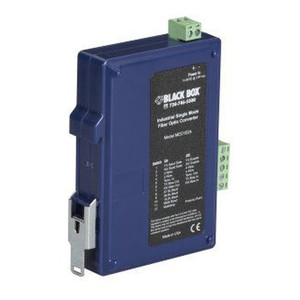
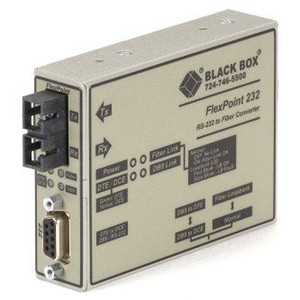
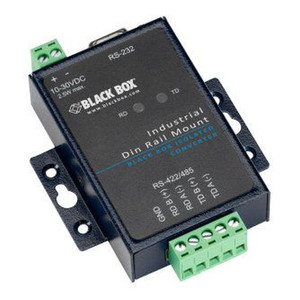
Black Box MED101A Async RS-232/422/485 Dual-Channel Fiber Extender
Overview
The Black Box MED101A is a dual-channel asynchronous serial fiber extender designed to carry RS-232, RS-422, and RS-485 signals over multimode fiber using ST connectors. If you're integrating legacy serial devices — access control panels, PTZ camera controllers, industrial automation equipment, or serial-based security hardware — into a fiber backbone, the MED101A provides the conversion layer without requiring you to replace the serial endpoint devices themselves.
The terminal block interface on the serial side makes field wiring straightforward: no proprietary connectors, no special tools beyond a screwdriver. The ST multimode fiber port on the other side plugs into standard multimode plant, keeping this compatible with existing fiber infrastructure in commercial buildings and campus environments.
Key Features
- Triple-protocol serial support (RS-232 / RS-422 / RS-485): A single unit handles all three asynchronous serial standards. This matters in mixed deployments where a PTZ controller might be RS-485 while a legacy access panel runs RS-232 — you're not buying separate extenders per protocol.
- Dual-channel architecture: Two independent serial channels over a single fiber link. Running two serial devices over one fiber run reduces cabling cost and conduit congestion compared to deploying two single-channel extenders.
- ST multimode fiber interface: ST connectors are the installed standard in most older commercial and industrial fiber plants. Plugging directly into existing ST-terminated multimode runs avoids costly re-termination or adapter chains.
- Terminal block serial connections: Screw-terminal wiring on the serial side accepts field-stripped conductors directly — a practical advantage in retrofit installations where pre-terminated cables may not reach cleanly.
- Fiber isolation: Converting serial to fiber breaks ground loops and provides galvanic isolation between the serial devices at each end — a meaningful benefit in industrial or multi-building environments where ground potential differences can corrupt RS-232 signals or damage equipment.
Integration and Compatibility
The MED101A is suited to environments running serial-dependent hardware that can't be replaced or upgraded to IP: PTZ camera dome controllers, access control head-end panels, building automation controllers, and legacy intercom or intercommunication systems. The RS-422 and RS-485 modes support longer balanced-line serial runs on the device side, reducing sensitivity to noise before the signal reaches the fiber conversion point.
Consult the Black Box networking and connectivity catalog for companion serial extenders and media converters if your project requires mixing copper-serial and fiber segments. For broader fiber infrastructure planning, the fiber optic cable and assemblies category covers the multimode plant this unit connects into. If your deployment also involves IP cameras or network video recorders alongside legacy serial PTZ controllers, the MED101A bridges the serial control layer without disrupting the IP video architecture. For PoE switch selection when combining IP and serial-controlled devices, see the network switches category.
Frequently Asked Questions
Q: What serial standards does the MED101A support?
A: The MED101A supports RS-232, RS-422, and RS-485 asynchronous serial protocols. All three modes are available on the same unit.
Q: How many serial channels does the MED101A provide?
A: The MED101A provides two independent asynchronous serial channels, allowing two separate serial devices to share a single fiber link.
Q: What type of fiber connector does the MED101A use?
A: The MED101A uses ST connectors on the fiber side and is designed for multimode fiber infrastructure.
Q: What is the wiring method on the serial side of the MED101A?
A: The serial side of the MED101A uses terminal block connectors, which accept field-stripped conductors and require only a screwdriver — no proprietary connectors or crimping tools needed.
Q: What types of devices is the MED101A typically used with?
A: The MED101A is commonly used with PTZ camera dome controllers, legacy access control panels, building automation systems, and other serial-dependent hardware that needs to communicate over a fiber backbone.
The MED101A is a straightforward solution to a problem that comes up constantly in retrofit security and automation projects: you've got a fiber backbone already in place with ST-terminated multimode runs, and you need to get RS-485 PTZ control or RS-232 panel data across it without pulling new copper. The dual-channel architecture is the detail worth noting — two serial devices over one fiber pair is the difference between one conduit penetration and two in a finished ceiling or concrete wall.
Technical Highlights:
- RS-232 / RS-422 / RS-485 on one unit: All three async serial standards supported, so the same extender pair handles a balanced RS-485 PTZ bus and an RS-232 legacy panel without sourcing separate SKUs per protocol.
- Dual-channel fiber link: Two independent serial channels carried on a single ST multimode fiber connection — halves the fiber port consumption on your patch panel versus running two single-channel units.
- Terminal block serial interface: Field wiring with a screwdriver only; no crimped connectors required. In retrofit installs where cable lengths are uncertain until you're in the ceiling, this is a practical time saver.
Deployment Considerations:
- Verify the fiber plant is ST-terminated multimode before ordering — SC or LC infrastructure will require ST adapters or re-termination at each end, which adds insertion loss that may affect link budget.
- Ground loop isolation is a secondary benefit of the fiber conversion path; if you're seeing RS-232 signal corruption between buildings, this is one of the faster fixes — but confirm baud rate and framing requirements with your serial device documentation before commissioning, as the MED101A's supported baud range should be matched to your endpoint devices.
The MED101A is a solid fit for campus security projects where a PTZ dome controller and a legacy access panel both need to reach a head-end across an existing multimode fiber plant — particularly in retrofits where ripping out the ST-terminated fiber is not on the table.