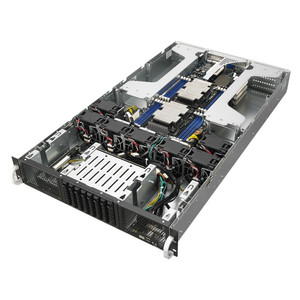
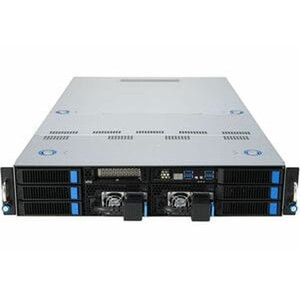
ASUS ESC4000A-E10 2U AMD EPYC GPU Accelerated Rack Server
Overview
The ASUS ESC4000A-E10 is a 2U single-processor rack server built around AMD's EPYC 7002 (Rome) platform, and it's designed from the ground up to carry GPU compute workloads. With four full-length PCIe x16 slots and a fifth x8 slot, this chassis can house up to four double-wide accelerator cards — making it the right call for AI inference, deep learning training, video analytics at scale, or any workload that has outgrown CPU-only architectures. At 43.82 x 23.43 x 10.23 inches and 97 lb, the ESC4000A-E10 is a proper 2U server that belongs in a data center rack, not a closet.
For teams evaluating ASUS server platforms, the ESC4000A-E10 occupies the GPU-dense tier of ASUS's commercial server lineup — distinct from storage-heavy or pure-compute variants in the ESC family.
Key Features
- AMD EPYC 7002 (Socket SP3): The Rome generation of EPYC delivers up to 64 cores per socket with high memory bandwidth — critical when feeding multiple GPU cards data fast enough to keep them saturated. A bottlenecked CPU defeats the purpose of the GPU investment.
- Four PCIe x16 + One PCIe x8 Expansion Slots: Four full x16 lanes means no bifurcation penalty on high-bandwidth accelerators. You can install four dual-slot GPUs without the bandwidth starvation that plagues cheaper 2U designs that share lanes across slots.
- 8 DIMM Slots — Up to 2 TB DDR4: DDR4-SDRAM in 8 slots supports individual modules up to 256 GB, with a platform ceiling of 2 TB total. For inference servers processing large model checkpoints or in-memory datasets, headroom here matters more than raw core count.
- NVMe / SAS / SATA Hot-Swap Storage Interface: Hot-swap bays with support for all three interface types mean you can mix NVMe for model storage with SAS or SATA for bulk data retention in the same chassis — without a separate storage server in the rack.
- Intel I350-AM2 LAN Controller — 3x RJ-45 Ports: Three Ethernet ports give you dedicated management, data ingress, and storage-network separation without adding a NIC card, preserving a PCIe slot for a GPU. The Intel I350-AM2 is a proven, driver-stable controller that plays well across Linux distributions commonly used in GPU compute environments.
- 6x USB 3.2 Gen 1 Type-A Ports: Six USB 3.1 Gen 1 ports are more than most 2U servers provide, useful for out-of-band provisioning, external storage during initial deployment, or peripheral connectivity in lab or edge-data-center contexts.
- 1x VGA (D-Sub) Output: Local display access without a KVM over IP license — useful during initial BIOS configuration or when troubleshooting GPU driver issues before your management network is up.
- 2U Rack Form Factor (43.82 × 23.43 × 10.23 in): At 97 lb fully configured, plan your rack rail loading carefully. Two units per 4U means this can stack efficiently in a GPU cluster deployment, but floor loading and PDU capacity need to be verified before ordering in volume.
Integration and Compatibility
The ESC4000A-E10 targets environments running GPU-accelerated compute workloads — AI/ML frameworks (PyTorch, TensorFlow), video analytics pipelines, HPC batch jobs, or virtualized GPU workloads via vGPU-capable hypervisors. The Socket SP3 platform is compatible with the full AMD EPYC 7002 series processor lineup. Storage flexibility across NVMe, SAS, and SATA means it integrates into existing SAN or DAS environments without requiring protocol-specific infrastructure changes.
For teams building out GPU compute racks, pairing this server with appropriate rack infrastructure and PDUs rated for the power draw of four populated GPU slots is a non-negotiable step. See the networking infrastructure category for 25GbE or 100GbE uplink switches if your data pipeline demands more than gigabit throughput between nodes.
Consult the server and storage planning guide for rack density, power budgeting, and cooling considerations specific to GPU-dense 2U deployments.
Frequently Asked Questions
Q: How many GPUs can the ESC4000A-E10 accommodate?
A: The ESC4000A-E10 has four PCIe x16 slots and one PCIe x8 slot. In practice, four double-wide GPU cards is the target configuration for this chassis — the four x16 slots provide full bandwidth per card without lane-sharing penalties.
Q: What processor generation does the ESC4000A-E10 support?
A: The ESC4000A-E10 uses Socket SP3 and supports AMD EPYC 7002 series (Rome) processors. It is a single-processor (UP) platform.
Q: What is the maximum RAM capacity of the ESC4000A-E10?
A: The server has 8 DIMM slots supporting DDR4-SDRAM. Individual module capacities of 16 GB, 32 GB, 64 GB, 128 GB, and 256 GB are supported, with a platform maximum of 2 TB total.
Q: Does the ESC4000A-E10 support hot-swap drives?
A: Yes. The ESC4000A-E10 includes hot-swap HDD bays with support for NVMe, SAS, and SATA interfaces, allowing drive replacement without taking the system offline.
Q: What is the weight and form factor of the ESC4000A-E10?
A: The ESC4000A-E10 is a 2U rack server measuring 43.82 × 23.43 × 10.23 inches (L × W × H) and weighing 97 lb. Verify rack rail load ratings and floor capacity before deploying in high-density configurations.
Q: Does the ESC4000A-E10 include an optical drive?
A: No. The ESC4000A-E10 does not include an optical drive, which is standard for 2U GPU servers where bay space is prioritized for storage and the chassis depth is optimized for accelerator cards.
The ESC4000A-E10 comes up often when teams are standing up GPU inference clusters and need to maximize accelerator density without going to a 4U chassis. The four PCIe x16 slots at full bandwidth — not bifurcated — is the spec that separates this platform from cheaper 2U designs that share lanes and throttle high-bandwidth cards under load. If you're sizing for four A100s or H100s in a 2U envelope, this is the platform to evaluate.
Technical Highlights:
- 4x PCIe x16 + 1x PCIe x8: Full x16 lanes on all four primary GPU slots means each accelerator gets dedicated bandwidth — no shared-lane bottleneck that undermines the GPU's actual throughput in training or inference workloads.
- 2 TB DDR4 Ceiling (8 DIMM, up to 256 GB per module): Enough system memory to keep large language model weights in RAM between inference calls, reducing reload latency in high-request-rate deployments. Most competing 2U platforms cap at 1 TB — the 2 TB ceiling matters for future memory-hungry models.
- NVMe + SAS + SATA Hot-Swap: Multi-protocol hot-swap bays let you put NVMe directly under the model-serving path and use SAS or SATA for logging or dataset storage in the same box — avoiding a separate NAS in smaller inference node deployments.
Deployment Considerations:
- At 97 lb, this server at full GPU configuration will draw substantial power — confirm your PDU and UPS circuits are rated for four high-TDP accelerator cards plus the EPYC platform before racking. This is not a last-minute power calculation.
- The single-processor (UP) design is a constraint: if your workload requires NUMA-aware multi-socket memory topology for CPU-side preprocessing, a dual-socket platform will be needed. For pure GPU inference where the CPU is mostly orchestrating, single-socket EPYC 7002 is sufficient.
The ESC4000A-E10 (often searched as ESC4000A E10) is the right fit for AI inference node deployments where you need four full-bandwidth GPU slots in a 2U footprint — specifically GPU clusters for video analytics pipelines, large-model inference, or HPC batch jobs where per-slot PCIe bandwidth directly affects throughput.