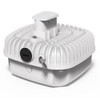
HPE R4W49A Outdoor Wi-Fi 6 Access Point
Overview
The HPE Aruba AP-567 (R4W49A) is a dual-radio Wi-Fi 6 outdoor access point built for deployments where weather, temperature swings, and IoT device density would sideline a standard indoor AP. It handles 802.11ax on both 2.4GHz and 5GHz simultaneously, delivering up to 1.49Gbps aggregate throughput — enough headroom for high-density outdoor venues, campus courtyards, stadium concourses, and distributed warehouse environments where a single AP needs to serve a wide mix of clients, sensors, and handhelds at once.
What separates the R4W49A from indoor Wi-Fi 6 alternatives is the integration of three radio technologies in one enclosure: the Wi-Fi 6 dual-band radios, a Bluetooth 5.0 radio, and an 802.15.4 radio for Zigbee. That means you can consolidate your wireless infrastructure, IoT gateway, and BLE location services into a single ceiling or pole mount rather than stacking separate devices on the same conduit run.
Key Features
- Wi-Fi 6 (802.11ax) on Both Bands: 802.11ax isn't just a speed upgrade — OFDMA and BSS Coloring let the AP coordinate transmissions across many clients simultaneously, which matters at 256 clients per radio. In a warehouse with 150+ scanners all transmitting short bursts, this is the spec that keeps latency predictable rather than spiky.
- 1.49Gbps Aggregate Data Rate: The 5GHz radio tops at 1.2Gbps and 2.4GHz adds 574Mbps. In practice, this gives you realistic multi-stream throughput for concurrent video feeds, barcode scan traffic, and voice — without saturating the uplink on a busy shift.
- 2x2:2 MIMO Per Radio: Two spatial streams per band keeps the radio chain efficient for the client mix typical in commercial outdoor deployments — most connected devices (handhelds, cameras, IoT nodes) are 1x1 or 2x2, and you don't pay the complexity cost of 4x4 chain management where it won't be used.
- Integrated Bluetooth 5.0 Radio: The onboard BT 5.0 radio supports BLE-based location services, asset tracking, and proximity applications without a separate overlay. If your facility already relies on BLE tags for equipment tracking, this eliminates a secondary infrastructure layer.
- 802.15.4 / Zigbee IoT Radio: The third radio handles Zigbee devices natively — relevant for smart building automation, environmental sensors, and access-control peripherals that don't speak Wi-Fi. One AP infrastructure becomes the convergence point for IT and OT traffic.
- Up to 256 Clients Per Radio: Rated for 256 associated clients per radio, which is a meaningful ceiling for high-density outdoor events and large warehouse floors where dozens of devices associate simultaneously. Most competing outdoor APs cap at 128 per radio.
- 802.3at PoE+ Powered: The AP draws power over a standard 802.3at PoE+ port at 48Vdc nominal. There is no DC power input option — the AP is PoE-only. Any 802.3at-capable switch port or midspan injector that can supply Class 3 or higher will power it. No separate power cable run required.
- Zero-Touch Provisioning: The AP supports zero-touch provisioning under Aruba Central (cloud) or an on-premises controller. For multi-site rollouts, this means APs can be drop-shipped to remote locations and brought online without a technician touching the config — a real operational savings at scale.
- Flexible Management Architecture: Runs under Aruba Central (cloud), an on-premises Aruba controller or gateway, or in standalone mode. This gives you the option to start standalone for a small site and migrate to centralized management as the deployment grows, without replacing hardware.
- Weatherproof, Temperature-Hardened Enclosure: The outdoor-rated enclosure is designed for continuous exterior exposure — relevant for loading docks, outdoor parking structures, sports venues, and transit hubs where indoor-rated APs fail within a season.
Integration and Compatibility
The R4W49A integrates into the Aruba wireless ecosystem — pairing with HPE Aruba wireless infrastructure including Aruba Central, Aruba Mobility Controllers, and Aruba Gateways. The AP supports the 802.11a/b/g/n/ac Wave 2/ax protocol stack for backward compatibility with legacy clients alongside Wi-Fi 6 devices, so mixed-generation device environments don't require a staged client refresh before deployment.
For PoE infrastructure, the single 10/100/1000 Base-T RJ-45 uplink port connects to any 802.3at-capable PoE+ switch. Planning your network infrastructure around 802.3at (not the older 802.3af) is a hard requirement — 802.3af cannot deliver sufficient wattage to power the AP. The software-configurable radios allow frequency and channel adjustments post-install, which is useful when the RF environment changes after deployment.
The integrated 802.15.4 and Bluetooth 5.0 radios extend the AP's role beyond Wi-Fi, making it a candidate for smart building projects that need a unified wireless infrastructure to handle both client connectivity and IoT sensor networks. Verify that your building automation or RTLS platform supports the specific Zigbee profile or BLE protocol variant required before treating this as a complete IoT gateway replacement.
Frequently Asked Questions
Q: Does the HPE Aruba AP-567 R4W49A require a controller, or can it run standalone?
A: The R4W49A supports three management modes: Aruba Central (cloud-managed), an on-premises Aruba controller or gateway, and standalone mode. You are not required to deploy a controller — standalone operation is a supported configuration, though centralized management unlocks additional policy and monitoring capabilities.
Q: What PoE standard does the R4W49A require, and will my existing 802.3af switch power it?
A: The AP requires 802.3at PoE+ (Class 3 or higher) at 48Vdc nominal. Standard 802.3af PoE delivers a maximum of 15.4W, which is insufficient. Verify your switch or midspan injector is rated for 802.3at before installation. The AP has no DC power input as a fallback.
Q: What is the maximum client capacity of the AP-567?
A: The AP-567 supports up to 256 associated clients per radio. With two radios (2.4GHz and 5GHz), the theoretical combined association capacity is 512 clients, though real-world throughput per client will degrade well before that ceiling in most environments.
Q: Does the R4W49A support IoT devices like Zigbee sensors?
A: Yes. The AP includes an integrated 802.15.4 radio, which supports Zigbee and similar sub-GHz mesh protocols. It also includes a Bluetooth 5.0 radio for BLE-based asset tracking and location services. These operate independently of the Wi-Fi radios.
Q: Is the AP-567 suitable for outdoor installation year-round?
A: The R4W49A enclosure is rated for outdoor, weatherproof, temperature-hardened deployment. It is designed for continuous exterior exposure. Consult the Aruba AP-567 installation guide for the verified operating temperature range and mounting hardware specifications before deploying in extreme climate conditions.
Q: What uplink connectivity does the AP-567 provide?
A: The AP provides a single 10/100/1000 Base-T RJ-45 uplink port. There is no fiber uplink option on this model. If your outdoor run exceeds standard copper Ethernet distance limits (~100m), a media converter or fiber-to-copper switch will be required at the AP end.
The spec that keeps coming up in conversations about the R4W49A is the triple-radio architecture — and for good reason. Most outdoor APs force you to choose between Wi-Fi coverage and IoT gateway capability. The AP-567 puts 802.15.4 (Zigbee), Bluetooth 5.0, and dual-band 802.11ax into a single outdoor-rated enclosure, which changes the infrastructure math significantly for mixed IT/OT environments.
Technical Highlights:
- 1.49Gbps Aggregate Throughput: The 5GHz radio delivers up to 1.2Gbps and the 2.4GHz radio adds 574Mbps. In a warehouse running WMS-connected handhelds on 5GHz and legacy devices on 2.4GHz, you have genuine headroom on both bands simultaneously rather than competing for shared airtime.
- 256 Clients Per Radio: That ceiling matters in high-density outdoor scenarios — a stadium concourse or a large distribution center floor with dozens of scanners, cameras, and handhelds all associating at the same time. The 802.11ax OFDMA scheduling is what makes 200+ concurrent associations practical rather than theoretical.
- Zero-Touch Provisioning: For multi-site deployments using Aruba Central, APs ship to remote sites and self-configure on first boot. At scale — 20, 50, 100 APs across multiple locations — eliminating manual on-site configuration is a meaningful reduction in deployment cost and error rate.
Deployment Considerations:
- The single GigE uplink port is the bottleneck to plan around. At 1.49Gbps aggregate Wi-Fi capacity feeding into a 1Gbps copper port, you will hit uplink saturation before you hit radio saturation on a busy site. Design your AP density accordingly, and ensure your PoE switch port is 802.3at — not 802.3af — before the cable pull.
- The integrated Zigbee and BLE radios require platform-side support to be useful. Confirm your building management system, RTLS platform, or IoT gateway software supports the specific Zigbee profile and BLE variant the AP exposes before designing the IoT architecture around this device.
The R4W49A is the right fit for large outdoor campus deployments, stadium or venue concourses, and industrial facilities where a single AP infrastructure needs to carry Wi-Fi 6 clients, BLE asset tags, and Zigbee sensors concurrently — specifically where running separate overlays for each radio type is operationally or physically impractical.