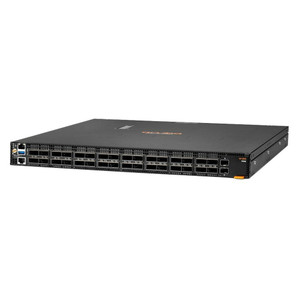
HPE R0X27C Aruba 6410 v2 Modular Layer 3 Switch
Overview
The HPE Aruba 6410 v2 (R0X27C) is a 10-slot modular chassis switch built for large enterprise distribution and core layers where throughput, PoE density, and high-availability failover are non-negotiable. With up to 28 Tbps switching capacity and 20 Bpps forwarding, it handles spine-level traffic volumes without becoming a bottleneck — even as you add high-density 802.3bt endpoints like pan-tilt-zoom cameras, 802.11ax access points, or IP phone arrays drawing 90W each. If you're designing a network switch tier for a large campus, healthcare system, or multi-building security deployment, this is the chassis that lets you scale port count and PoE budget independently as the installation grows.
The 6410 v2 belongs to the broader HPE Aruba Networking CX 6400 series, a modular family designed for organizations that need to configure their chassis to match their actual traffic mix — not buy a fixed-port switch and live with the trade-offs.
Key Features
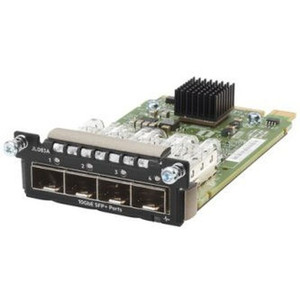
- 10 I/O Module Slots: The chassis accepts up to 10 line cards, letting you mix 1GbE/10GbE access-density cards with 25GbE/40GbE/100GbE uplink cards in a single chassis. You're not locked into a fixed ratio of access to uplink ports — configure the slot population to match your actual traffic pattern and expand as the deployment grows.
- 28 Tbps Switching Capacity / 20 Bpps Forwarding: These numbers represent the theoretical ceiling across a fully loaded chassis. In practice, they mean the switch fabric won't be your performance ceiling in a modern campus core — you can run high-density 10GbE access tiers and multiple 100GbE uplinks simultaneously without internal congestion.
- IEEE 802.3af/at/bt PoE with 28,880W Budget: A single chassis can deliver up to 28,880W of PoE across up to 480 Smart Rate ports at 1/2.5/5GbE. That's enough to power a dense physical security deployment — hundreds of 802.3bt cameras at 60–90W each — without needing a separate PoE injector infrastructure. For PoE switch consolidation projects, this budget changes the architecture conversation significantly.
- Smart Rate Ports (1/2.5/5GbE): Up to 480 ports operate at multi-gigabit speeds on existing Cat5e/Cat6 cabling. This matters in retrofit projects where rewiring isn't an option but you need more than 1GbE to the edge — Wi-Fi 6/6E APs and high-resolution cameras both benefit from the headroom above 1Gbps without requiring fiber or Cat6A runs.
- Quad-Core Management Module (ARM Cortex A72 @ 1.8GHz, 16GB DDR4 ECC, 32GB eMMC): The management plane has dedicated compute separate from the line card processors. 16GB of ECC RAM means the control plane stays stable under heavy routing table loads, and 32GB of onboard flash gives you room for multiple firmware images and logging without external storage dependencies.
- Dual-Core Line Card Processors (ARM Cortex A72 @ 1.8GHz, 4GB DDR4): Each line card runs its own processor and 4GB of local memory — local forwarding decisions don't depend on the management module, which keeps latency consistent even when the control plane is busy processing routing updates.
- Packet Buffer: 8MB or 32MB per Line Card: Buffer depth depends on the line card model installed. The 32MB option is relevant for deployments with bursty traffic patterns — video surveillance recording events, batch backup jobs, or warehousing workflows where many endpoints transmit simultaneously. Deeper buffers absorb those bursts without forcing early packet drops.
- HPE Aruba VSx High Availability: VSx provides active-active chassis virtualization — two physical switches appear as a single logical device to the rest of the network. In a campus core or distribution layer, this eliminates spanning-tree blocked paths and lets you run both uplinks active simultaneously, effectively doubling usable uplink bandwidth while maintaining sub-second failover if one chassis loses power or a card fails.
- Port Speed Flexibility (1GbE through 100GbE): The R0X27C supports line cards spanning 1GbE to 100GbE, making it suitable as both a distribution-layer aggregation switch and a spine in a leaf-spine fabric. You can start with 10GbE uplinks and upgrade specific slots to 100GbE as traffic demands grow — no forklift replacement required.
- Layer 3 Modular Architecture: Full Layer 3 routing on the chassis means you can terminate VLANs, run OSPF or BGP, and handle inter-VLAN routing at line rate without sending traffic to a separate router. For security deployments with segmented camera, access control, and corporate traffic VLANs, this simplifies the topology considerably.
- SNMP v2c/v3 and RMON Management: Standard management protocols mean the 6410 v2 integrates with any enterprise NMS — SolarWinds, PRTG, Nagios, or your existing toolchain — without requiring proprietary management software. SNMP v3 with authentication and encryption is available for environments with management-plane security requirements.
Integration & Compatibility
As a member of the HPE Aruba CX 6400 series, the 6410 v2 is managed through Aruba's CX operating system, which supports integration with Aruba Central for cloud-based monitoring and policy management. The switch interoperates with standard LLDP-MED for IP phone and camera discovery, 802.1X port authentication for device onboarding, and standard RADIUS/TACACS+ for management-plane access control.
For security system integrators, the combination of 802.3bt PoE, multi-gigabit access ports, and VSx high availability makes the R0X27C a natural fit at the distribution or core layer of a converged building network — one where physical security (cameras, access control readers, intercoms), wireless infrastructure, and corporate data all share the same switching fabric but stay isolated in separate VLANs with policy enforcement at the chassis level. Pair it with downstream access-layer switches for endpoint connectivity and upstream 100GbE links to the data center.
Input voltage accepts 110–127V and 200–240V AC, so the chassis operates on standard North American or international power infrastructure without step-down transformers. Maximum chassis dimensions are 52.88 × 44.26 × 44.85 cm at up to 53.5 kg fully loaded — plan for a reinforced rack and verify your floor loading if you're stacking multiple chassis.
Frequently Asked Questions
Q: What is the maximum PoE power budget on the HPE Aruba 6410 v2?
A: The maximum PoE power budget is 28,880W across the chassis, supporting up to 480 Smart Rate PoE ports at 1/2.5/5GbE speeds. The switch supports IEEE 802.3af, 802.3at, and 802.3bt standards, so it can power devices from 15.4W (802.3af) up to 90W (802.3bt) per port depending on the line card configuration.
Q: What switching capacity and forwarding rate does the R0X27C support?
A: The 6410 v2 delivers up to 28 Tbps switching capacity and up to 20 Bpps forwarding throughput across a fully populated chassis. These figures represent the maximum across all 10 I/O module slots when loaded with high-density line cards.
Q: How does HPE Aruba VSx high availability work on the 6410 v2?
A: VSx (Virtual Switching Extension) pairs two physical 6410 v2 chassis as a single logical switch. Both chassis actively forward traffic simultaneously — there is no standby unit sitting idle. If one chassis fails, the other continues forwarding without a spanning-tree reconvergence delay. This is the standard HA architecture for campus distribution and core deployments requiring sub-second failover.
Q: What port speed options are available on the 6410 v2?
A: The chassis supports line cards with 1GbE, 2.5GbE, 5GbE, 10GbE, 25GbE, 40GbE, and 100GbE port speeds. The specific speeds available depend on which line cards you populate in the 10 I/O module slots. Smart Rate ports (1/2.5/5GbE) are available on up to 480 ports for multi-gigabit access over existing copper cabling.
Q: What are the physical dimensions and weight of the 6410 v2 chassis?
A: Maximum chassis dimensions are 52.88 × 44.26 × 44.85 cm, with a maximum weight of 53.5 kg when fully loaded. Verify rack load ratings and floor load capacity before deploying multiple chassis in the same rack or row.
Q: What management protocols does the HPE Aruba 6410 v2 support?
A: The switch supports SNMP v2c and v3, RMON, and CLI management. SNMP v3 provides authenticated and encrypted management-plane communication for environments with strict network security policies. The CX operating system also supports integration with Aruba Central for cloud-based monitoring where that is part of the architecture.
The R0X27C is the chassis I'd spec at the distribution layer of any large converged campus network — specifically because of that 28,880W aggregate PoE budget across up to 480 Smart Rate ports. When you're aggregating a building with hundreds of 802.3bt cameras and Wi-Fi 6 APs simultaneously, having that power budget centralized in a modular chassis rather than distributed across dozens of fixed-port switches simplifies both the power audit and the topology.
Technical Highlights:
- VSx Active-Active HA: Two chassis paired via VSx both forward traffic simultaneously — no idle standby, no spanning-tree blocked uplinks. For a campus distribution layer handling security and corporate traffic, sub-second failover without reconvergence is the difference between a brief blip and a reported incident.
- Management Module Isolation (16GB ECC RAM, Quad-Core A72): The control plane runs on dedicated hardware separate from the line cards. Under heavy OSPF reconvergence or a large routing table update, line card forwarding stays unaffected. The ECC memory matters in always-on environments where a single-bit flip in the routing table is a problem, not a statistic.
- Packet Buffer Depth (up to 32MB per line card): In surveillance networks, recording events generate synchronized bursts from dozens of cameras simultaneously. The deeper 32MB buffer option absorbs those bursts without early-drop at the aggregation layer — which shows up as reduced dropped frames in NVR recordings during motion events.
Deployment Considerations:
- At 53.5 kg maximum loaded weight and dimensions of 52.88 × 44.26 × 44.85 cm, this chassis requires a reinforced rack rated for its weight. Confirm both rack load capacity and raised-floor or slab load ratings before installing multiple chassis in adjacent positions.
- The 28,880W PoE budget assumes adequate power feed to the chassis — verify your facility's electrical capacity and PDU ratings before committing to a full 802.3bt deployment across all 480 ports. The power draw at full PoE load is substantial and needs to be accounted for in UPS sizing.
This chassis fits best in large healthcare campuses, multi-building education facilities, or enterprise security deployments where 200+ PoE endpoints need to aggregate into a resilient, high-throughput distribution layer — and where the network team needs a switching platform that can grow slot-by-slot rather than requiring a full replacement when traffic demands increase.