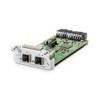
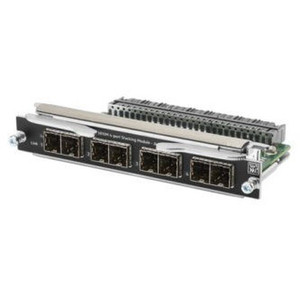
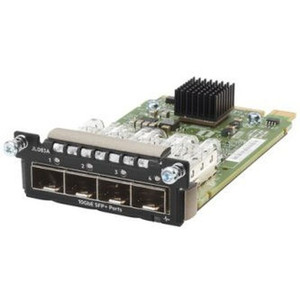
HPE JL325A Aruba 2930M 2-Port Stacking Module
Overview
The HPE Aruba JL325A is a two-port stacking module designed exclusively for the HPE Aruba 2930M switch series. It converts standalone 2930M switches into a unified logical stack, giving network architects a way to scale access-layer capacity without adding management complexity. Each port runs at 40 Gbps, delivering 80 Gbps of aggregate network switching bandwidth across the stacking fabric — enough headroom for high-density PoE deployments, IP camera aggregation, and converged enterprise access layers where a single management plane matters more than raw core throughput.
Where most access-layer scaling strategies mean additional management IP addresses, separate firmware upgrade cycles, and siloed monitoring, a properly built 2930M stack collapses up to 10 switches into one logical device. For security and IT infrastructure teams running mixed wired/wireless environments, this simplifies day-to-day operations considerably.
Key Features
- 40 Gbps per stacking port: Each of the two stacking ports operates at 40 Gbps — not the 10 Gbps links common on entry-level stacking modules. In a surveillance or PoE-heavy deployment where dozens of cameras and APs compete for uplink bandwidth, that headroom prevents the stacking interconnect from becoming the bottleneck before your uplinks are.
- 80 Gbps aggregate stack bandwidth: Both ports operating simultaneously deliver 80 Gbps of fabric throughput. For a multi-camera IP security deployment aggregating high-bitrate streams from multiple access switches, the stacking fabric will not be the limiting factor — your WAN or recorder write speed will be.
- Up to 10-switch stack support: A single logical stack can span up to 10 Aruba 2930M switches. This lets you grow access-layer port count incrementally — add a switch to the stack as a floor, wing, or building section comes online — without redesigning the management architecture or re-addressing anything.
- Single-pane management: All switches in the stack present as one device with one IP, one CLI session, and one firmware image to maintain. Compared to managing 8–10 independent switches individually, the operational difference is significant during firmware update windows, configuration audits, or incident response.
- Unified switch configuration: Port assignments, VLANs, QoS policies, and ACLs configured on the stack apply across all member switches consistently. For security deployments where camera VLANs, management VLANs, and staff VLANs need to be enforced uniformly across an entire floor or building, this eliminates configuration drift between individual switches.
- Modular slot installation: The JL325A installs into the dedicated module bay on the 2930M — no tools beyond what ships with the switch are typically required, and the module does not consume any of the switch's front-panel PoE or data ports.
Integration & Compatibility
The JL325A is designed specifically for the Aruba 2930M switch family. It is not compatible with the 2930F, 2540, 2530, or any other Aruba series — the module slot and stacking protocol are specific to the 2930M platform. Before ordering, confirm your installed base consists entirely of Aruba 2930M switches; mixing in 2930F or other variants in the same physical stack is not supported.
Stacking cables are sold separately and are required to physically interconnect the modules between switches. Verify that your cable run lengths and routing match available stacking cable SKUs before finalizing the stack design. The 2930M supports up to 10 stack members, so plan ring vs. chain topology based on physical rack layout and redundancy requirements — a ring topology provides path redundancy in the stacking fabric if a single cable or member fails.
For environments running network video recorders or IP surveillance infrastructure, the 2930M stack with this module simplifies the access layer considerably: all camera-facing ports across multiple switches are managed from one device, VLAN segmentation is consistent, and firmware updates can be pushed to the entire stack in a single maintenance window rather than switch by switch.
The JL325A also pairs naturally with PoE switch planning — because the stacking module occupies its own module bay, it does not reduce the PoE port count available on any 2930M member switch, preserving the full per-switch PoE budget for cameras, access points, or VoIP endpoints.
Frequently Asked Questions
Q: Is the JL325A compatible with the Aruba 2930F series switches?
A: No. The JL325A is designed exclusively for the Aruba 2930M series. The 2930F uses a different platform architecture and does not have a compatible stacking module bay. Verify your switches are 2930M models before ordering.
Q: How many switches can be stacked using the JL325A?
A: The Aruba 2930M supports stacking up to 10 switches in a single logical stack using this module.
Q: Does installing the JL325A reduce the number of available PoE or data ports on a 2930M switch?
A: No. The JL325A installs in a dedicated module slot on the 2930M and does not consume any front-panel data or PoE ports.
Q: What is the aggregate stacking bandwidth provided by the JL325A?
A: The JL325A provides two stacking ports at 40 Gbps each, for a total aggregate stacking bandwidth of 80 Gbps.
Q: Are stacking cables included with the JL325A?
A: Stacking cables are not included and must be ordered separately. Confirm cable part numbers and run lengths for your specific rack layout before deployment.
Q: Can I add JL325A modules incrementally as I expand the stack?
A: Yes. Each 2930M switch in the stack requires its own JL325A module. You can add switches and modules to an existing stack incrementally, up to the 10-member maximum, without rebuilding the existing stack configuration.
The JL325A is a straightforward module with one job: turn a row of independent 2930M switches into a single managed device. The 80 Gbps aggregate stacking fabric is more than sufficient for the aggregated camera, AP, and endpoint traffic these switches typically carry — I have not seen a 2930M access-layer deployment where the stacking interconnect, rather than uplink capacity or PoE budget, was the constraint.
Technical Highlights:
- 40 Gbps per port: At 40 Gbps per stacking port, this module sits well above the 10 Gbps links on entry-tier stacking products. For dense PoE floors aggregating high-bitrate IP cameras alongside wireless traffic, that extra headroom keeps the stacking fabric out of the conversation during capacity planning.
- 80 Gbps aggregate bandwidth: The two-port design delivers 80 Gbps of total stacking bandwidth, which comfortably exceeds the realistic throughput of a fully-loaded 2930M access switch in most physical security or enterprise access deployments.
- 10-member stack maximum: A single logical stack spanning up to 10 switches means you can cover a substantial access layer — multiple floors or wings of a building — under one management plane without segmenting into separate stacks prematurely.
Deployment Considerations:
- Plan stacking cable runs before ordering. The JL325A module connects to adjacent stack members via separate stacking cables (sold separately), and cable length options are limited — measure rack-to-rack distances carefully before finalizing the BOM.
- Ring topology is strongly preferred over chain for any production deployment. A chain stack loses all members beyond a break point if a cable or module fails; a ring maintains connectivity to all members via the alternate path. This requires one additional cable run but is worth it in any environment where switch availability matters.
The JL325A is the right call for enterprise access-layer buildouts — particularly multi-IDF physical security or converged wired/wireless deployments on the 2930M platform — where the operational cost of managing 6–10 independent switch management sessions outweighs the incremental hardware cost of stacking them. It is not a fit for any other switch platform.