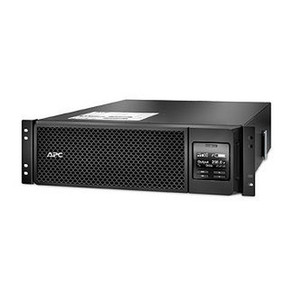
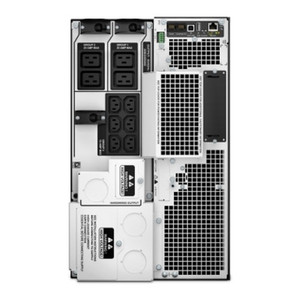
APC by Schneider Electric SRT5KXLT-IEC 5kVA Double-Conversion Online UPS
Overview
The SRT5KXLT-IEC is a 5kVA / 4250W double-conversion online UPS designed for critical loads — servers, NVRs, network infrastructure, and surveillance command centers — where even a 10ms utility glitch cannot be tolerated. Unlike standby or line-interactive designs that wait for a fault before switching, this unit runs your equipment off a continuously regenerated sine wave 100% of the time, so there is zero transfer time on utility failure. That topology matters when you're protecting a video wall controller, a multi-terabyte NVR array, or a rack of PoE switches driving 200-camera deployments.
Rated at 208V output with IEC connector configuration, the SRT5KXLT-IEC (often searched as SRT5KXLT IEC) targets enterprise and institutional environments where IEC-format PDUs and international equipment racks are the norm. The wide input voltage window — 100V to 275V — means it accepts whatever the building feeds it, from low utility sag to high-voltage international mains, without burning battery runtime on minor fluctuations.
Key Features
- Double-Conversion Online Topology: Your load runs off the inverter at all times, never directly from raw utility power. On utility failure, there is zero switchover delay — critical for NVR write operations and active recording streams that drop on even a sub-cycle interruption.
- 5000 VA / 4250 W Output Capacity: At a 0.85 power factor, this covers a full rack of network video recorders, managed PoE switches, and associated compute without running at the thermal edge. Size your connected load below 80% (3400W) for thermal headroom during extended battery runs.
- Pure Sine Wave Output, <2% THD: Total harmonic distortion under 2% means sensitive switching power supplies in servers and NVRs receive cleaner power than most utility feeds deliver. High-THD modified-sine UPS units can cause PSU failure or erratic behavior in rack-mount systems — this one won't.
- 100V–275V Input Operating Range: The wide input window absorbs sagging or elevated utility voltage without triggering battery mode, preserving runtime for actual outages. Deployments in buildings with known voltage instability — older industrial facilities, international sites — benefit directly.
- Input Frequency 40–70 Hz Acceptance: Operates on both 50 Hz and 60 Hz utility feeds without reconfiguration. Useful for global deployments or facilities using generator power that may wander in frequency under load.
- 480J Surge Energy Rating: Adequate surge suppression for standard commercial environments. Note: this is not a substitute for dedicated surge protection on sensitive signaling lines — treat it as the last line of defense on AC, not the only one.
- 3:1 Crest Factor Tolerance: Handles loads with high peak-to-RMS current ratios (switching power supplies, UPS-on-UPS stacking) without clipping or fault trips that a lower crest-factor inverter would trigger.
- Emergency Power Off (EPO): Hardwired EPO port allows integration with building emergency systems and data center kill switches — a code requirement in many commercial and government facilities. The UPS can be safely deenergized from a remote switch without touching the unit.
- Web-Based Management: Monitor load percentage, battery status, input/output voltage, and configure thresholds through a browser without deploying separate management software. Integrates into network operations center dashboards via SNMP when paired with a compatible network management card.
- Auto-Restart: After a utility restoration following a full battery discharge, the unit restores output automatically without requiring a technician on-site. For remote or unmanned installations — roof equipment rooms, remote surveillance posts — this prevents an extended outage from becoming a site visit.
- 55 dB Acoustic Output: Audible in open equipment rooms but not intrusive in enclosed server rooms with background HVAC. Factor this into deployments where the UPS lives in an occupied space or in a quiet NOC environment.
- Audible Alarm System: On-battery, overload, and fault conditions trigger distinct audible alerts, giving on-site staff immediate notice without requiring eyes on a monitoring dashboard.
Integration and Compatibility
The SRT5KXLT-IEC outputs 208V on IEC connectors, which aligns with international rack PDU standards and dual-voltage server PSUs (most enterprise servers auto-range 100–240V). Verify your connected equipment accepts 208V input — some single-voltage North American gear expects 120V and will not operate at 208V.
Web-based management supports remote monitoring and is compatible with APC's EcoStruxure IT platform for fleet-level UPS visibility across multiple sites. For Milestone, Genetec, or similar VMS deployments, configure the UPS shutdown integration via the network management interface to trigger graceful NVR shutdown before battery depletion — this protects active recording databases from dirty shutdowns that cause index corruption.
EPO integration requires a normally-open or normally-closed dry-contact connection to the building's emergency power-off circuit. Confirm the contact type with your facilities team before wiring.
Frequently Asked Questions
Q: What is the difference between the SRT5KXLT-IEC and a line-interactive UPS at this power level?
A: The SRT5KXLT-IEC uses a double-conversion online topology, meaning your load always runs off the inverter output — never directly from utility. A line-interactive UPS transfers to battery on fault, introducing a brief (4–8ms typical) switchover. For NVRs, servers, and network gear where any interruption risks data loss or camera dropout, double-conversion eliminates that risk entirely.
Q: Does the SRT5KXLT-IEC support both 50 Hz and 60 Hz utility power?
A: Yes. The input accepts 40–70 Hz, covering both 50 Hz (international) and 60 Hz (North American) utility feeds. Output frequency tracks the configured value (50 or 60 Hz) independently of input frequency variations, which is useful when utility or generator feed wanders under load.
Q: What is the EPO port and when is it required?
A: The Emergency Power Off port allows the UPS to be deenergized via a remote hardwired dry-contact switch — typically integrated into a building's emergency shutdown or fire suppression system. It is a code requirement in many data center and commercial facility designs. Consult your local electrical codes and facilities team for wiring specifications.
Q: Can I monitor the SRT5KXLT-IEC remotely without additional software?
A: The unit includes web-based management, allowing browser access to load, battery, voltage, and alarm status without installing standalone software. For SNMP-based integration into a network management system, an optional APC network management card is required — verify current compatible card models with APC's product documentation.
Q: What load should I connect to stay within safe operating limits?
A: The unit is rated at 4250W output. Best practice is to keep connected load at or below 80% of rated capacity (approximately 3400W) to maintain thermal headroom during extended battery discharge and allow for load spikes. At full 4250W, the unit operates within spec but with no thermal margin reserve.
Q: Is the output voltage suitable for standard North American servers?
A: The SRT5KXLT-IEC outputs 208V–240V, which is compatible with dual-voltage enterprise server and network equipment PSUs that auto-range 100–240V. Single-voltage 120V equipment will not operate correctly at 208V. Verify your connected equipment's input voltage rating before deployment.
The SRT5KXLT-IEC is the UPS I'd specify for any deployment where the recorder or network core absolutely cannot drop — a 4250W double-conversion unit with a 100V–275V input window and full EPO integration is a rack-room workhorse, not a consumer-grade afterthought. The sub-2% THD output is the spec I'd point to first: I've seen rack-mount server PSUs develop premature failures behind cheap modified-sine or high-THD inverters, and that failure mode is invisible until you're replacing hardware mid-deployment.
Technical Highlights:
- Double-Conversion Topology: Zero transfer time on utility fault — no 4–8ms window where NVR write buffers can corrupt or PoE switches momentarily drop camera feeds. The load is always on inverter output.
- 480J Surge Rating + 3:1 Crest Factor: Handles the high-inrush current draw of multiple server PSUs spinning up simultaneously without tripping the inverter, and absorbs transient surges before they reach connected equipment.
- Web Management + EPO: Browseraccessed status and threshold configuration without additional software, plus hardwired EPO for facilities that require code-compliant emergency shutdown integration.
Deployment Considerations:
- At 55 dB, this unit is audible in quiet environments — plan accordingly if it's going into an occupied space or an open-plan NOC. A dedicated equipment room or enclosed rack cabinet will contain the noise effectively.
- The 208V IEC output means you must verify every connected device accepts 208V input. Dual-voltage enterprise PSUs (100–240V auto-range) are fine; single-voltage 120V equipment is not — a common mistake when mixing North American and international gear in the same rack.
For a large-format surveillance deployment — 64-channel NVR plus a managed PoE core switch stack serving 80–100 cameras — the SRT5KXLT-IEC at 80% load headroom gives you roughly 3400W of protected capacity with runtime to spare for a graceful shutdown sequence before battery exhaustion.