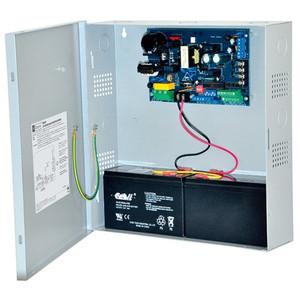
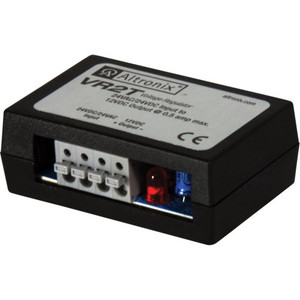
Altronix VR4T 24V to 12V Regulated Voltage Regulator
The Altronix VR4T is a compact voltage regulator engineered to convert 24VAC or 24VDC input to stable 12VDC output, delivering 1A continuous current. Designed for security deployments where 12V devices must operate on existing 24V power infrastructure, the VR4T eliminates the need for separate 12V circuits while maintaining tight voltage regulation—no external adjustment, no configuration overhead. Integrators use it to retrofit 12V cameras, access control readers, and auxiliary devices into 24V backbone systems without rewiring or additional power supplies.
Key Features
- Dual Input Acceptance: Accepts both 24VAC and 24VDC without jumper changes. Simplifies stock management and field deployment across mixed 24V infrastructure.
- Regulated 12VDC Output: ±10% stable output voltage under load transients. Protects downstream 12V devices from brownout and noise typical of long cable runs on 24V circuits.
- 1A Continuous Current: Sufficient for single mid-range camera, access control reader, or small cluster of auxiliary devices (door strike, sensor module, indicator light).
- Compact Form Factor: DIN-rail or surface-mount compatible. Fits into existing 24V power distribution enclosures without major reconfiguration.
- Passive Thermal Design: No active cooling required. Operates in ambient temperatures up to 50°C continuous without derating.
- Lifetime Limited Warranty: Covers manufacturing defects; field-replaceable at no cost under standard Altronix terms.
The VR4T addresses a recurring real-world pain point: security integrators installing 12V devices on sites with mature 24V power backbones. Rather than run new 12V circuits or stack separate supplies at each device location, a single VR4T at the hub converts the 24V rail once, eliminating voltage drop penalties and reducing bill-of-materials cost on distributed deployments. The dual-input design (24VAC or 24VDC) means the same SKU works across AC-sourced transformers and DC-sourced power supplies, cutting inventory complexity on regional warehousing.
Typical deployment scenarios include retrofitting Hikvision or Axis 12V turret cameras into existing Altronix or Pelco 24V hub infrastructure, powering HID or Salto 12V access control readers from 24VDC circuits in larger campuses, and supplying auxiliary control modules (relay logic, sensor interface) that expect stable 12V. The regulator is rated for continuous duty in HVAC closets, electrical enclosures, and outdoor weatherproof cabinets where passive cooling is acceptable and ambient temperature stays within bounds.
Integration is passive—no software, no network dependency. The VR4T works with any downstream 12V device conforming to standard power expectations (polarity protection on the device side is recommended but not required). It presents no compatibility friction with VMS platforms, NVRs, or access control management systems; the regulator sits purely in the power distribution layer. For deployments exceeding 1A per device (e.g., multiple heaters, PTZ motors, or high-brightness LED illuminators), parallel units can be used with diode isolation, or a larger Altronix regulator family (e.g., VR6 for 2A) may be more cost-effective.
Marty AllisonPerspective based on aggregated IP Security Depot and affiliated engineering team experience.
In our experience, the VR4T solves a recurring integration headache that's easy to overlook during project planning. You specify a 12V camera or reader, procurement sources it from a vendor's standard lineup, and then the site survey reveals a 24V backbone already in place. Rather than eat the cost and timeline of new circuit breakers, conduit, and transformer capacity, a single VR4T at the hub lets you run existing 24V to the device location and condition the voltage locally. We've deployed dozens of these on mixed-technology campuses where legacy Hikvision 12V PTZ domes sit alongside Axis 24V boxes on the same backbone. The dual-input design (24VAC or 24VDC) is a genuine operational win—no hunting for the right variant, no guessing whether the site is AC or DC sourced. It just works. The passive design means zero MTBF risk from cooling-fan failure, which matters on unstaffed outdoor enclosures. The only real constraint is the 1A ceiling; anything drawing more than that requires either a larger unit or parallel regulators with diode isolation—a detail worth confirming during device selection, not after installation.
Technical Highlights:
- Regulated Output Voltage (±10%): Unlike a passive dropping resistor or unregulated transformer tap, the VR4T actively maintains 12VDC within a tight band regardless of input fluctuation (24V AC/DC swing) or load variation (0–1A draw). This matters because camera imagers and reader circuits degrade performance below 11.5V; regulation guarantees consistent image quality and card-read reliability.
- 24VAC or 24VDC Input Acceptance: A single device works with both transformer-sourced AC and DC power supplies. On multi-building campuses, where some wings run AC 24V hubs and others run DC 24V, you stock one SKU instead of two, reducing field-swap complexity and inventory carrying cost.
- 1A Continuous Rating at 50°C Ambient: Specified for thermal derating in non-cooled enclosures. In a typical 40°C equipment room or pole-mounted cabinet, the unit has headroom. Confirm thermal envelope during design; if the enclosure runs hot or dense, a larger regulator or external fan may be needed.
- No External Adjustment or Configuration: DC-to-DC converters often require trim potentiometers or jumper settings for voltage selection. The VR4T ships factory-set to 12VDC nominal; no technician interaction needed. Reduces installation variance and field errors.
- Passive Thermal Design: No cooling fan means lower noise, no mechanical MTBF, and minimal maintenance burden on unattended sites. The trade-off is lower total continuous power in high-ambient conditions—plan accordingly.
Deployment Considerations:
- The 1A ceiling includes input ripple and transient margin. A 12V device drawing 0.95A sustained is at the threshold; confirm device nameplate specs before specifying. Stacks of LED indicators, heaters, or motor drives can exceed this budget—use a larger regulator or separate power conditioning in those cases.
- 24VAC input assumes standard 60 Hz transformer output with normal AC noise envelope. Highly distorted or rectified 24VAC from poor-quality switching supplies may cause instability; confirm source quality during site commissioning.
- Polarity protection on the output (user-side diode) is recommended but not built-in. A reversed-polarity 12V device can destroy itself before the regulator detects the fault. Work with the device manufacturer on reverse-polarity limits and add external diode protection if needed.
- The VR4T is not a surge suppressor or transient clamp. Upstream 24V spikes (e.g., from motor coil kickback, contactor arcing) can couple through to the 12V output. Use separate surge suppression or TVS diode banks on high-inductive 24V circuits before the regulator input.
- Mounting on or near large 24V relay coils or switching power supplies can cause conducted noise coupling. Physically separate the regulator from high-current switching nodes, and use shielded cable for low-voltage output runs if noise-sensitive sensors are downstream.
The VR4T is the right choice for integrators retrofitting 12V security devices into existing 24V power ecosystems, particularly on multi-building or multi-vendor campuses where purchasing a separate 12V backbone is cost-prohibitive. The dual-input acceptance and passive thermal design make it a low-drama field solution. For high-power 12V clusters or thermally constrained enclosures, explore Altronix's larger regulator family or consider a dedicated 12V hub design. See the Altronix catalog for the full range of power conditioning and distribution products.