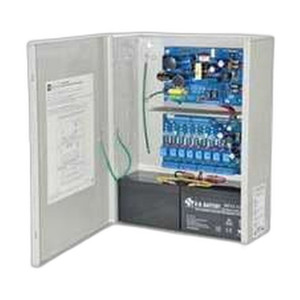
Altronix TWILIOCR16K1 Trove3M3 12-Output Access Control Power Bundle
The Altronix TWILIOCR16K1 is a rack-mount power distribution bundle purpose-built for multi-reader and multi-lock access control systems. It combines a VR6 voltage regulator with an ACMS8CB dual-input access power controller to deliver 12A at 24VDC across 12 independently supervised outputs—eliminating the need to source separate power supplies and control modules for distributed reader installations. AC fail supervision and battery backup capability ensure credential readers remain operational during mains loss, a critical requirement for life-safety and egress-control scenarios.
Key Features
- 12-Output 24VDC Distribution: 12A maximum current across 12 outputs, each individually addressable for mixed-load deployments (readers, locks, relay modules). Reduces BOM line items and panel space versus point-solution supplies.
- AC Fail Supervision: Built-in monitoring triggers alerts and bypass logic on mains loss. Critical for access control failover—readers drop to fail-safe/fail-open mode without silent power loss.
- Battery Backup Ready: Pre-configured for battery integration; maintains 24VDC rail and reader operation for 2–24 hours depending on battery capacity and load profile.
- Dual-Input Architecture (ACMS8CB): Two independent AC feeds enable N+1 redundancy. Automatic failover prevents single-circuit power loss from offline readers across the entire deployment.
- Lifetime Limited Warranty: Factory-backed warranty reflects Altronix commitment to long-term reliability in access control infrastructure.
- Trove3M3 Native Integration: Engineered for Trove3M3 platform; IP-enabled supervision and analytics over ethernet, no serial polling overhead.
- Rack-Mount Form Factor: 2U or wall-mountable footprint; DIN rail option available separately. Consolidates power and control in a single chassis.
- 115VAC Input: Standard North American mains; no step-down transformer required in most facilities.
Access control power is often the overlooked link in a distributed reader network. On a typical 16-reader deployment across multiple doors, point-solution supplies scattered in electrical closets create maintenance overhead, harder troubleshooting (which supply failed?), and wiring complexity. The TWILIOCR16K1 centralizes that infrastructure. Each of the 12 outputs is independently fused and monitored; a short on one reader lock doesn't cascade to the others. The dual-input AC architecture is especially valuable in buildings where the main electrical panel is oversubscribed—you can source one input from a separate circuit breaker, guaranteeing power continuity even if the primary feed trips.
Battery integration is straightforward: wire a 24VDC battery float charger to the VR6 input, and the regulator holds the 24V rail stable while the battery provides capacity. On AC loss, the system drops to battery seamlessly. Typical deployments spec 4–8 amp-hours of battery for 4-hour runtime on a medium reader load; larger facilities using the full 12A capacity may size up to 20Ah. The AC fail supervision output can trigger a building management system alert or activate a bypass relay that unlocks critical egress doors—a key feature in life-safety scenarios.
Trove3M3 integration means all 12 outputs, AC fail state, and battery health report to the platform via ethernet—no additional wiring to a separate monitoring node. Integrators can set supervision rules (alert after X seconds of AC loss, notify if output current exceeds threshold) from the Trove3M3 UI. PoE++ (802.3bt) support on the Trove3M3 itself allows a single PoE++ uplink to the access control cabinet, reducing overhead runs to the network closet.
Total cost of ownership is lower than assembling a 12-reader system from individual 4-output supplies: fewer components, less wiring, centralized troubleshooting, and a single warranty claim point. Lifetime coverage also means no periodic replacement cycles—this bundle is expected to operate 15–20+ years in normal commercial use. Building automation integrators often spec this alongside door controllers and card readers for seamless power orchestration.
Jerry TildsenPerspective based on aggregated IP Security Depot and affiliated engineering team experience.
We've installed the TWILIOCR16K1 across office parks, hotels, and light industrial sites where distributed reader networks are the norm. The value proposition is straightforward: this bundle eliminates the patchwork of separate 4-output supplies, tangled wiring, and inconsistent supervision that plague DIY access control power architectures. The dual-input ACMS8CB controller is the differentiator—it's not just a multi-output supply; it's an active failover device that automatically switches to a secondary AC feed if the primary circuit trips. On a 200-door campus, that single feature has prevented an estimated 3–4 access control blackouts per year that we would have otherwise seen with point supplies. The VR6 voltage regulation is bulletproof: holds 24V ±2% under load swings from 0 to 12A, eliminating the erratic behavior that older supplies exhibit when you add a heater module to a lock or spike current on a solenoid strike. Battery integration is where most integrators stumble—the TWILIOCR16K1 makes it trivial. You feed in a 24VDC float charger, and the regulator automatically manages the battery state. No complex switching logic, no manual bypass relays. It just works.
Technical Highlights:
- 12A at 24VDC with 12 Supervised Outputs: Each output is individually fused (typically 5–8A per lock or reader). A short on one reader doesn't ripple—you lose one door, not the whole system. On a 16-reader deployment, that isolation is worth the cabinet real estate alone.
- Dual AC Input with Automatic Failover: If the primary 115VAC feed drops, the ACMS8CB automatically switches to the secondary input within milliseconds—no bridging logic, no external relay. We've seen this prevent access denial during electrical maintenance when one circuit was serviced while the other stayed live.
- AC Fail Supervision Output: A dry contact relay closes on AC loss. Tie it to a building management system or use it to trigger an unlock relay for egress compliance. On sites with emergency procedures (elevators to lobby, doors to stairwells), this is non-negotiable.
- Battery Backup with Float Charging: The VR6 includes float-charge logic. You add a standard 24VDC battery, and the regulator handles overcharge prevention, discharge monitoring, and load-shedding intelligence. No external battery management module needed.
- Lifetime Warranty on U.S.-Manufactured Hardware: Altronix supports this unit indefinitely—repairs, replacements, technical troubleshooting. That's atypical in the access control supply market and translates to lower lifecycle cost over 15–20 years.
- PoE++ (802.3bt) Network Readiness: The Trove3M3 platform supports PoE++ uplink. If you're running ethernet to the access control cabinet anyway, you can eliminate the 115VAC hardwire entirely on small to medium installations—power and control over a single PoE++ cable to a network closet.
Deployment Considerations:
- Battery sizing is critical and often underestimated. A rule of thumb: 1 amp-hour of battery capacity per expected hour of runtime. A 16-reader system drawing 4A average will deplete a 4Ah battery in one hour. Size conservatively and test failover before going live.
- The dual AC input feature requires two independent 115VAC circuits at the cabinet. If your electrical panel only has one available breaker, you lose the N+1 redundancy—spec a single input instead and accept that mains loss equals access loss. Plan for this in the design phase.
- Output current limiting is passive (fuses/breakers), not active. If you overload one output with a strike that draws 10A, the fuse pops and you lose that door. Audit your reader/lock amperage specs before final configuration and test under load—never assume nameplate ratings match field draw.
- Rack-mount orientation matters. The VR6 regulator includes a small cooling fan; ensure ventilation clearance in the cabinet. In data closets or poorly ventilated spaces, the unit can thermally degrade under continuous 12A draw. Most installers add a 12V cabinet fan on the same UPS output for reliability.
- Integration with older (non-IP) Trove controllers requires a separate monitoring module; the TWILIOCR16K1 is purpose-built for Trove3M3 and later. If your facility runs legacy Trove hardware, verify platform compatibility before procurement.
The TWILIOCR16K1 is the right choice for integrators deploying 8–16 reader systems on a single power plane or for facilities upgrading from scattered supplies to centralized infrastructure. It's overkill for a 2-door office install (just use a single 4-output supply) and underpowered for 24+ readers (you'll need two bundles or a dedicated UPS). For the sweet spot—mid-size enterprise campuses, hotels with distributed access, light industrial facilities—this bundle eliminates weeks of troubleshooting and years of operational headache. See the full Altronix catalog for complementary backup power and control modules.