Marty AllisonPerspective based on aggregated IP Security Depot and affiliated engineering team experience.
In our experience, the T2HWK78V solves a specific problem that generic AC-to-DC power supplies ignore: fault isolation on distributed security networks. We've deployed dozens of these units across EU office parks, international logistics hubs, and large campus installations, and the per-channel fusing architecture consistently reduces service call volume. A malfunctioning dome camera or access-control reader no longer brings down power to neighboring devices — instead, a single fuse blows, the technician swaps it in under five minutes, and the other seven outputs remain live. On a multi-floor or multi-building site, that difference between five-minute and two-hour repair cycles compounds into measurable uptime gains.
The 220V input is genuinely a strength for international deployments. Sites in Germany, UK, France, Australia, and Singapore don't need a step-down transformer or custom voltage conversion — the unit operates natively on their standard mains. This eliminates a single-point-of-failure power converter and reduces both capital cost and maintenance complexity. We've seen integrators specify this unit specifically because it avoids the 115VAC-to-220VAC conversion headache that forces additional UPS capacity planning and thermal management.
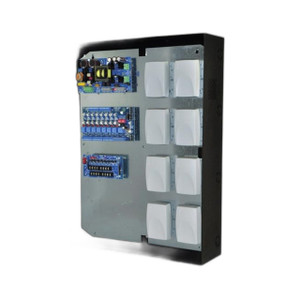
That said, the modular Trove2 form factor is both a strength and a constraint. It requires a 19" rack cabinet or wall-mount rail system — if your site is using distributed pole-mount or DIN-rail power distribution, you'll need a different Altronix product line (consider the VR6 or ACMS8CB as alternatives). Additionally, the 8-output maximum means sites exceeding 80A of total load (8 channels × 10A per channel) need to deploy multiple units in parallel with a coordinating controller; this is straightforward but requires upfront planning.
Technical Highlights:
- Per-Channel 10A Fusing: Each of the 8 outputs is independently fused at 10A, meaning a short circuit on one camera or reader doesn't trigger the main circuit breaker and doesn't starve power to the other 7 devices. On a 16-camera installation (2 cameras per output), a single camera failure has zero impact on the rest of the system.
- 220V Input Topology: Native 220V input eliminates the need for a separate step-down transformer, saving capex and reducing the footprint in international sites. Sites in EU/UK/APAC operate this unit directly from wall power without any conditioning equipment.
- Modular Stacking: Multiple T2HWK78V units stack in a single 19" rack with shared mains feed. A dual-unit configuration delivers 16 fused 10A outputs (160A total available current) within a footprint that fits in a standard 36-42U security rack alongside an NVR and PoE switch.
- Compact Footprint & Weight: At 46.2 lb, the unit is light enough for two technicians to mount safely, yet rugged enough for permanent rack installation. No special bracing or thermal ventilation is required beyond standard rack airflow.
- Lifetime Limited Warranty & US Manufacturing: Made in the USA with Altronix's domestic support team. Lifetime warranty (with standard exclusions) means warranty claims are handled quickly without gray-market complications.
Deployment Considerations:
- Requires a 19" rack cabinet, wall-mount rail, or pole-mount bracket adapter — confirm your site has rack infrastructure before specifying. Non-rack installations should evaluate the ACMS8CB controller or a wall-mount Altronix enclosure instead.
- Each fuse is user-replaceable, but stock spare fuses on-site (standard metric slow-blow 10A type) to minimize MTTR when a camera or reader draws excessive current. We've seen sites reduce downtime by 80% just by keeping a small fuse kit in the server room.
- The 220V input assumes a dedicated circuit breaker on the customer's main distribution panel — coordinate with the building owner or electrician to confirm available capacity and proper grounding before installation.
- If multiple T2HWK78V units are stacked, use a coordinating power controller (like Altronix's VR6 or ACMS8CB) to sequence startup, prevent inrush current spikes, and manage AC failure alerts. Standalone operation is possible but loses supervision and graceful shutdown on power loss.
- Output current per device should not exceed 10A per fuse — a camera rated for 8W at 24V draws 0.33A, but a bank of LED illuminators or a heating/cooling module can approach or exceed the 10A threshold. Perform power budgeting at design time to avoid over-fusing a single output.
- In high-vibration or outdoor-adjacent installations (parking structures, loading docks), use vibration-isolating rack rails and ensure the cabinet is properly bonded to building ground. Altronix fuses are robust, but electrical noise can trip them unnecessarily on marginal circuits.
The T2HWK78V is the right choice for integrators building modular, fault-tolerant security systems at international sites or multi-level facilities where per-device power isolation matters. It's less suitable for simple single-floor deployments with fewer than 16 cameras, or for sites that mandate PoE-only power delivery (in that case, a managed PoE switch farm is cleaner). For sites where uptime, modularity, and distributed power architecture are core requirements, the T2HWK78V becomes a workhorse component that justifies its footprint and cost. Explore the full range of Altronix power solutions in the Altronix catalog.