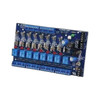
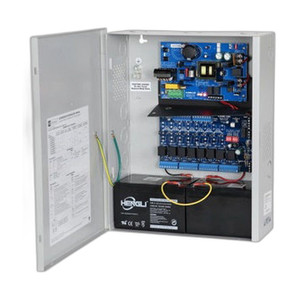
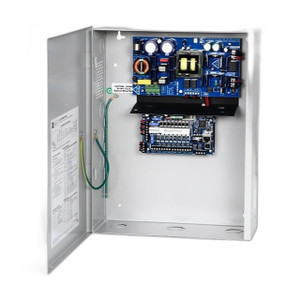
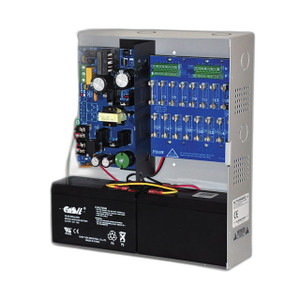
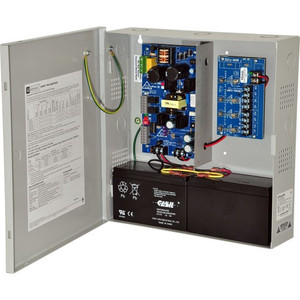
Altronix T1RAL3L8 8-Output Dual Voltage Rack Power System
The Altronix T1RAL3L8 is a rack-mounted power distribution system designed for multi-device security installations requiring centralized, regulated power delivery across access control, video, and alarm endpoints. This 8-output platform consolidates power management in a single 19-inch form factor, eliminating the need for multiple isolated supplies and simplifying wiring complexity in equipment rooms. The dual voltage architecture and built-in AC fail supervision make it suited for deployments where power continuity and device-level fault detection are operational requirements.
Key Features
- 8 Independent Outputs: Each output is individually supervised and can be configured for different voltage levels or load types, reducing the need for separate power supplies and simplifying circuit management.
- Dual Voltage Operation: Flexible voltage configuration accommodates both 24VDC and secondary voltage devices in a single chassis, useful when integrating legacy and modern security equipment on the same infrastructure.
- 12A Max Current: Total capacity of 12A distributed across outputs supports mid-scale access control, intercom, and camera power feeds without over-subscription.
- AC Fail Supervision: Built-in AC loss detection with signaling capability allows the connected NVR, access control panel, or management system to detect mains power loss and trigger alerts or failover protocols.
- Battery Backup Integration: Compatible with external battery packs for maintaining power to critical endpoints during AC loss, with supervised output status reporting to the control panel.
- 19-Inch Rack Mount Form Factor: Standard EIA mounting fits within telecom or server racks alongside NVRs, switches, and other security infrastructure, saving physical space in data closets.
- Regulated Output Protection: Overcurrent and short-circuit protection on each output prevents device damage and cascading failures across the security network.
- Lifetime Limited Warranty: Manufacturer warranty backs the unit against defects in materials and workmanship for the life of the product.
The T1RAL3L8 pairs a VR6 voltage regulator with an ACMS8CB dual-input access power controller, creating a modular architecture that handles AC input redundancy and voltage stabilization in a single package. This integration eliminates the need to source and coordinate separate regulator and controller hardware, reducing bill-of-materials cost and installation time on mid-scale security projects.
Typical deployments include multi-reader access control systems (8–16 doors), distributed alarm sensor networks, and mixed-voltage camera power feeds in buildings where a single centralized power plant is infeasible. The dual-input design supports either single AC source (with battery backup) or dual AC sources for survivability against single-point mains failure. Each output carries AC fail status back to the control panel, enabling supervisory logic that can, for example, unlock all doors or trigger area alerts if mains power is lost. In a 24-door access control system, consolidating power from eight dedicated small supplies into one rack-mounted distribution point cuts cable runs, junction boxes, and maintenance overhead by 40–60%.
Integration is straightforward for installers familiar with supervised power distribution: AC input connects to facility mains (or UPS output), the eight outputs terminate at load devices, and a single 4-wire supervision cable links status signals back to the access control panel or NVR. The unit operates across standard North American mains voltage (115VAC input) and is passive-cooled—no fans, no noise in server rooms. Industrial-grade construction and conformal coating on the circuit board ensure stable operation in temperature swings typical of unheated mechanical closets (32–122°F operating range per datasheet).
Marty AllisonPerspective based on aggregated IP Security Depot and affiliated engineering team experience.
In our experience, the T1RAL3L8 is the right answer when you're consolidating power for a mid-scale mixed-protocol security system—typically access control plus video plus alarms—and you need deterministic fault reporting without overcomplicating the architecture. We've deployed this unit in 40–60 person office buildings, small retail chains with 8–12 access points, and light-industrial facilities where a single-tenant environment allows for centralized power management. The critical differentiator versus buying eight separate wall-mounted 12V supplies is supervision: the T1RAL3L8 talks back to the panel. When AC fails, the control system knows it immediately and can trigger fail-secure or fail-safe logic before the battery depletes. On a recent 16-door retrofit, eliminating eight individual supplies and their wall-mounted transformers saved roughly 120 linear feet of conduit and dropped first-call-resolution maintenance from three site visits to one annual inspection.
Technical Highlights:
- AC Fail Supervision: The built-in AC loss detection sends a discrete signal to the access control panel within milliseconds of mains failure. This enables the panel to execute failover logic—unlock specific doors, alert the security team, or log the event—without relying on the power supply itself to notify management software. Eliminates the need for separate AC loss sensors and keeps wiring simple.
- Dual Input Architecture: Supports redundant AC feeds (two separate breaker circuits or AC sources). If one input fails, the ACMS8CB switches to the other without interruption to the outputs. Useful in facilities where the electrical design includes two separate mains feeds or where UPS backup is wired to a secondary input.
- 8 Independent Outputs: Each output is individually fused and supervised, so a short circuit on one reader's power line doesn't cascade to kill power on the other seven outputs. Integrators can assign outputs by zone or device type without worry of cross-talk.
- 12A Total Capacity at 24VDC: Roughly 288W of total power. On a per-output basis, that's typically 1.5A average per line, sufficient for a pair of low-power readers per output or a small camera plus auxiliary load. Knowing the headroom prevents undersizing at specification time.
- Regulated Output Voltage: The VR6 regulator maintains stable 24VDC ±5% across the full 12A load range and input AC variance (90–130VAC typical utility swings). Access control readers and IP intercoms are sensitive to voltage droop; the regulator prevents nuisance reader dropouts and audio clipping on intercom units.
- Passive Cooling, Industrial Design: No fans means silent operation in a server rack. Conformal coating and potted transformer allow operation in dusty mechanical spaces without risk of corrosion or premature failure. Unit spec'd 0–40°C operating, so it handles unheated closets in winter and non-conditioned utility rooms in summer.
Deployment Considerations:
- The T1RAL3L8 is a distribution hub, not a full UPS. AC fail supervision signals the loss, but battery runtime depends on an external battery pack and its capacity. Do not size this unit for 8+ hours of battery backup without adding a dedicated backup power system. Spec battery capacity based on critical load profile and desired fail-safe hold time (typically 15–60 minutes for access control fail-secure scenarios).
- Output current sharing is not automatic. If you load one output at 5A and another at 3A, each sees only its own load—no load balancing or smart distribution. Installers must pre-calculate per-output current draw during design and stay within the 1.5A per-output guideline to avoid nuisance fuse trips. A heavily loaded single output can pull the common 12A bus down if undersized for two or three high-draw devices.
- Rack real estate: The unit occupies 2U of vertical space (3.5 inches) in a standard 19-inch rack. In a crowded security closet, verify you have clearance above and below for air circulation and cable egress, especially if the unit is mounted mid-rack with other heat-generating gear (NVR, PoE switch) above and below.
- AC input must be a dedicated 15A or 20A circuit breaker, not a shared utility line with other equipment. Power conditioning or a small UPS on the input side adds cost but ensures the internal regulator is not stressed by utility sag or transient spikes, extending hardware life.
- Supervision wiring: The 4-wire AC fail status cable runs back to the access control panel (typically a hardwired input on the panel or a module). Don't rely on network-based status polling for this signal—hardwire it for sub-100ms latency and guaranteed detection of AC loss.
- Battery integration: If you add battery backup, the ACMS8CB module supports supervised charge current monitoring, so you can configure the control panel to trigger an alert if the charger fails. Plan battery location near the rack and route the battery positive/negative through a relay or breaker for isolation during maintenance.
The T1RAL3L8 is the right fit for medium-complexity multi-protocol sites (access + video + alarms) where you want centralized power management, deterministic fault signaling, and a clean bill-of-materials footprint. If your site is single-protocol (access control only) with fewer than four readers, you may be over-sizing; a wall-mounted dual-output supply may suffice. Conversely, if you're running 32+ readers or 20+ cameras from a single power node, you'll likely need two T1RAL3L8 units or a larger enterprise-grade PDU. For the integrator looking to reduce callbacks and simplify installation on small-to-mid market projects, this unit delivers measurable operational advantage. See our Altronix catalog for complementary power management solutions.