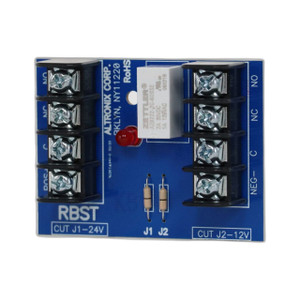
Altronix RBR1224 DPDT Relay Module
The Altronix RBR1224 is a dual-pole, dual-throw (DPDT) relay module engineered for 12/24VDC control circuits that need to switch 120VAC or 28VDC loads independently. It's a control-layer component — not a power supply — designed to handle relay logic and load switching in access control, alarm, and distributed security infrastructure. Two independent relay outputs mean you can drive a door strike on one circuit and a magnetic lock on another from a single module, or toggle between normally open and normally closed states for logic-driven applications.
Key Features
- Dual DPDT Relay Configuration: Two independent outputs, each capable of switching between normally open and normally closed states. Useful when you need to control multiple locks or switches from a single control input without daisy-chaining relays.
- Selectable Input Voltage (12VDC or 24VDC): Configure the module for either supply rail without swapping hardware. Reduces inventory complexity if your facility runs mixed 12V and 24V control circuits.
- Dual Output Options (120VAC or 28VDC): Match the module to your installed load voltages. 120VAC output supports standard solenoid strikes; 28VDC output serves legacy and modern magnetic locks without intermediate conversion.
- 120VAC Output (0.5A Maximum): Sufficient for single-load 120VAC switches — a typical door strike. Exceeding 0.5A will trip the relay; verify strike current draw before deployment to avoid nuisance failures.
- 28VDC Output (2A Maximum): Supports multiple 24VDC magnetic locks or a single high-current lock (up to 2A). Higher current capacity on the 28VDC side reflects typical security lock power profiles.
- Toggle or Ratchet Relay Operation: Choose latching (ratchet) behavior for sustained lock engagement without continuous control signal, or toggle mode for synchronized momentary switching. Ratchet mode is power-efficient for fail-secure electromagnetic locks.
Integration & Compatibility
The RBR1224 integrates into any 12/24VDC control system — access control panels, alarm hubs, automation controllers — that provides a dry contact or low-voltage signal to trigger the relay. No ONVIF, IP, or network involvement; this is pure relay logic. It pairs well with door controllers, fire alarm panels, and custom automation sequences that need multi-load switching capability. Mounting is panel-mount or bracket-install; confirm enclosure space before ordering.
When to Choose a Different Model
If you need more than two independent outputs, consider a multi-relay expansion module from the Altronix line — the RBR1224 is a two-output device. If your control signal is a higher voltage (480VAC or industrial three-phase), this 24VDC module is not suitable; consult the Altronix industrial relay family. For networked or IP-based relay control, this is a hardwired logic device — you'll need an IP relay gateway or networked control module instead.
Frequently Asked Questions
Q: Can the RBR1224 drive both a 120VAC strike and a 28VDC lock simultaneously?
A: No. The module is configured at commissioning for either 120VAC output or 28VDC output, not both. If you need both voltage outputs in the same enclosure, you'll need two RBR1224 modules or a different multi-voltage relay module.
Q: What is the minimum control signal voltage required to trigger the RBR1224?
A: The source evidence specifies selectable 12VDC or 24VDC input operation, but does not detail minimum trigger voltage or coil sensitivity. Consult the full datasheet or contact the manufacturer for minimum signal requirements and pull-in voltage specs.
Q: Does the RBR1224 have surge or transient protection?
A: The source specification does not mention built-in protection against voltage spikes or inductive kickback. When switching inductive loads (solenoids, magnetic locks), install a protective diode or TVS across the load to protect the relay contacts; this is standard practice in access control.
Q: What is the warranty on the Altronix RBR1224?
A: Altronix provides a Lifetime Limited Warranty on the RBR1224. Terms and exclusions apply; contact Altronix or your specialty distributor for full warranty details.
Q: Can the RBR1224 be controlled by a 24V relay output from an access control panel?
A: Yes. If the panel provides a 24VDC dry contact or relay output, it can trigger the RBR1224 input. Verify polarity and current rating match the panel's output spec and the RBR1224 input rating.
Q: Is the RBR1224 suitable for outdoor or wet-environment installation?
A: The source specification does not detail an IP enclosure rating. This is a relay module and requires panel mounting inside an enclosure. If deployed outdoors, house it in an IP66 or higher NEMA/IP-rated cabinet; the RBR1224 itself is not rated for direct weather exposure.
Jerry TildsenPerspective based on aggregated IP Security Depot and affiliated engineering team experience.
The Altronix RBR1224 is a straightforward relay workhorse — it fills a specific need in access control and alarm circuits where you need two independent switching paths from a single 24VDC control signal. The dual DPDT configuration eliminates daisy-chaining or duplicate relay modules when logic demands it, and the toggle/ratchet modes give you operational flexibility without adding complexity to the control layer.
Technical Highlights:
- Independent 120VAC (0.5A) and 28VDC (2A) Outputs: The RBR1224 enforces a single output voltage per installation, not both simultaneously. The 2A rating on 28VDC is designed for typical magnetic lock current draw (most 24VDC locks pull 0.5–1.5A); the lower 0.5A cap on 120VAC reflects solenoid strike profiles. Verify your load current before commissioning to prevent relay chatter or nuisance dropout.
- Selectable 12VDC or 24VDC Input: Many older facilities run 12V alarm circuits; newer access systems default to 24V. This flexibility reduces the need to stock separate relay modules — configure it once at install, wire it in, and move on. Switching between voltages requires opening the module, so plan your voltage scheme before final deployment.
- Toggle vs. Ratchet Mode: Ratchet (latching) mode holds the relay open or closed after the trigger signal drops, cutting standby power draw — ideal for battery-backed fail-secure locks. Toggle mode requires a continuous or timed signal, which is useful for momentary push-button or time-of-day logic. Confirm your control system output can provide the signal type the mode requires.
Deployment Considerations:
- This is a hardwired relay — it has no ONVIF, IP, or networked control. If your system is IP-based and you need to switch 24VDC loads remotely, integrate this module behind an IP relay gateway or networked access controller. The RBR1224 works as a slave to any 12/24VDC logic layer.
- Inductive loads (solenoid strikes, electromagnetic locks) will generate transient spikes when the coil de-energizes. The spec does not detail clamping or clamp diodes on the output terminals. Install external flyback diodes or transient suppressors across any solenoid or coil — this is non-negotiable to protect relay contacts from arc damage and premature failure.
- The module is designed for panel mounting or bracket install inside an enclosure. Do not expose it to moisture, dust, or wide temperature swings without a rated cabinet. If you're mounting this in a remote equipment room with poor temperature control, verify the operating range against your ambient temps (the spec does not list them).
Best fit: multi-load access control systems where two independent 24VDC switching circuits are needed — for instance, driving a fail-secure strike and a fail-safe bolt from the same access panel, or switching between two locks based on time-of-day or sensor input. If your system is monolithic IP control or you need more than two relay outputs, look at networked relay modules or a larger Altronix power/relay distribution product instead.