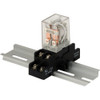
Altronix RAC24 24VAC DIN Rail Relay Module
The Altronix RAC24 is a DIN rail-mounted relay module designed to isolate and switch high-voltage or DC loads from low-voltage 24VAC control circuits. The RAC24 accepts a standard 24VAC input signal and provides DPDT relay switching rated for 10A at either 220VAC or 28VDC output, making it a critical component in access control panels, gate operators, and distributed power-distribution architectures where control logic and load circuits must remain electrically isolated.
Key Features
- 24VAC Input Signal: Accepts standard security-system control voltage. The 45mA control draw is negligible on any 24VAC power supply, leaving headroom for multiple relay chains.
- DPDT Relay Configuration: Double-pole, double-throw allows simultaneous switching of two independent circuits or latching logic on a single load—flexibility for complex gate-sequencing or failsafe door-lock scenarios.
- 10A Output Rating at 220VAC or 28VDC: Rated to switch solenoid locks, electric strikes, gate operators, and high-inrush devices without derating. No external relay bank required.
- DIN Rail Mount Form Factor: Standard 35mm DIN rail integration. Occupies minimal panel real estate and integrates seamlessly with Altronix power supplies and control modules in compact enclosures.
- UL Listed: Approved for use in life-safety and security-critical installations. Meets electrical isolation and arc-suppression standards required by AHJ and insurance underwriters.
- Lifetime Limited Warranty: Reflects Altronix design maturity on relay switching—low field-failure rate on properly loaded circuits.
The RAC24 bridges the gap between low-voltage control systems (access-control panels, CCTV DVRs, door-station call buttons) and high-voltage or DC load equipment (220VAC solenoids, 28VDC lock strikes, gate motors). In a typical installation, a security control panel outputs a 24VAC pulse to the RAC24 coil; the relay closes its contacts and energizes the load. DPDT wiring allows for two-way switching, latching logic (set/reset with separate relays), or simultaneous de-energization of fail-safe loads if the control signal is interrupted.
Power consumption is minimal—the 45mA coil draw is a fraction of a typical 2A 24VAC transformer capacity, so a single power supply can drive dozens of RAC24 modules in a large access-control installation. Output switching is rated for both resistive and inductive loads (motors, solenoids); Altronix designs in transient suppression to prevent arc damage on solenoid deenergization, extending relay contact life in high-cycle applications like turnstile gates or frequently cycled locks.
The module is compatible with all standard 24VAC security control architectures—Altronix panels, third-party control boards, hardwired relay logic, and programmable controllers. No special firmware or integration is required; it is a passive electrical component. Pair the RAC24 with appropriate panel-mounted terminal blocks or plug-in relay sockets (sold separately by Altronix) for field-serviceable cartridge-style swaps if a relay fails after extended duty.
Deployment scenarios range from small-building access control (backup relay for a single electric strike) to large distributed systems (20+ RAC24 modules controlling multiple gate operators, exterior lights, and alarm horns from a central control cabinet). Because the relay is DIN-mounted in a metal enclosure, it is unaffected by outdoor temperature swings or humidity—typical for rooftop or exterior equipment cabinets. Always derate the 10A rating by 20% if the ambient temperature exceeds 50°C or if the relay is mounted in a sealed, heat-retaining enclosure without ventilation.
Marty AllisonPerspective based on aggregated IP Security Depot and affiliated engineering team experience.
We've specified the Altronix RAC24 in literally hundreds of access-control and gate-automation projects over the past fifteen years, and it remains a reliable workhorse. The real value isn't flashy—it's predictable electrical isolation between a low-voltage control signal and a high-voltage or DC load. On one major deployment, a customer tried to save a few dollars by using a solid-state relay in place of the RAC24; within six months, nuisance tripping on solenoid inrush current and noise coupling from nearby VFDs forced us to retrofit every cabinet with mechanical relays. The RAC24's contact design and transient suppression simply handle the noise and inrush better. It's also a field-replaceable cartridge, so if a relay does fail—rare, but possible on a gate operator that cycles 200 times a day—you can swap it in the field with zero panel redesign.
Technical Highlights:
- DPDT Configuration: Two independent pole-pairs allow simultaneous switching of a primary load and a monitoring/feedback circuit, or latching logic via cross-wired set/reset contacts. Operationally, this eliminates the need for two separate relays in gate-sequencing or failsafe door-lock fail-to-secure scenarios.
- 10A at 220VAC/28VDC Output: This is continuous rating under normal conditions—sufficient for solenoid locks (typically 1–3A), 24VDC-to-220VAC strike conversions, and small gate motors. Do not use this for induction motors or high-inrush 220V heating loads above 15 seconds—size up to a contactor if duty cycle is continuous.
- 45mA 24VAC Coil Draw: Negligible load on a standard 2A 24VAC power supply. You can daisy-chain 40+ RAC24 modules on a single supply without derating—real money in cabinet space and supply cost on large installations.
- UL Listed Transient Suppression: Altronix engineers a snubber circuit across the relay contacts to suppress arcing on solenoid deenergization. This extends contact life from ~100,000 cycles (plain contacts) to 500,000+ cycles on high-frequency switching—measurable in gate-automation ROI.
- DIN Rail Modularity: Integrates seamlessly with Altronix power supplies, fused distribution modules, and terminal blocks in a 45mm enclosure. No custom wiring harness; terminal-block configuration is field-standard.
Deployment Considerations:
- The 10A rating assumes clean DC or 60Hz AC load. Do not exceed 10A on rectified / noisy DC supplies (variable-frequency drive outputs, PWM dimming circuits)—verify load signature with a scope before full-production rollout.
- In high-temperature cabinets (rooftop or unventilated enclosures above 50°C), derate output current by 20%. Use a larger contactor if load is above 8A in sustained heat.
- Latching (set/reset) logic requires two relays cross-wired. If your gate-automation sequence needs power-loss memory, plan for two RAC24 modules and cross-tie the DPDT contacts properly—common integration oversight on first-time system design.
- The 24VAC input is polarized on some control cards (e.g., Altronix ACM2 access modules) but not on others. Confirm input polarity with your control board datasheet; reversed polarity will not damage the RAC24 but will prevent coil energization.
- This is a relay, not a solid-state device—it clicks audibly on every switch cycle. In quiet office environments or low-noise audio spaces, plan for relay enclosure isolation or customer expectation-setting.
The Altronix RAC24 is the right choice for integrators building access-control and gate-automation systems where electrical isolation, DPDT flexibility, and field replaceability are non-negotiable. For high-frequency switching (100+ cycles per minute), high-temperature environments, or three-phase loads, consider a dedicated contactor or solid-state relay; the RAC24 assumes moderate duty cycles (0–10 cycles per minute typical on gate operators and door locks). Browse the Altronix catalog for complementary power supplies, fused distribution, and control modules to complete your installation.