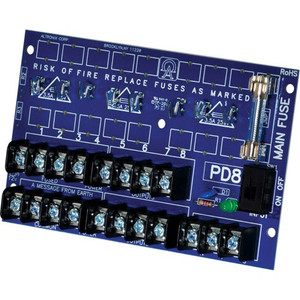
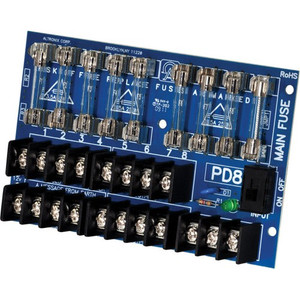
Altronix PDS8CB 8-Output PoE Distribution Module
The Altronix PDS8CB is a voltage regulator designed to accept PoE input and distribute regulated power to eight independent outputs, making it a practical solution for multi-device deployments where a single PoE source needs to feed several endpoints across access control, surveillance, and emergency communication networks.
Overview
Field deployments often require power distribution from a single upstream PoE source to multiple downstream devices—door readers, IP speakers, status lights, or local power injectors. The PDS8CB eliminates the need for separate power supplies by stepping down and regulating PoE input across eight isolated outputs. This reduces panel clutter and cable count, particularly useful in space-constrained electrical enclosures. Each of the eight outputs operates independently, so a fault or overcurrent on one output won't affect the others.
Regulation is critical: unregulated power distribution can cause device instability, especially in access control systems or emergency signage where voltage sag or ripple introduces timing errors or dimming. The PDS8CB delivers stable, regulated voltage—meaning devices operate reliably even if the PoE source sits at the far end of a long cable run where line loss would normally cause sagging.
Key Features
- 8 Independent Outputs from Single PoE Input: Eliminates the need for multiple power supplies or PoE injectors in a single installation location, reducing bill-of-materials cost and physical footprint.
- PoE Input Acceptance: Draws power from standard 802.3af or 802.3at PoE sources—switch port, injector, or mid-span—without requiring dedicated 24VDC or 12VDC supplies.
- Regulated Voltage Output: Maintains stable, clean voltage to downstream devices even under load variation or cable distance effects, preventing device resets or performance degradation in access control or communication systems.
- Fire Alarm Disconnect Capability: Supports code-mandated power shutdown for emergency systems—critical when installations must comply with NFPA 101 or local fire codes that require supervised disconnect of non-life-safety loads during alarm conditions.
- Compact Modular Architecture: DIN-rail or enclosure-mount form factor preserves valuable cabinet space in distributed installations—each module occupies minimal footprint while serving eight ports.
- Isolated Output Distribution: Each of the eight outputs is electrically isolated, preventing cascading faults if one device draws excessive current or fails short.
Integration and Deployment Context
The PDS8CB is typically deployed in edge locations—guard stations, server closets, or electrical rooms—where multiple IP endpoints (access readers, PoE cameras, emergency intercoms, status indicators) share infrastructure. Rather than pull individual power leads or inject PoE at each device, a single PoE source feeds the PDS8CB, which then distributes to all eight devices from one location.
Common use cases include multi-door access control arrays where each door reader needs independent power management, distributed surveillance networks where edge switches or injectors need to power local auxiliary devices, and emergency communication systems where intercoms, strobes, and call buttons require reliable, synchronized power.
The fire alarm disconnect feature means the PDS8CB integrates cleanly into systems governed by building codes—power can be cut to non-life-safety loads (like status lighting or general access readers) while maintaining power to fire alarm door holders or emergency speakers.
Warranty
The PDS8CB carries a lifetime limited warranty, reflecting Altronix's confidence in the platform's reliability in stationary, controlled-environment deployments.
Frequently Asked Questions
Q: Does the PDS8CB require a separate power supply, or does it run purely from PoE?
A: The PDS8CB accepts PoE as its sole input source. It converts and regulates PoE power to feed eight outputs, so you do not need a separate AC or DC supply.
Q: What happens if one of the eight outputs experiences a short or overcurrent event?
A: Each output is isolated, so a fault on one output will not disable the other seven. However, the affected output may disconnect or degrade depending on the module's protection scheme; consult the datasheet for exact current-limiting behavior.
Q: Is the PDS8CB suitable for outdoor installation?
A: The PDS8CB is a voltage regulator designed for indoor enclosure or cabinet mounting. For outdoor or field-mounted scenarios, it should be housed in a NEMA-rated enclosure to protect against weather and physical damage.
Q: Can the PDS8CB work with 802.3af (standard PoE) or does it require 802.3at (PoE+)?
A: The PDS8CB accepts PoE input; it will operate with either 802.3af or 802.3at sources. Total available power output is limited by the input source's power budget.
Q: What voltage does the PDS8CB output to the eight ports?
A: Consult the product datasheet for exact regulated output voltage specification; this ensures compatibility with your downstream devices before purchase.
Q: Does the fire alarm disconnect require external wiring or configuration?
A: The PDS8CB includes fire alarm disconnect capability; integration with your fire control panel or relay logic will depend on your building automation or control system design.
Ted PerryPerspective based on aggregated IP Security Depot and affiliated engineering team experience.
The PDS8CB solves a real problem in distributed IP security and building automation: managing eight independent power outputs from a single PoE source without cascading supply dependencies or running multiple power injection points. If you're deploying multi-door access control, distributed surveillance edge devices, or emergency communication networks, this module's isolated outputs and voltage regulation reduce installation complexity and support code compliance.
Technical Highlights:
- Eight Isolated Outputs: Each output runs independently, so a load fault or device failure on one port doesn't cascade to the other seven—essential in access control where a stuck solenoid or shorted reader shouldn't black out adjacent doors.
- PoE-to-Regulated Conversion: Eliminates the need for separate 24VDC or 12VDC power supplies; PoE input directly feeds the module, which steps down and regulates to stable voltage—particularly valuable in cable runs longer than 100 meters where line loss would otherwise cause sag.
- Fire Alarm Disconnect Integration: Supports code-mandated load shedding during alarm conditions, allowing non-life-safety loads to disconnect while maintaining power to emergency-designated devices—critical for NFPA compliance.
Deployment Considerations:
- Total output power is capped by the incoming PoE budget: a standard 802.3af port can deliver ~15W, 802.3at ~30W, and 802.3bt up to 90W. Plan downstream load totals carefully—eight simultaneous max-draw devices may exceed a single 802.3af source.
- The PDS8CB is enclosure-mount only; it is not weatherproof. Outdoor or field installations require NEMA-rated cabinet housing, adding cost and installation complexity.
- Each output is isolated, but the module itself requires power return to a common ground; ensure your PoE source and downstream devices share a ground reference, or isolation benefits degrade.
Position the PDS8CB in centralized equipment rooms or guard stations where multiple IP devices—readers, speakers, intercoms, status lights—need independent, regulated power from a single PoE upstream source. It's especially valuable in retrofit access control expansions where adding eight door readers or emergency speakers would otherwise require new dedicated power supplies and more rack real estate.