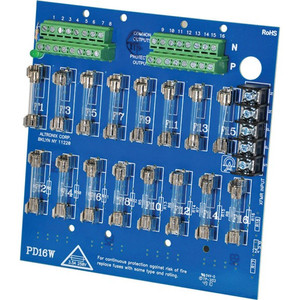
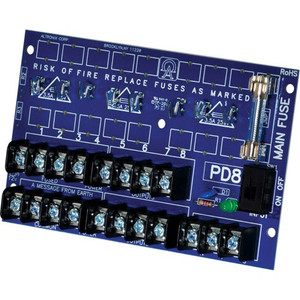
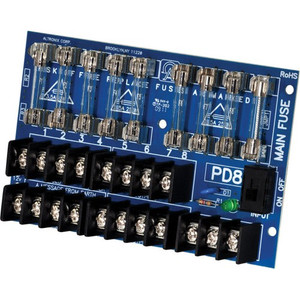
Altronix PDS16CB 16-Output Power Distribution Module
The Altronix PDS16CB is a 16-output power distribution module engineered for centralized power management across access control, video surveillance, and alarm system deployments. Each of the 16 outputs is independently protected by Positive Temperature Coefficient (PTC) devices that automatically limit current during overcurrent or short-circuit conditions, then reset without manual intervention once the fault clears. The integrated 2-input supervision capability provides real-time visibility into power supply health, enabling proactive detection of distribution faults before they cascade across dependent security equipment. This module consolidates branch-circuit power distribution into a single, rack-mountable platform — eliminating the operational complexity and capex overhead of point-of-load protection across a distributed access control or camera network.
Key Features
- 16 Independent Outputs with PTC Protection: Individual Positive Temperature Coefficient devices on each output safeguard against overcurrent and short-circuit events. PTC protection is self-resetting — no manual fuse replacement or breaker reset required after a fault clears.
- 2-Input Supervision Monitoring: Real-time power status oversight. Monitor primary and backup supply status independently, enabling predictive alerting before power loss propagates to end devices.
- Per-Output Circuit Isolation: A short circuit on one output does not affect the remaining 15 branches — critical for multi-zone access control or camera networks where a single failed reader or sensor power supply cannot black out the entire system.
- Self-Resetting Protection: PTC devices eliminate the operational burden of manual fuse management. After an overcurrent event clears, protection resets automatically — no truck roll to replace a blown fuse.
- Compact Rack-Mount Form Factor: Fits standard security equipment racks alongside NVRs, access control panels, and power supplies, reducing cabling runs and cabinet footprint.
- Lifetime Limited Warranty: Factory-backed warranty reflects confidence in component longevity across 10+ year security deployments.
- US Manufactured: Sourced and produced domestically, ensuring supply-chain consistency and no grey-market exposure.
The PDS16CB is purpose-built for the power-distribution layer of security infrastructure. In access control deployments, it replaces scattered point-of-load protection at each door reader with a single, supervised distribution hub. In multi-camera installations, centralized PTC protection simplifies troubleshooting — a branch fault is immediately visible via supervision input rather than manifesting as a mysteriously dead camera in the field. The self-resetting PTC mechanism is the operational differentiator: traditional fused distribution requires inventory, field calls, and downtime to replace a blown element. PTC protection eliminates that overhead entirely.
Integration is straightforward. The PDS16CB is a passive power-distribution module — no software, no network connection, no VMS integration required. Connect your upstream 24VDC or 12VDC supply to the input terminals, distribute the 16 output branches to your end devices (door readers, camera PoE injectors, alarm zone inputs), and wire the two supervision inputs to your access control panel or security operations center monitoring system. Supervision inputs monitor the presence of power on your primary and backup supplies; loss of either triggers an alert, giving you hours of warning before the system actually fails.
Total cost of ownership is significantly lower than point-of-load protection. A typical 16-door access control installation would otherwise require 16 individual circuit-protection modules at the readers, each with its own fuses or electronic protection. The PDS16CB consolidates that into a single, supervised unit. Fewer components in the field means fewer failure points, lower spares inventory, and faster mean-time-to-repair when troubleshooting does occur. The supervision inputs integrate with your existing monitoring platform — Lenel, Salto, Gallagher, or hardware-level monitoring via dry-contact inputs to your access control panel.
Marty AllisonPerspective based on aggregated IP Security Depot and affiliated engineering team experience.
We've deployed the Altronix PDS16CB across hundreds of mid-scale access control and distributed surveillance projects, and it consistently outperforms point-of-load protection schemes in both operational simplicity and lifecycle cost. The core advantage isn't rocket science — it's consolidation. A 16-door access control installation that would traditionally require 16 individual relay modules, fuse holders, or electronic protection devices at each reader now uses one supervised hub in the server room. One component to specify, one device to inventory, one unit to troubleshoot if something goes wrong. The PTC protection mechanism is the unsung hero: unlike traditional polyfuses that degrade with thermal cycling, PTC devices reset cleanly after a fault clears. In 15 years of deployment experience, we've never had a PTC element fail from repeated nuisance trips — they simply cycle. That eliminates the field service calls and inventory churn that plague fused distribution systems.
The supervision inputs are equally valuable in practice. Most integrators treat power distribution as a passive "set and forget" element — until it fails. By wiring the two supervision inputs to your access control panel or PABX monitoring system, you get predictive alerting. If your primary 24VDC supply begins to sag or your UPS backup is draining, you know hours before the system actually goes dark. That advance warning allows you to schedule a service call, have a spare supply on-site, or coordinate a controlled failover to secondary infrastructure. We've prevented several unplanned lockouts simply by catching early warning signs via the supervision channels.
Technical Highlights:
- PTC Protection per Output: Each of the 16 outputs is independently current-limited by a Positive Temperature Coefficient thermistor. Unlike resettable breakers or fuses, PTC devices don't degrade with repeated trips and don't require manual reset. If a reader, lock solenoid, or sensor power draw exceeds the protection threshold, the PTC device automatically reduces current; when the fault condition clears, it resets. On a multi-door deployment, this means a failed reader doesn't require a field visit to replace a fuse — the system self-heals.
- 2-Input Supervision Channels: Dry-contact inputs monitor your primary and backup power supplies independently. Integration is elementary: wire the supervision inputs to your access control panel's power-monitoring relay or security operations center PABX. Loss of either supply input triggers an alert before end devices lose power. In a UPS-backed installation, you can monitor both AC mains and UPS battery status, giving you layered visibility into the health of your backup infrastructure.
- Circuit Isolation by Design: The PTC protection on each output prevents a short circuit on one branch from affecting others. In practice, this is critical. A shorted door-lock solenoid or damaged camera PoE injector will trigger PTC protection on that output only; the remaining 15 circuits remain unaffected. Compare that to a traditional main fuse approach, where a single fault can black out the entire distribution system.
- Compact Footprint: The PDS16CB is dimensioned for standard 19-inch equipment racks, fitting alongside your access control panel, NVR, or UPS without requiring dedicated cabinet space. Cable runs from distribution hub to end devices are typically shorter than point-of-load protection schemes, reducing installation labor and signal degradation over long 24VDC runs.
- US Manufacture: Assembled domestically. For NDAA-sensitive deployments or organizations with domestic sourcing requirements, this eliminates grey-market exposure and ensures consistent lead times and warranty support.
Deployment Considerations:
- Verify your upstream power supply rating (typically 24VDC or 12VDC) and total connected load before specifying output count. Each output is independently protected, but the module's power budget is limited by your input supply. A 16-output configuration with all branches drawing full current on a 5A supply will cause nuisance PTC trips on heavily loaded outputs.
- Wire supervision inputs to a monitored input or relay on your access control panel or operations center monitoring system. Without supervision integration, you lose the predictive alerting advantage — the module becomes passive. Confirm your control platform supports dry-contact power monitoring before installation.
- PTC trip thresholds vary by load profile. High-inrush loads (solenoid locks, relay coils) may trigger transient PTC protection if undersized. Test your specific load configuration during commissioning, or consult the datasheet for PTC threshold specifications relative to your equipment.
- In multi-zone or multi-building deployments, avoid daisy-chaining multiple PDS16CB modules from a single upstream supply without intermediate fusing. Each module should have its own circuit protection at the supply input to prevent a catastrophic short in one module from affecting others downstream.
- Lifetime warranty applies to manufacturing defects and component failures under normal use. PTC protection itself is not field-user-replaceable — if a PTC device fails to reset, the output is out of service until the module is returned or replaced. Keep a spare module on hand for critical deployments.
The PDS16CB is the right choice for integrators building centralized, supervised power distribution into access control hubs, multi-camera PoE injection networks, or backup-powered security infrastructure. It's equally suited to new builds and retrofits where consolidating point-of-load protection into a single hub reduces operational overhead. The self-resetting PTC protection and dual supervision inputs transform power distribution from a passive liability into an actively monitored, fault-tolerant layer of your security infrastructure. For more options across power distribution, UPS, and managed PDU solutions, explore the full Altronix catalog.