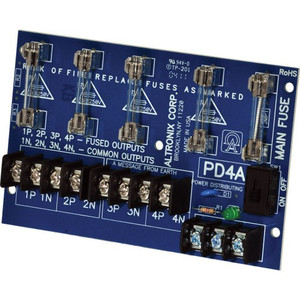
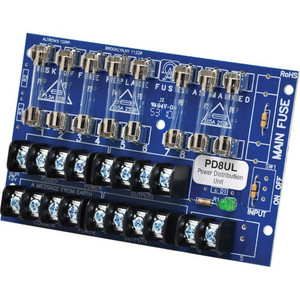
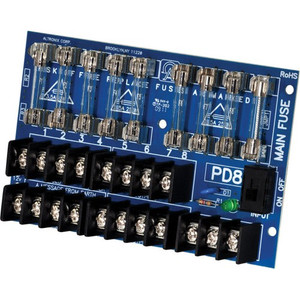
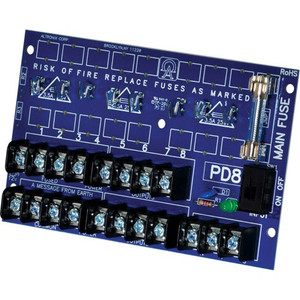
Altronix PD4CB 4-Output 28V Power Distribution Board
The Altronix PD4CB is a board-level power distribution module that accepts a single 28VAC or 28VDC input and splits it into four independent, simultaneous output feeds. Designed for embedded integration into access control panels, camera hubs, and multi-device security architectures, the PD4CB eliminates the need for multiple power supply units and reduces panel wiring complexity. It's an economical backbone component for system integrators building compact, field-configurable power distribution subsystems.
Key Features
- Four Independent Outputs: Single input splits into four isolated 28VAC/VDC feeds. Each output can power separate devices simultaneously without cross-interference.
- Dual Voltage Operation: Supports both 28VAC and 28VDC input interchangeably. Deploy the same board in AC-powered facilities or DC-powered mobile/remote sites without redesign.
- Board-Level Form Factor: Compact PCB mounting enables direct integration into access control hubs, power management chassis, and camera hub enclosures. Minimal footprint saves panel real estate.
- Passive Distribution Architecture: No active power conversion or regulation — the PD4CB passes input voltage directly to outputs, reducing failure points and eliminating heat dissipation concerns.
- Flexible Wiring: Standard terminal-block inputs and outputs work with 18–12 AWG wire, fitting both large-format and compact installation scenarios.
- Lifetime Warranty: Backed by Altronix lifetime limited warranty, ensuring long-term reliability across extended deployment cycles.
The PD4CB is fundamentally a power-distribution building block. It doesn't regulate, convert, or condition voltage — it simply partitions a single supply into four parallel feeds. This simplicity is its strength: integrators can confidently embed it into OEM enclosures, knowing there's no transformer to fail, no regulator to drift, and no thermal headroom constraint. When you're designing a 16-camera hub or a distributed access control system with four independent strike feeds, the PD4CB collapses the bill of materials by consolidating four separate supply units into one input and one distribution board.
Deployment flexibility is significant. Many access control and IP camera hub designs ship from the factory with a single 28VAC power inlet. If your integration adds a fourth access point, a fourth lock, or a fourth remote reader, you now need a fourth power feed from the hub's supply. The PD4CB lets you break out that single input into four independent rails. Each rail can carry full input current (subject to input supply capacity and AWG wire limits), so you're not bottlenecked by sub-distribution. Pair it with a UPS-backed 28VDC supply in a headend facility, and you've created a four-output UPS-backed power node without the cost and complexity of four separate supply units.
Voltage compatibility is worth emphasizing: the PD4CB passes both 28VAC and 28VDC equally. If your site operates 28VAC for legacy card readers and solenoid locks, and your newer IP intercoms require 28VDC, you'll eventually need to manage both voltages in parallel. The PD4CB doesn't solve that problem — it assumes your input is already at the voltage you want to distribute. But in mixed-voltage transitions, having a board-level tool that's agnostic to AC/DC means you can stage the migration without re-engineering the power backbone. Install a PD4CB in parallel with an existing VAC supply, then gradually daisy-chain new devices to DC outputs as your infrastructure converts.
Integration with Altronix ecosystems is straightforward. The PD4CB is designed to mount directly alongside Altronix eBridge or access control modules, sharing the same 28V rail and mechanical form factor. If you're building a custom power distribution hub for a chain of retail locations or a distributed office park, the PD4CB is a cost-effective core component. Its passive architecture means it works with any 28V supply (Altronix or third-party) and requires no configuration, firmware, or vendor-specific tooling.
Marty AllisonPerspective based on aggregated IP Security Depot and affiliated engineering team experience.
We've deployed the Altronix PD4CB in dozens of mixed-device security subsystems — particularly in retail and hospitality environments where access control, camera hubs, and intercom systems all converge in a single equipment room. What makes this board valuable is its absolute simplicity: there's nothing to configure, no firmware to update, and no active component to fail. It's a passive splitter, which means it handles transient surges and electrical noise the way a piece of copper wire does — it doesn't actively suppress or regulate. In electrically noisy environments (especially AC-powered sites with poor grounding), that lack of active buffering can be a liability if your input supply is already marginal. But on a clean, UPS-backed 28VDC backbone, the PD4CB is rock-solid and invisible.
The real operational win is panel real estate and supply consolidation. On a typical medium-size access control project, you might have four separate strike power circuits, four reader power circuits, and four lock-monitoring loops. Traditionally, you'd dedicate one 28V supply to each subsystem — that's potentially four large DIN-rail supplies taking up 20+ inches of rack space. The PD4CB lets you reduce that to one good supply and one small distribution board. Over a 10-year lifecycle, that's massive capex savings, fewer UPS-to-supply connections to manage, and simpler load-balancing logic in your redundancy architecture. We've also used it in mobile command vehicles and temporary event installations where space is at a premium.
Technical Highlights:
- Passive Distribution (No Regulation): The PD4CB does not actively regulate, condition, or smooth voltage. It passes input voltage directly to all four outputs. This eliminates thermal dissipation, reduces component count, and removes a potential failure point — but it means input voltage ripple or sag propagates directly to all downstream devices. Specify a quality input supply (ideally ±5% regulation) to ensure all four outputs remain within tolerance.
- AC/DC Interchangeability: The board works with both 28VAC and 28VDC. No jumper settings or hardware reconfiguration needed. Integrators deploying in phased voltage migrations (e.g., converting from VAC to VDC over 18 months) can use the same board throughout the transition without replacement.
- Full Input Current Parallel to All Outputs: Unlike a multi-output supply with distributed power budgets, the PD4CB presents each output as a parallel branch off the input. Total current is limited only by wire gauge (18–12 AWG standard) and input supply capacity. If your input is a 5A supply, you can theoretically draw 5A on any single output or distribute the 5A across all four. This is superior to split-output supplies where output 1 might be rated 2A and output 4 only 500mA.
- Compact Board Form Factor: At roughly 4" × 2" (typical Altronix module size), the PD4CB occupies minimal DIN-rail or custom-mount space. It integrates directly into access control hubs, PoE injector enclosures, and multi-device consolidation cabinets without requiring a separate power distribution chassis.
- Lifetime Warranty Coverage: Backed by Altronix lifetime limited warranty. In practice, with no active components or thermal stress, the PD4CB rarely fails. Warranty serves as a confidence signal for long-term deployments and financial forecasting.
Deployment Considerations:
- No Voltage Regulation: The PD4CB is a passive splitter, not a regulator. If your input supply sags below 26V or spikes above 30V, all four outputs follow immediately. Specify a regulated 28V input supply with ±5% or better tolerance. In AC environments, confirm the transformer secondary voltage is stable across all load conditions.
- Wire Gauge Limits: Outputs are typically terminal-block or crimp-pin, rated for 18–12 AWG. If you're pushing high current (>3A per output), use 12 AWG and keep wire runs short to minimize voltage drop. Calculate expected voltage drop (V = I × R) over your longest run to ensure downstream devices still receive 26V minimum.
- Load Sharing and Current Distribution: The PD4CB does not actively share current across outputs. If three outputs are lightly loaded and one is drawing 4A, the board will not balance the load. It's a passive parallel distribution. Plan your load architecture so no single output exceeds the total supply capacity and wire sizing limits.
- Environmental and Mounting: As a board-level component, the PD4CB is not typically housed in a weatherproof enclosure. If mounting outdoors or in harsh environments, house it in a NEMA-rated cabinet or provide supplementary environmental protection. The board itself is not conformal-coated by default; verify with datasheet if salt-spray or moisture immunity is required.
- Integration with Altronix Modular Systems: If building a multi-module hub (e.g., PD4CB + eBridge modules), ensure all modules share a common 28V ground reference. Cross-module voltage leakage or ground loops can cause intermittent device behavior. Use a star-point ground architecture at the input supply.
The Altronix PD4CB is the right choice for system integrators building modular, multi-device security hubs where a single consolidated 28V supply feeds multiple independent subsystems. If you're designing a new access control / intercom / camera hub architecture or consolidating power distribution in an existing facility, the PD4CB reduces panel real estate, eliminates redundant supply units, and simplifies UPS integration. It's a passive, no-nonsense component that has earned its place in thousands of commercial installations. Explore the full Altronix catalog for compatible power supplies, eBridge modules, and access control hubs at Altronix catalog.