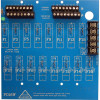
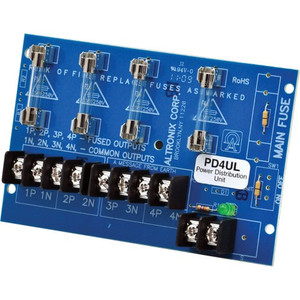
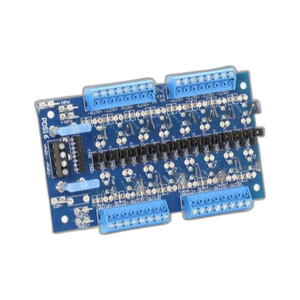
Altronix PD16WCB 16-Output Power Distribution Board
The Altronix PD16WCB is a board-form power distribution module engineered for centralized power management in security and access control installations. It distributes 28VAC or 28VDC input power across 16 independent outputs, enabling parallel wiring architecture that simplifies multi-device power provisioning and reduces per-device wiring labor in medium to large deployments.
Key Features
- 16 Independent Power Outputs: Each output operates independently, meaning you can service or troubleshoot one powered device without affecting the others. This granularity is critical in larger installations where a single fault should not cascade across your entire access control or camera network.
- Dual Input Voltage Support (28VAC/28VDC): The PD16WCB accepts both alternating and direct current at 28V, so it integrates with existing transformer-based power supplies or DC power plants without requiring separate distribution modules. Mix-and-match flexibility reduces inventory and simplifies system consolidation.
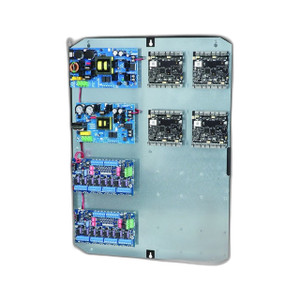
- Board Form Factor: The modular board design fits into enclosures and power management cabinets alongside relays, terminal blocks, and DIN-rail equipment. No external chassis required — you mount it directly into your panel, saving rack space and reducing assembly time on site.
- Parallel Wiring Topology: By consolidating power distribution at one board, you eliminate individual point-to-point wiring from a central supply to each reader, lock, or sensor. This cuts installation time and reduces the total conductor run, which translates to lower materials cost and cleaner cable management in crowded electrical closets.
- Centralized Load Balancing: Sixteen outputs on a single board allow you to segment your load — assign camera power circuits, reader circuits, and door lock circuits to separate outputs, then monitor or fuse each segment independently. If a short occurs on one output, only that circuit is affected.
- Lifetime Limited Warranty: Altronix backs the PD16WCB with a lifetime limited warranty, meaning component failures under normal use are covered for the life of the product. No arbitrary 3-year or 5-year cliff; this reduces long-term risk in installations you expect to operate for a decade or more.
Integration & Compatibility
The PD16WCB is a distribution board, not a standalone power supply. You supply 28VAC or 28VDC input from an external transformer, UPS, or regulated DC supply. Output terminals are standard screw-down connectors, compatible with 14–16 AWG wire for typical 24V access control and camera power circuits. It integrates into any power infrastructure architecture where centralized distribution reduces device-level complexity. Common pairings include Altronix regulated supplies, battery backup units, and multi-output transformer modules.
Typical Deployments
The PD16WCB is well-suited to:
- Access Control Systems: Power multiple card readers, electromagnetic locks, and request-to-exit devices from one board, each on its own fused or monitored output.
- Distributed Surveillance Power: Feed power to analog or IP cameras mounted across a facility, with each camera or camera pair on a dedicated output for easier troubleshooting.
- Warehouse Automation: Supply power to gate controls, sensor arrays, and badge readers in large facilities where cable runs are long and load segments are many.
- Multi-Zone Security Installations: Divide your outputs by zone or floor, so a fault in one zone does not bring down security infrastructure in others.
Limitations & Considerations
The PD16WCB does not include integrated surge protection, fusing, or current monitoring. You must supply external 28V power and add overcurrent protection (fuses or breakers) on the input and, if required, on individual outputs. It is not a power supply itself — only a distribution switch. For installations requiring per-output monitoring, status indication, or managed failover, pair the PD16WCB with a monitored power distribution unit or add supplementary monitoring relay modules.
Frequently Asked Questions
Q: Can I use the PD16WCB with a 24V power supply instead of 28V?
A: The PD16WCB is specified for 28VAC or 28VDC input. Using 24V may result in insufficient voltage drop across downstream devices. Check your supply documentation and confirm compatibility with the 28V rating before installation.
Q: Does the PD16WCB have built-in fusing or circuit protection on each output?
A: No. The board distributes power but does not include per-output fusing or breakers. You must add external fuses or circuit breakers on the input and, if required, on individual outputs to protect against shorts and overcurrent conditions.
Q: What wire gauge should I use to connect the PD16WCB to my power supply and to the end devices?
A: The terminal blocks accept 14–16 AWG wire. Consult the datasheet and your local electrical code for voltage drop calculations over long runs. Heavier gauge (12 AWG) may be needed for runs exceeding 50 feet.
Q: Can I mix AC and DC inputs on the same PD16WCB?
A: The board accepts either 28VAC or 28VDC input, not both simultaneously on the same unit. Use separate boards if you require both AC and DC distribution in the same installation.
Q: Is the PD16WCB UL-listed or certified for use in access control or fire alarm systems?
A: Consult the datasheet and Altronix technical support for certification status. Many power distribution components are listed for general use; fire alarm and life-safety applications may have specific regulatory requirements.
Q: What is the maximum current per output?
A: Refer to the product datasheet for per-output current specifications. Overloading an output will require external protection (fusing) to prevent equipment damage.
Ted PerryPerspective based on aggregated IP Security Depot and affiliated engineering team experience.
The Altronix PD16WCB is a straightforward power distribution switch — no intelligence, no monitoring, just 16 independent 28V outputs on a single board. That simplicity is its strength. In access control and surveillance installations, the PD16WCB eliminates the wiring nightmare of individual point-to-point feeds from a central supply to dozens of readers, locks, or cameras. You consolidate to one board in your electrical closet, then fan out 16 circuits to your field devices.
Technical Highlights:
- 16 Independent Outputs: Each output is isolated, so a short or fault on one circuit does not collapse the entire distribution network. Critical in multi-zone access control where one failed lock should not disable card readers on other floors.
- 28VAC/28VDC Input Flexibility: Accepts both AC transformer and DC supply input without requiring separate modules. Common in retrofit installations where you're consolidating legacy transformer-based systems with newer DC UPS units.
- Board Form Factor for Panel Integration: Mounts directly into a standard electrical enclosure alongside DIN-rail fusing, relays, and terminal blocks. No external chassis, no additional power handling footprint — saves rack space and installation labor.
- Lifetime Limited Warranty: No expiration cliff. Component failures are covered for the operational life of the device, reducing capital replacement cycles in long-lived installations.
Deployment Considerations:
- No Built-In Protection: The PD16WCB does not fuse or monitor individual outputs. You must specify external fusing on the input and per-output if required. Undersizing fuses or omitting them is a common field mistake — budget time for proper short-circuit analysis and breaker sizing.
- Voltage Drop Over Distance: If output runs exceed 50–75 feet at full load, voltage drop becomes significant. Heavier wire (12 AWG instead of 14) will be required, adding material cost. Factor this into long warehouse or perimeter camera runs.
- Not a Power Supply: This is a distribution board only. You must source 28VAC or 28VDC externally. Many integrators pair it with an Altronix regulated supply or UPS — specify the input supply separately in your bill of materials.
The PD16WCB is the right choice for multi-device access control or surveillance installations where simplicity and parallel distribution take priority over per-output monitoring. It's a workhorse in larger facilities — warehouses, campuses, and multi-building access control systems — where you need reliable power fanning without complexity. For single-reader or single-camera deployments, it's overkill; for anything with 8+ powered endpoints, it pays for itself in labor and cable consolidation.