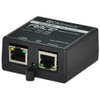
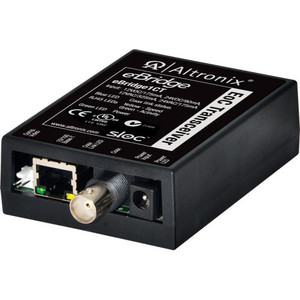
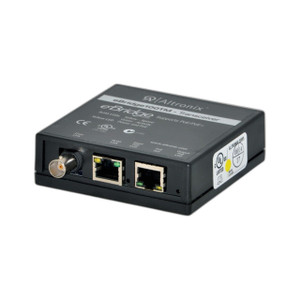
Altronix PACE1ST Long Range Ethernet over CAT5e Mini Transceiver
The Altronix PACE1ST is a PoE-powered transceiver that extends standard Ethernet connectivity to 500 meters over existing CAT5e copper cabling. This addresses a fundamental problem in security infrastructure: standard Ethernet copper runs reliably only to about 100 meters before signal degradation becomes unmanageable. When your IP cameras, access control readers, or door controllers sit 200, 300, or 400 meters away from your network backbone, the PACE1ST eliminates the need for fiber optic runs or additional conduit—a significant cost and installation advantage on large campuses or warehouse deployments.
Key Features
- 500-meter extended range over CAT5e: Pushes standard copper cabling distance five times beyond the typical 100-meter limit. On sprawling warehouse floors or multi-building sites, this means fewer network nodes and simpler topology—direct cost reduction in switch ports and management overhead.
- PoE-powered operation: Draws power from the network itself (802.3af PoE), so you don't need to provision a separate 12VDC or AC power supply at the remote location. This cuts installation time and eliminates a potential point of failure.
- 1U rack-mount form factor: Designed to integrate directly into standard 19-inch security cabinets and server racks, keeping cable runs clean and your equipment organized in a central hub.
- Single Ethernet output port: Provides one active Ethernet connection per unit. If you need to extend multiple circuits to the same remote location, deploy multiple PACE1ST units in parallel.
- UL Listed: Meets safety standards for commercial and industrial installation, a requirement for many enterprise procurement policies and insurance audits.
- Lifetime Limited Warranty: Altronix backs the device indefinitely under normal use conditions, reducing long-term replacement costs and signaling design confidence in the core circuit architecture.
Typical Deployments
The PACE1ST shines in three common scenarios:
- Remote camera feeds: Deploy IP cameras at the far end of a parking lot or perimeter fence without requiring fiber infrastructure or expensive fiber media converters.
- Access control and door electronics: Extend network connectivity to badge readers, electronic locks, and door controllers in remote buildings or secure zones beyond the 100-meter Ethernet horizon.
- Distributed sensor networks: Connect environmental monitors, traffic counters, or other networked devices in warehouse zones or outdoor facilities where trenching fiber would be prohibitively expensive.
Integration and Compatibility
The PACE1ST is transparent to IP devices—it behaves like standard Ethernet from the perspective of your connected equipment. Any IP camera, access control module, or networked sensor that runs over standard Ethernet (ONVIF-compliant or proprietary) will function at the remote end without modification. This makes retrofit deployments straightforward: remove your existing CAT5e run and insert a pair of PACE1ST units at each end (one in your rack, one at the remote site receiving power from a local PoE injector or PoE switch port). The device works with standard PoE switches and injectors, and its compact footprint means it fits in tight cabinet spaces alongside your network video recorders and other infrastructure.
For detailed technical parameters and pinout diagrams, consult the product datasheet linked in the specifications section below.
When to Choose a Different Approach
If your remote site is more than 500 meters away or requires multiple simultaneous connections to the same location, consider fiber-based Ethernet media converters or a dedicated long-haul network architecture. For distances under 100 meters, standard Ethernet is adequate and eliminates the extra hardware cost. If PoE power availability is limited at the remote end (no PoE switch or injector), you'll need to provide external DC power, which diminishes one of the PACE1ST's key advantages.
Frequently Asked Questions
Q: Does the PACE1ST require a matching unit on both ends of the cable run?
A: Yes. One PACE1ST connects to your primary network side (powered by your backbone PoE switch or injector), and a second unit connects at the remote location. The remote unit receives power from a local PoE source (typically a PoE injector installed on-site).
Q: Will the PACE1ST work with my existing CAT5e cabling?
A: Yes. The PACE1ST is designed specifically for CAT5e (and higher grades like CAT6). It does not require new conduit or fiber runs—it uses your existing copper infrastructure, which is why it's cost-effective for retrofit projects.
Q: What happens if I try to run it beyond 500 meters?
A: Signal degradation and packet loss increase beyond 500 meters. The device is rated and tested to 500m; exceeding that voids the warranty and introduces reliability risks. Stick to the 500m specification or deploy intermediate hubs.
Q: Is the PACE1ST compatible with my NVR or VMS?
A: The PACE1ST is a transparent Ethernet extender—it does not parse or filter traffic. Any IP device (camera, access control module, NVR) that works over standard Ethernet will work through the PACE1ST without special configuration or drivers.
Q: What is the power consumption of the PACE1ST?
A: The PACE1ST draws power from the network via PoE (802.3af). Consult the datasheet for exact wattage. Verify that your PoE switch or injector has sufficient budget to power both the remote endpoint device and the transceiver simultaneously.
Q: Is the PACE1ST NDAA Section 889 compliant?
A: This information is not specified in the available product documentation. Contact Altronix or your specialty distributor for compliance questions.
Ted PerryPerspective based on aggregated IP Security Depot and affiliated engineering team experience.
The Altronix PACE1ST solves a real infrastructure problem: getting Ethernet beyond 100 meters without fiber. I've deployed the PACE1ST in warehouse expansions where running new conduit to a remote gate access point would cost $8–12K. Instead, two units and existing copper made it a $1200 solution. The 500-meter specification is the critical number here—measure your run carefully before specifying.
Technical Highlights:
- 500-meter CAT5e range: Five times the standard Ethernet limit means fewer intermediate network nodes and lower overall infrastructure cost on sprawling sites.
- PoE-powered (802.3af): No external AC or DC supply at the remote end simplifies installation and reduces single points of failure—power comes from your backbone or a local injector.
- 1U rack-mount footprint: Fits standard 19-inch cabinets alongside your switches and NVRs, keeping the hub clean and cable-run organized.
Deployment Considerations:
- You must deploy PACE1ST units in matched pairs (one per end of the run). Budget for two units, not one, and ensure your remote location has PoE power available—typically a wall-mount injector or local switch port.
- The 500-meter limit is hard. Beyond that, signal quality degrades rapidly. Measure your actual copper run; if it's borderline (say, 480–500m), test in the field before full deployment.
- Latency through the transceiver is minimal, but verify it meets your access control or real-time camera feed requirements—in most security deployments, sub-millisecond delay is not a concern.
Position the PACE1ST for cost-driven warehouse and campus deployments where fiber infrastructure is not already in place. It's especially effective for retrofit access control extensions and remote camera feeds. Skip it if fiber is already in the conduit, or if your run exceeds 500 meters without intermediate hubs.