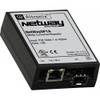
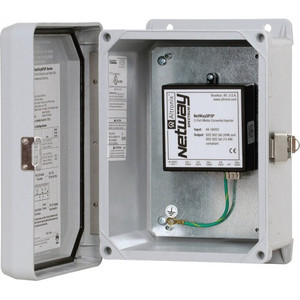
Altronix NETWAYSP1A Ether over Fiber Media Converter
The Altronix NETWAYSP1A is a PoE-powered media converter and repeater that extends Ethernet connectivity over fiber optic cable. It bridges copper and fiber networks while maintaining power delivery, solving the core problem of distance and electromagnetic interference in distributed surveillance and security installations. This compact unit converts standard twisted-pair Ethernet to fiber and back, enabling camera, access control, and network traffic to travel hundreds of meters (or kilometers with appropriate fiber runs) without signal degradation or EMI contamination—critical in industrial and multi-site deployments where electrical noise would corrupt copper-only runs.
Key Features
- Ether over Fiber Conversion: Converts Ethernet signals to fiber optic transmission and back, allowing IP cameras and network devices to operate at distances where standard CAT5e/CAT6 copper would degrade signal quality or introduce EMI interference. Eliminates the need for expensive long-run copper cable in electrically noisy environments.
- PoE Power Input: Powered directly from a PoE source (802.3af), reducing field installation complexity—no separate power supply or external batteries required. Draw remains within standard PoE budget, so you won't overload your switch power allocation on densely wired installations.
- Integrated Switch Functionality: Provides multiple connection scenarios in a single device, allowing flexible network topology without requiring additional hardware. Useful in hub-and-spoke or daisy-chain deployments where fiber backbone consolidates traffic from remote copper segments.
- Media Converter and Repeater in One Unit: Acts as both a signal converter (copper-to-fiber, fiber-to-copper) and a network repeater, regenerating signals to maintain clean, strong transmission across extended runs. Eliminates signal degradation that can occur when fiber spans exceed typical single-mode or multimode distance limits without amplification.
- Compact Form Factor: Small physical footprint suits distributed mounting—near camera nodes, in electrical enclosures, or on DIN rails. Does not require dedicated rack space or ventilation, reducing deployment footprint in space-constrained sites.
- Lifetime Limited Warranty: Altronix backs the unit with a lifetime limited warranty, providing long-term confidence in a critical infrastructure component.
Why Choose This Unit
Select the NETWAYSP1A when your deployment requires IP camera or network device connectivity across distances or environments where standard Ethernet copper cable is impractical. Typical scenarios include multi-building campuses, industrial facilities with heavy electrical machinery (welding, motors, VFDs), rail yards, ports, or any site where EMI ingress would corrupt unshielded or poorly shielded copper runs. Fiber optic transmission is immune to electromagnetic interference, ground loops, and lightning-induced surges—advantages that compound across long runs.
Because the NETWAYSP1A integrates PoE input, you avoid the cost and complexity of separate power distribution to remote fiber endpoints. A single PoE source at your switch can power the converter and any downstream camera or access control device receiving power from the fiber-connected segment. This simplifies commissioning and reduces field wiring labor.
Integration and Deployment Context
The NETWAYSP1A is part of the broader Altronix catalog of IP security infrastructure products, which includes network video recorders and switching components for centralized surveillance control. In system design, pair this converter with PoE planning to ensure your source switch has adequate power budget for all endpoints. For multi-site fiber backbone deployment, reference managed Ethernet switches to control VLAN segmentation and traffic shaping across the fiber backbone.
Installation is straightforward: connect copper Ethernet from your switch or camera node to the copper port of the NETWAYSP1A, connect your fiber optic cable (single-mode or multimode, depending on distance and your infrastructure) to the fiber port, and supply PoE to the unit. The converter requires no configuration—it operates transparently to IP cameras, NVRs, and other network devices.
When to Consider Alternatives
If your deployment does not exceed reliable copper run distances (typically 100 meters for standard CAT6, up to 300 meters in ideal conditions) and your electrical environment is clean (no high-power motors, welders, or RF transmitters nearby), standard Ethernet switching or long-run copper cabling may be more cost-effective. For deployments requiring managed fiber switch capabilities, redundancy, or advanced traffic control across the fiber segment, evaluate higher-tier fiber switching products in the Altronix line.
Frequently Asked Questions
Q: What fiber types does the NETWAYSP1A support?
A: The unit supports both single-mode and multimode fiber optic cable. Single-mode is optimized for longer distances (10+ km); multimode suits shorter runs (up to 2 km) with lower cost per meter. Consult the datasheet to confirm the exact fiber specifications and connector types for your installation.
Q: Can I daisy-chain multiple NETWAYSP1A units?
A: Yes, the repeater function allows cascading of converters across multiple fiber spans, regenerating signal at each node. However, each additional converter adds latency and potential signal degradation—design your topology to minimize cascade depth.
Q: Does the NETWAYSP1A require configuration?
A: No. The NETWAYSP1A is a transparent, plug-and-play media converter. It requires no IP configuration, management interface, or software. Connect and it operates immediately.
Q: Is the NETWAYSP1A suitable for industrial environments with high EMI?
A: Yes. Fiber optic transmission is inherently immune to electromagnetic interference, making this converter ideal for electrical substations, manufacturing floors, welding shops, and other electrically noisy environments where copper cable would require extensive shielding and grounding.
Q: What is the maximum latency introduced by the NETWAYSP1A?
A: Media converters typically introduce minimal latency (microseconds). For real-time surveillance applications, this is negligible. Consult the datasheet for exact latency specifications if your deployment has strict timing requirements.
Q: Can the NETWAYSP1A power a remote IP camera directly?
A: The NETWAYSP1A accepts PoE input and can pass PoE to a connected Ethernet device on its copper port, provided your source supplies adequate power budget. A typical IP camera drawing 10–15W will operate normally downstream of the converter.
Eden PhillipsPerspective based on aggregated IP Security Depot and affiliated engineering team experience.
The NETWAYSP1A is straightforward infrastructure, but that simplicity masks a critical capability: extending Ethernet across fiber eliminates EMI as a deployment blocker. I've seen installations where unshielded copper runs in noisy electrical environments introduced packet loss and latency spikes that NVRs and cameras couldn't explain—until fiber was introduced. The NETWAYSP1A solves this for modest sites without requiring managed fiber switching complexity.
Technical Highlights:
- PoE Power Input (802.3af): Operates from standard 48V PoE, drawing minimal current. No separate power supply means one less field connection to debug and one less potential failure point. Simplifies deployment in remote camera nodes or distributed access control systems.
- Integrated Switch with Repeater Function: Repeater regenerates signals across the fiber span, preventing signal degradation on long runs. Integrated switching allows flexible multi-port configurations without cascading separate devices. Reduces bill of materials and enclosure footprint.
- Fiber-Optic Immunity to EMI: In environments with VFDs, welding equipment, high-current switchgear, or RF transmitters, fiber eliminates ground loops and noise ingress that plague copper runs—a practical advantage that compounds over distance and electrical density.
Deployment Considerations:
- Fiber termination and connector type must match your backbone infrastructure—confirm single-mode vs. multimode and connector standard (LC, ST, SC) before ordering cable or second converters. Mismatched fiber types mean dead links.
- Cascading multiple NETWAYSP1A units works, but each converter adds latency. For multi-span backbones, evaluate whether a managed fiber switch provides better performance and control at higher cost.
Deploy the NETWAYSP1A in multi-building campuses, industrial sites with electrical noise, or anywhere copper runs exceed 100 meters and reliability trumps lowest initial cost. For retrofit projects where trenching additional copper is prohibitive, fiber conversion via this unit often costs less than new copper infrastructure and offers superior immunity to future electrical expansion on site.