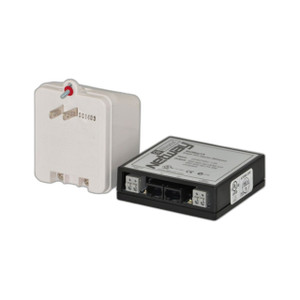
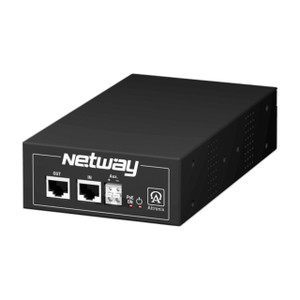
Altronix NETWAY112 Single-Port PoE Midspan Injector
The Altronix NETWAY112 is a single-port midspan PoE injector designed to solve a common infrastructure problem: deploying powered IP devices on network segments where the switch itself lacks PoE capability, or where available power is insufficient for the target device. The NETWAY112 injects 12VDC power onto existing twisted-pair cabling up to 100 meters, eliminating the need for separate power runs or conduit work during retrofits.
Key Features
- 15W PoE Budget: Delivers enough power for low-to-mid power consumption devices—IP cameras drawing under 12W, wireless access points, proximity readers, and alarm endpoints. If your endpoint requires more than 15W, you'll need a higher-tier midspan or a switch-based PoE solution.
- Single RJ45 Port: One input, one output. Simplifies sequential deployment in retrofit scenarios where you're adding power to one run at a time rather than upgrading entire switch infrastructure.
- 12VDC Output Voltage: Matches the power requirements of most access control devices, emergency lighting controllers, and compact IP camera models. Confirm your endpoint's voltage spec before purchasing.
- 100-Meter Cable Run Support: Covers typical building runs without power loss concerns. Longer runs risk voltage drop; validate cable gauge and distance with your installer.
- 230VAC Input Power Requirement: This is not a 110V device. Requires 230VAC mains (standard in most non-North American regions). Confirm regional availability before deployment.
- UL Listed and CE Approved: Meets North American and European safety standards. Acceptable for institutional and commercial installations where third-party certification is required.
Typical Applications
IP Camera Retrofits: Existing network infrastructure (Cat5e/Cat6 to a camera location) lacks switch PoE. Mount the NETWAY112 at the source, inject power inline, and avoid running a separate 12VDC cable.
Access Control & Readers: Proximity readers, card readers, and door strike controllers rated for 12VDC can be powered via the existing network run without additional electrical work.
Emergency and Alarm Endpoints: Low-power alarm sensors, siren controllers, and backup lighting systems benefit from consolidated cabling.
Legacy Infrastructure Reuse: When rewiring is cost-prohibitive or structurally impractical, a midspan injector extends the life of existing cabling.
Integration & Compatibility
The NETWAY112 works with any IP device rated for 12VDC input that draws 15W or less. Verify your endpoint's voltage and power consumption in its datasheet. The injector is transparent to network traffic—no configuration required. Mount it near the network source (switch, patch panel, or router) or at an intermediate junction box closest to the powered device. Pair with standard Ethernet cabling rated for your distance; consider cable gauge impact on voltage delivery over longer runs.
For deployments involving multiple powered endpoints, evaluate whether a PoE-capable switch or a higher-capacity power infrastructure solution would reduce complexity and future maintenance.
Specifications Summary
- Model: NETWAY112
- Output Ports: 1 RJ45
- Power Output: 15W @ 12VDC
- Input Voltage: 230VAC
- Maximum Cable Distance: 100 meters
- Certifications: UL Listed, CE Approved
- Warranty: Lifetime Limited
Frequently Asked Questions
Q: Can the NETWAY112 power an IP camera drawing 18W?
A: No. The NETWAY112 is rated for a maximum 15W output. If your camera exceeds this, you will need either a higher-capacity midspan injector or a PoE-capable switch with sufficient power budget.
Q: Does the NETWAY112 require configuration or software?
A: No. It is a passive inline injector. Mount it between your network source and the powered device, plug in mains power, and it begins injecting voltage immediately. No configuration interface or IP address assignment is needed.
Q: What happens if I exceed the 100-meter cable distance?
A: Voltage drop over longer cable runs will reduce the power available at the endpoint, potentially causing unreliable operation or device shutdown. Stick within the 100-meter specification, or confirm your endpoint's acceptable input voltage range and test with your actual cable gauge and distance.
Q: Can I use the NETWAY112 with 110V / 120V mains power?
A: No. The NETWAY112 requires 230VAC input. It is designed for regions with 230V standard power distribution. If your site uses 110V/120V, you will need a regional power converter or an alternative injector rated for your mains voltage.
Q: Is the NETWAY112 suitable for outdoor installations?
A: The injector itself is not rated for outdoor mounting. Install it indoors at the network source (switch closet, distribution box, or equipment room) and run the cabling to your outdoor endpoint. Outdoor connectors and cabling should meet appropriate environmental ratings (IP67 connectors, UV-resistant cable jacketing) independently of the injector.
Q: What is covered under the Lifetime Limited Warranty?
A: Consult the Altronix warranty terms or contact the distributor for specific coverage details, exclusions, and claim procedures.
Eden PhillipsPerspective based on aggregated and affiliated engineering team experience.
The Altronix NETWAY112 is a straightforward, no-frills solution for a specific problem: you have an unpowered network run and a 12VDC endpoint that needs power, and you want to avoid running a second cable. At 15W, this injector sits in the lower-to-mid power range and is best suited for compact cameras, small access control readers, and alarm controllers. The 100-meter limit is standard for midspan architecture and reflects realistic voltage drop over typical building runs.
Technical Highlights:
- 15W Power Budget: Sufficient for most single-device retrofits. Confirm your endpoint's power consumption in its datasheet—cameras often draw 8–12W; readers and controllers typically 2–5W. Anything over 15W will not function reliably.
- 230VAC Input Only: This is a regional constraint. If you are deploying in North America (110V/120V standard), the NETWAY112 is incompatible without a step-down transformer, which introduces additional failure points. Verify your site's mains voltage before purchase.
- Single RJ45 Port: One device per injector. If you need to power three cameras on three separate runs, you will need three NETWAY112 units. This is a cost multiplier in larger retrofits—weigh the total hardware cost against a managed PoE switch upgrade.
Deployment Considerations:
- Mount the injector indoors, close to the network source. Avoid placing it in damp or uncontrolled environments unless it is enclosed in a cabinet rated for that environment.
- Voltage drop is real over 80–100 meter runs, especially with Cat5e or smaller gauge cabling. On a 100-meter run with 24 AWG cabling, you may see 1–2V drop under load. Confirm your endpoint tolerates 10–12VDC input (most do, but verify the datasheet).
- The injector is transparent to network traffic and requires no IP configuration. Installation is mechanical only: power the unit, connect network source to input RJ45, connect output RJ45 to your endpoint. No setup overhead.
Use the NETWAY112 for targeted single-device power retrofits in existing infrastructure—a camera retrofit in one corner of a warehouse, a reader upgrade at a door that lacks local power, or emergency lighting on an existing network drop. For multi-device deployments or mixed power requirements (some devices 12V, others PoE), a managed switch is cleaner and reduces future complexity.