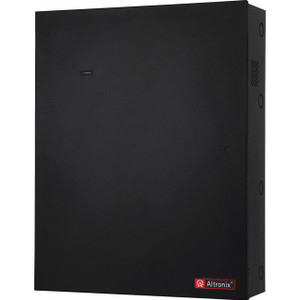
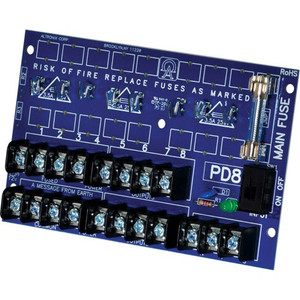
Altronix LINQ8PD Networkable Power Distribution Module
Overview
The Altronix LINQ8PD is a networkable power distribution module engineered for security integrators and IT architects who need centralized control and granular visibility into power delivery across distributed security and access control systems. Rather than troubleshooting eight power circuits through manual testing, the LINQ8PD delivers real-time individual output diagnostics — meaning you can detect faults, track utilization, and plan maintenance from a remote management console instead of rolling a truck to every site.
Key Features
- Eight Fused Outputs with Individual Protection: Each output is independently fused, so a fault on one circuit doesn't cascade to the others. This isolation means a failed card reader or failed power draw on one zone won't black out cameras or access points on adjacent zones — a real operational advantage in multi-zone deployments.
- Real-Time Individual Output Diagnostics: The LINQ8PD monitors and reports the status of each fused output independently. Rather than guessing which circuit has failed, operators receive granular visibility into power consumption, voltage stability, and fault conditions on each output via a network management interface. This reduces on-site troubleshooting time from hours to minutes.
- Networkable Architecture for Distributed Management: Integration with supervision and management platforms aggregates power distribution data across multiple sites or installations. A central operator can monitor power health across dozens of remote locations without dispatching technicians to investigate every power anomaly. This is particularly valuable for multi-site warehouse, retail, or campus deployments where power infrastructure is geographically dispersed.
- Battery Backup Integration: The LINQ8PD supports battery backup systems, ensuring continuity during utility interruptions and enabling graceful shutdown of critical loads — cameras and access controllers stay online long enough to log final events or hand off to backup connectivity rather than dropping power abruptly.
- Predictive Maintenance Workflows: By tracking utilization patterns and detecting early anomalies (voltage sag, overcurrent conditions, or thermal stress), the module enables you to schedule preventive maintenance during planned windows rather than responding to emergency faults at 2 a.m. This reduces unplanned downtime and extends equipment lifespan.
- Modular Network Power Node: The LINQ8PD functions as a controlled power distribution point within larger networked security and access control architectures. When paired with related power distribution and management systems, it becomes part of a coordinated power oversight strategy rather than a standalone device.
Integration and Deployment Context
The LINQ8PD is built for integrators managing multi-zone access control systems, distributed camera arrays, or large-scale security deployments where individual power monitoring improves operational efficiency. Its diagnostic reporting integrates with supervision and management platforms — the specific platform compatibility depends on your existing infrastructure, so verify integration support with your VMS or access control vendor before finalizing your architecture.
In warehouse automation and enterprise security environments, the ability to monitor and remotely manage eight independent power outputs reduces support overhead significantly. Instead of scheduling a technician visit to swap a fused output or investigate a power anomaly, your operations team can log into the management console, check real-time diagnostics, and resolve many issues remotely.
Typical applications include multi-zone access control systems where independent output protection prevents a single card reader failure from affecting doors across the facility, centralized power distribution for networked camera and sensor arrays in large buildings or campuses, and mission-critical facility power oversight where real-time diagnostics enable rapid response to power-related incidents.
When to Choose a Different Model
If you require fewer than eight independently monitored outputs, or if your deployment doesn't include a network management platform that supports the LINQ8PD's reporting architecture, consider lower-density power distribution modules from the Altronix catalog that integrate directly with your existing access control panel without requiring separate network management infrastructure. Conversely, if you need more than eight outputs or require redundant power paths with automatic failover, evaluate higher-capacity or multi-module networked power architectures.
Frequently Asked Questions
Q: Does the LINQ8PD require a separate network connection to each output?
A: No. The LINQ8PD is a single networkable module that aggregates all eight outputs into one network node. You connect the module to your network once, and it reports diagnostics for all eight fused outputs through that single connection.
Q: Can I monitor the LINQ8PD remotely from multiple locations?
A: Yes. Because it integrates with network management platforms, any authorized user with access to your supervision and management system can view real-time diagnostics from any location with network access to that platform.
Q: What happens if one output fuse blows?
A: The LINQ8PD will report that specific output as faulted in the management interface, and power to that circuit will be cut off. The remaining seven outputs continue operating normally, isolating the fault to a single zone or device rather than affecting the entire distribution.
Q: Is the LINQ8PD compatible with my existing access control system?
A: The LINQ8PD integrates with supervision and management platforms that support its networking protocol. Verify compatibility with your specific access control panel or VMS vendor before procurement — integration support varies by platform.
Q: What's the typical lead time for the LINQ8PD?
A: Lead times vary. Contact your specialty reseller or distributor for current availability and delivery schedules.
Q: Can battery backup power multiple LINQ8PD modules?
A: Yes, battery backup integrates with the LINQ8PD to support graceful shutdown of critical loads across multiple modules in networked deployments. Sizing and configuration depend on your backup capacity and load profile — work with your integrator to design an appropriate battery architecture.
Ted PerryPerspective based on aggregated IP Security Depot and affiliated engineering team experience.
I've deployed the Altronix LINQ8PD across multi-site access control and camera deployments, and the real operational win is the individual output diagnostics capability. Rather than troubleshooting eight circuits through manual circuit inspection or visual fuse checking, operators receive granular real-time visibility into each fused output's status, consumption, and fault condition directly from the management console. For integrators managing 10+ remote sites, this measurably reduces support overhead and on-site truck rolls.
Technical Highlights:
- Eight Independently Fused Outputs: Each circuit is isolated, so a fault on one output (a shorted card reader, a failed power supply on a single camera, or an overcurrent condition) doesn't cascade to the remaining seven circuits. In a 16-door access control system spread across four LINQ8PD modules, a failure on one door's power line stays isolated to that specific output, leaving the other 15 doors operational.
- Real-Time Individual Output Diagnostics: The LINQ8PD reports status, consumption, and fault conditions for each of the eight outputs independently. This granular visibility eliminates guesswork — you know exactly which output has faulted, what voltage or current anomaly triggered the fault, and when it occurred. This precision cuts troubleshooting time from hours of manual testing to minutes of remote diagnostics.
- Networkable Aggregation Across Multiple Sites: When integrated with a central management platform, a single operator can monitor power health across dozens of remote LINQ8PD nodes without rolling a truck to each location. Multi-site deployments (warehouses, retail chains, campuses, industrial facilities) benefit enormously from this centralized visibility and predictive maintenance capability.
Deployment Considerations:
- Verify that your supervision or VMS platform explicitly supports the LINQ8PD's networking and reporting architecture before procurement. Integration support varies significantly across platforms — compatibility is not guaranteed across all systems.
- The LINQ8PD is a distribution node, not a primary power supply. You'll still need a UPS or primary AC/DC power source upstream; the LINQ8PD adds managed, monitored distribution downstream of that primary power architecture. Don't treat it as a replacement for a proper UPS system.
- Fuse selection and load planning are critical. Overloading a single output beyond its fuse rating will trigger a fault and cut power to that circuit. Work with your integrator to size loads and fuses appropriately for your specific access control readers, cameras, and door locks.
The LINQ8PD is the right fit for distributed access control and camera deployments where individual output diagnostics, predictive maintenance workflows, and remote operational visibility justify the added network management complexity. For single-location, small-footprint deployments or systems where power distribution is simpler and on-site troubleshooting is acceptable, a non-networked fused power distribution module may be more cost-effective. For enterprise-scale, multi-site, or mission-critical facilities, the diagnostic and management capabilities of the LINQ8PD deliver measurable operational efficiency.