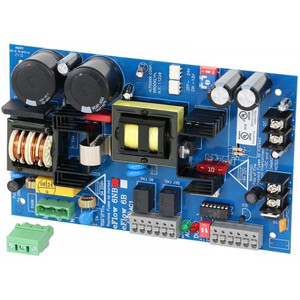
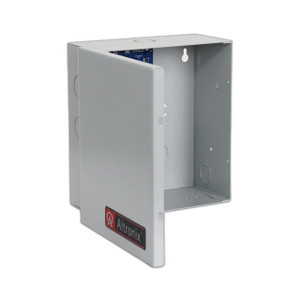
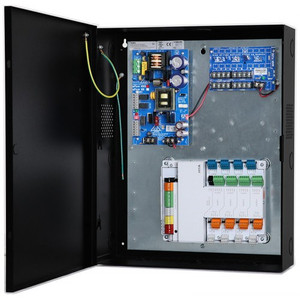
Altronix AL600ULPD4 4-Output Power Supply with Battery Backup
The Altronix AL600ULPD4 is a compact four-output power supply and charger designed to deliver redundant, supervised power to access control systems, alarm panels, door locks, and security camera installations. Rated for 6A maximum output current across four individually fused channels, the AL600ULPD4 accepts standard 115VAC input and includes integrated battery backup and charging circuitry—critical for maintaining system operation during mains failure and ensuring graceful shutdown or continued monitoring of critical infrastructure.
Key Features
- 4 Individually Fused Outputs: Each output is circuit-protected, so a short on one channel won't cascade across the system. Useful in multi-zone access control where independent reader or lock circuits require isolation.
- Selectable 12VDC or 24VDC Output: Configure the entire unit for either voltage to match your reader, lock, or controller specifications—eliminates the need for multiple SKUs in inventory.
- 6A Maximum Output Current: Sufficient to power a small to mid-sized access control deployment: roughly 3–4 readers with integrated power modules, or 2–3 electric strikes, or a combination thereof. Confirm your aggregate load before deployment.
- Integrated Battery Backup and Charger: Built-in charger circuitry automatically maintains battery charge from AC mains. On AC loss, the unit transitions to battery power, holding critical devices active. Supervision signals alert you to mains failure or low battery, enabling remote monitoring or automatic failover workflows.
- AC Fail Supervision Signal: Detects loss of input AC power and outputs a relay contact or analog signal, allowing your control system to log the event, trigger alerts, or switch to backup systems without delay.
- Low Battery and Battery Presence Supervision: Monitors battery health in real time. Low Battery signals warn before capacity is depleted; Battery Presence confirms a battery is installed and connected. Prevents silent failures.
Integration and Deployment
The AL600ULPD4 is commonly installed in access control cabinets, alarm panels, or security closets where centralized power distribution is required. Pair it with access control systems to ensure readers, electric strikes, and magnetic locks stay powered during utility faults. Wire the four outputs to separate circuits or zones so that a single load short does not disable unrelated equipment. Use the supervision signals to integrate battery and AC status into your network video recorders or access control management software for proactive alerting.
The 115VAC input requirement means this unit is designed for North American deployments. Confirm your site electrical infrastructure before installation. The voltage-selectable output (12VDC or 24VDC) must be set during commissioning—switching requires internal reconfiguration, so plan this during the initial setup phase.
Battery Sizing and Holdover Time
Backup runtime depends entirely on battery capacity and load current. The AL600ULPD4 provides the charging circuit; you supply an appropriate sealed lead-acid or lithium battery. A typical 7Ah SLA (sealed lead-acid) battery paired with a modest load (e.g., one reader plus one lock at 2A total) will hold the system for 2–3 hours. Heavier loads or longer holdover times require larger batteries, which consume more cabinet space and cost. Consult your system integrator or the AL600ULPD4 datasheet for battery selection guidance.
When to Choose a Different Model
If you need 8A or 12A output capacity, Altronix manufactures higher-current variants in the same family—confirm part numbers with your supplier. If your site uses 240VAC input (common in some industrial or European installations), a different model may be required. If you require uninterruptible power for network infrastructure (PoE switches, NVRs), consider a purpose-built uninterruptible power supply with longer runtime and higher capacity.
Frequently Asked Questions
Q: Can the AL600ULPD4 power both 12VDC and 24VDC devices simultaneously?
A: No. The unit is configured for either 12VDC or 24VDC output across all four channels. If you need mixed voltages, you will need separate power supplies.
Q: What battery should I use with the AL600ULPD4?
A: The AL600ULPD4 is compatible with sealed lead-acid (SLA) batteries. The exact capacity depends on your load and required holdover time. Consult the product datasheet or contact your integrator for battery sizing.
Q: Does the AL600ULPD4 support 240VAC input?
A: No. This model is rated for 115VAC input only. Confirm your site has 115VAC available before purchasing.
Q: What does the AC Fail supervision signal do?
A: The AC Fail signal outputs a relay contact when mains power is lost, allowing your access control panel or monitoring system to detect the outage and trigger an event log or alert.
Q: Can I upgrade the output current from 6A to 8A or 12A?
A: No. The AL600ULPD4 is fixed at 6A maximum. Altronix offers higher-current models in its power supply lineup; consult your supplier for alternatives.
Q: Is the AL600ULPD4 compatible with my access control panel?
A: As long as your panel supports 12VDC or 24VDC input at 6A or less total load, the AL600ULPD4 will work. Confirm voltage requirements and total current draw before installation.
Ted PerryPerspective based on aggregated IPSD and affiliated engineering team experience.
I've deployed the Altronix AL600ULPD4 in several mid-range access control projects, and it's a workhorse for shops that need battery backup without overengineering the solution. The 6A maximum output and four fused channels mean you get circuit-level protection and granular load distribution—essential when you're powering a mix of readers, strikes, and control relays on the same shelf. The AL600ULPD4 shines when you need to supervise both AC loss and battery health in real time, because those two signals tie directly into your panel's monitoring logic.
Technical Highlights:
- 6A Total Output Capacity: Divides evenly across four fused channels—roughly 1.5A per circuit. Enough for a small reader + strike pair on each channel, or you can stack channels for a single high-load device. Plan your circuit load carefully during design.
- Integrated Battery Charger and Supervision Relay: The built-in charger eliminates the need for an external trickle charger, and the AC Fail + Low Battery + Battery Presence signals integrate with your panel's input module without additional hardware. Reduces wiring complexity in the cabinet.
- Voltage Selectable 12VDC / 24VDC: Set once during commissioning, covers two of the most common access control voltage standards. If you're standardizing on 24VDC (which I often do for longer cable runs and lower current draw), the AL600ULPD4 handles it cleanly.
Deployment Considerations:
- Battery selection is your responsibility—the AL600ULPD4 provides charging and supervision, but you must size the SLA battery for your load and holdover time. A 7Ah battery is typical for 2–3 hours of backup on a light load; heavier draws require 12Ah or more.
- This is 115VAC input only. If your site is running 240VAC, you'll need a different unit or a separate step-down transformer—not ideal in a compact cabinet.
Deploy the AL600ULPD4 when you're building a compact access control distribution point and you need supervised power with battery backup. It's the right fit for single-door to five-door control clusters, especially where you want per-circuit fusing and real-time mains/battery monitoring fed back to your panel logic. Skip it if you need massive capacity (8A+) or if your site runs 240VAC primary power.