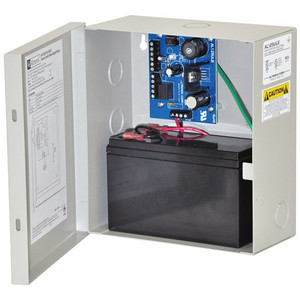
Altronix AL125UL Dual-Output 12/24VDC Power Supply
The Altronix AL125UL is a UL-listed, dual-output power supply and battery charger engineered for access control, fire alarm, and distributed security infrastructure. It accepts 24VAC input and delivers independently configurable 12VDC or 24VDC output at 1A per channel — a practical constraint that means you'll size this for lower-current loads like networked readers, card readers, door locks, and alarm system modules rather than high-draw infrastructure devices. The dual-channel design lets you power mixed-voltage loads from a single unit, reducing overall enclosure count in compact installations.
Key Features
- Dual independent outputs: Configure each channel for 12VDC or 24VDC independently. This eliminates the need for separate 12V and 24V power supplies when you're mixing voltage requirements across access control and alarm devices.
- 1A maximum current per channel: Each output is limited to 1A, which is sufficient for door strikes (typically 600–1000mA), wireless transmission modules, and fire alarm panel circuits, but won't support motor-driven devices or high-current solenoid banks. Plan your load distribution accordingly.
- Integrated battery charging and management: Supports one 12VDC/7AH or two 12VDC/4AH batteries for uninterruptible operation. The unit handles the charging cycle so you don't need a separate charger in the enclosure.
- Supervised fire alarm disconnect: Includes latching or non-latching reset modes for supervised shutdown circuits required by fire code. When triggered, the supply de-energizes and either latches off (requiring manual reset) or allows automatic re-energization — choose the mode that matches your jurisdiction's life-safety requirements.
- Standby runtime of 4 hours at nominal load: With a standard battery, the AL125UL maintains power long enough to handle brief utility outages. The 5-minute alarm runtime ensures critical circuits remain active during detection and notification sequences.
- UL Listed for regulated installations: Compliance with UL standards means this unit is approved for use in facilities subject to fire and security code audits. It's not just a power supply — it's a code-compliant component that auditors recognize.
Integration & Compatibility
The AL125UL fits into larger power supply and infrastructure architectures where you need distributed, supervised power for access control readers and fire alarm circuits. It's designed to wall-mount or integrate into cabinet systems, making it suitable for small-to-medium commercial deployments where enclosure real estate is limited. Because both outputs are independently programmable, you can retrofit mixed-voltage installations without running separate supply lines to different device zones.
The supervised fire alarm disconnect is particularly relevant if your installation includes monitored alarm circuits. It provides the supervisory feedback that central monitoring stations and local panels expect, ensuring that power loss or unauthorized supply shutdown is immediately flagged — a feature that standard unmanaged power supplies don't offer.
When to Choose a Different Model
If your access control or alarm loads exceed 1A per channel, consider higher-amperage Altronix models in the same family. The AL125UL is intentionally designed for distributed, low-current applications; if you're powering a central server, a wireless mesh node with continuous transmission, or a large solenoid lock, you'll outgrow this unit's capacity quickly. Similarly, if you don't require fire alarm disconnect supervision or battery backup, a standard 24VAC-to-12VDC converter is simpler and cheaper.
Frequently Asked Questions
Q: Can the AL125UL power both a door strike and a wireless reader from the same output?
A: Not reliably. A typical door strike draws 600–1000mA on activation, and a wireless reader may draw 200–400mA continuously. You'd exceed the 1A per-channel limit. Distribute these across the two channels — strike on Channel 1 (12VDC), reader on Channel 2 (24VDC) — or use a higher-capacity model if both devices must run simultaneously.
Q: What happens if a battery is not installed?
A: The AL125UL operates as a non-backed-up power supply. It powers your devices normally, but if AC input is lost, output ceases immediately. Battery installation is optional but recommended for life-safety circuits and access control where uninterruptible operation is required by code.
Q: Is the AL125UL compatible with fire alarm systems from any manufacturer?
A: The supervised fire alarm disconnect is a generic logic output designed to interface with industry-standard monitored circuits. Verify with your panel manufacturer that the latching/non-latching configuration matches their input expectations, but UL listing and standard NFPA signaling mean compatibility is broad across major brands.
Q: How long will a 7AH battery sustain power at nominal load?
A: The AL125UL provides 4 hours of standby runtime at nominal load with a 7AH battery. Actual duration depends on your real load current; lighter loads last longer, heavier loads drain faster. Calculate your typical standby amperage (sum of all powered devices) to estimate your specific runtime.
Q: Does the AL125UL support simultaneous charging and load powering?
A: Yes. The unit charges the battery while delivering output to connected devices. During normal AC operation, excess capacity is routed to the battery charger; during AC loss, the battery takes over seamlessly.
Q: What's the warranty on the AL125UL?
A: The AL125UL is covered under Altronix's Lifetime Limited Warranty. This covers manufacturing defects and component failure under normal operating conditions, but does not cover misuse, improper installation, or battery degradation beyond the battery's inherent lifespan.
Ted PerryPerspective based on aggregated IP Security Depot and affiliated engineering team experience.
The Altronix AL125UL is a workhorse for access control and alarm infrastructure in facilities where you need code-compliant, supervised power in a compact footprint. The dual-channel architecture with independent 12/24VDC configuration is genuinely practical — it eliminates the need to cram two separate supplies into a wall cabinet when you're mixing reader voltages and alarm panel requirements. The 1A per-channel limit is not a weakness; it's intentional design for distributed, low-current loads.
Technical Highlights:
- Supervised fire alarm disconnect (latching or non-latching): This feature is essential if your jurisdiction requires monitored shutdown circuits. Central monitoring stations expect supervisory feedback when power is interrupted or reset; the AL125UL provides that via simple relay logic, eliminating the need for a separate supervision module.
- 4-hour standby runtime with 7AH battery: Long enough to survive typical utility blinks and give occupants time to exit during an alarm event. The 5-minute alarm runtime ensures notification circuits stay live during the critical first minutes of a fire or security event.
- Dual outputs at 1A each: This constraint is actually your load-balancing tool. You can't run high-draw devices from a single channel, but you *can* split reader and strike loads across channels without exceeding 1A per line — a cleaner architecture than daisy-chaining power from a single output.
Deployment Considerations:
- Calculate your real steady-state load current before installation. A reader card and transmitter might idle at 300mA but spike to 800mA during credential transmission — if you're adding a door strike to the same channel, you'll trip the 1A limit during simultaneous events.
- Battery selection matters: a 7AH battery gives you 4 hours at nominal load, but your actual runtime depends on simultaneous load. If multiple devices are powered during an outage (reader + strike + alarm circuit), runtime compresses. Plan accordingly and consider dual-battery configuration if life-safety duration is critical.
Deploy the AL125UL in small-to-medium commercial facilities where you're consolidating multiple low-current circuits into a single supervised, code-approved enclosure — a data closet powering door readers and a fire panel, or a telecom room backing up alarm circuits. It's not for centralized high-capacity scenarios, but for distributed security infrastructure where compactness and code compliance are non-negotiable, it's a solid, proven choice.