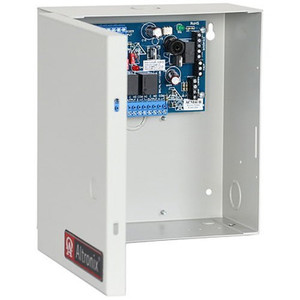
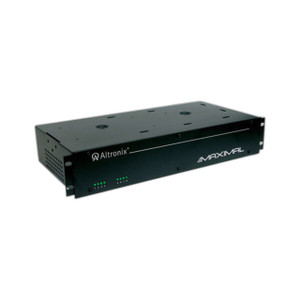
Altronix ACM4E 4-Output Access Power Controller
The Altronix ACM4E is a multi-output access power controller that converts a single 12 to 24 VAC or VDC input into four independently controlled fuse-protected outputs. This device routes power to access control hardware—magnetic locks, electric strikes, and magnetic door holders—with each output configurable for Fail-Safe or Fail-Secure operation modes. It's built for commercial buildings, emergency egress systems, and multi-door security infrastructure where independent output control and fire alarm integration matter.
Key Features
- Four independently controlled 2.5A outputs: Each output is individually fused at 3A/32V, so a fault on one lock doesn't kill power to the other three. A 10A main fuse protects the entire unit—practical in deployments where you can't afford cascading failures across multiple access points.
- Configurable output types: Each output can supply direct 12–24V power, dry form "C" relay contacts (rated 5A), or unswitched auxiliary power. This flexibility means you can mix lock types on a single controller—some pulling direct power, others triggered via relay—without needing separate hardware.
- Flexible trigger inputs: Accepts normally open (NO) or open collector sink signals from access control systems, card readers, keypads, or PIR sensors. No special interface electronics required—simple contact closure or ground signal does the job.
- Dual power input option: Run a single source for both board and lock power, or feed isolated inputs for the controller board and accessory devices. The dual-input design reduces wiring complexity in buildings with distributed power infrastructure.
- Fire alarm disconnect per output: Each output can be individually configured to disconnect on fire alarm signal—essential for emergency egress. You can set some outputs to unlock on alarm and leave others energized, depending on the egress strategy.
- FACP interface: Integrates with fire alarm control panels for alarm monitoring and auxiliary device triggering, tying access control directly into life-safety systems.
Power and Enclosure
Input voltage ranges 12 to 24 VAC or VDC with auto-sensing—no manual configuration needed. The controller consumes 0.4A at 12V or 0.2A at 24V on the board itself, leaving headroom for lock power. Output voltage mirrors the input, so a 24V supply delivers 24V to locks. The BC100 form factor enclosure measures 8.5" × 7.5" × 3.5" (215.9mm × 190.5mm × 88.9mm) and weighs 3.4 lb (1.55 kg), fitting standard electrical cabinets. Power dissipation is minimal—2 BTU/Hr at 12V, 3 BTU/Hr at 24V—so cooling is rarely a concern.
Environmental and Compliance
The ACM4E operates in 0°C to 49°C (32°F to 120°F) environments, suitable for controlled indoor spaces. Storage range extends to –20°C to 70°C. Relative humidity tolerance is 85% ±5%, which covers most indoor access control deployments but rules out direct outdoor cabinet mounting without protection. Access control power infrastructure choices depend heavily on environment—verify enclosure ratings if the controller sits in a weathered location. The unit carries UL294 Access Control and cUL General Signaling Equipment listings, meeting North American safety and signaling standards required by most building codes. Lifetime Limited Warranty covers defects.
When to Choose a Different Model
If you need more than four outputs, Altronix produces higher-channel controllers in the same power infrastructure family. If your access points require higher current per output or greater relay contact ratings, you may need a larger industrial controller. If fail-safe/fail-secure mode flexibility isn't critical and you're only powering simple magnetic locks in a small building, a simpler two-output controller could reduce cost. Consult the access control integration guide to compare controller options against your door count and power budget.
Frequently Asked Questions
Q: Can I use the ACM4E with wireless card readers or access panels?
A: Yes, provided the reader or panel outputs a normally open contact or open collector sink signal. If your access system outputs a voltage signal instead of a contact, you'll need an interface relay or converter.
Q: What happens to the locks if the main power fails?
A: That depends on your Fail-Safe or Fail-Secure configuration per output. Fail-Safe outputs de-energize and unlock on power loss (for emergency egress). Fail-Secure outputs remain locked if power is lost—you'll need battery backup or a separate UPS on the input supply to maintain power during outages.
Q: Is the ACM4E NDAA Section 889 compliant?
A: The datasheet does not specify NDAA compliance. If Section 889 certification is required for your project, contact the manufacturer or a systems integrator familiar with your specific compliance mandate.
Q: Can I integrate the fire alarm disconnect feature with a conventional fire alarm panel, or does it need a smart FACP?
A: The ACM4E supports FACP interface and can accept a simple contact closure from older systems. Confirm with your fire alarm technician that your panel outputs a relay contact suitable for the controller's FACP input.
Q: What's the maximum total current I can draw across all four outputs?
A: The 10A main fuse limits total output current to 10A. With four 2.5A outputs individually fused, you can draw up to 2.5A per output, but the sum cannot exceed 10A—so full-load operation on all four outputs simultaneously is not possible if each lock pulls 2.5A.
Q: Can the ACM4E be mounted outside an electrical cabinet or used in harsh environments?
A: The controller is designed for indoor, climate-controlled enclosures. Operating temperature range is 0°C to 49°C and humidity tolerance is 85% ±5%, which rules out direct outdoor exposure or high-temperature mechanical rooms without additional protection.
Ted PerryPerspective based on aggregated IP Security Depot and affiliated engineering team experience.
The ACM4E delivers practical control over multi-lock installations where independent output protection and fire alarm integration are non-negotiable. The per-output 3A/32V fuses are the real story here—they isolate faults. If one magnetic lock fails shorted or draws excess current, that individual output fuse blows, but the other three keep power. That's not a luxury in production facilities or hospitals where a single faulty door shouldn't cascade into a full access outage.
Technical Highlights:
- Per-output fuse protection (3A/32V) with 10A main fuse: Each lock is isolated from the others. If a magnetic lock or electric strike develops a short, only its output shuts down. The main fuse is your system-level backup.
- Dual power input option: Board and lock power can share a source or run independently. In buildings with separate infrastructure for control logic and device power, this eliminates cross-coupling noise and simplifies troubleshooting.
- Configurable Fail-Safe/Fail-Secure per output: Some doors unlock on power loss (Fail-Safe for emergency egress); others lock down (Fail-Secure for sensitive areas). Single controller, mixed strategy—no need for separate units.
- Fire alarm disconnect per output: You can unlock certain egress doors on alarm signal and keep others energized, tying physical security directly into life-safety without extra hardware.
Deployment Considerations:
- The 10A main fuse limits total draw to 10A across all four outputs—so you cannot run four 2.5A locks simultaneously at full load. Budget current carefully and verify lock datasheets.
- The ACM4E expects simple contact closures or open collector triggers. If your access panel outputs voltage signals or proprietary protocol, you'll need a relay interface or gateway.
- Operating temperature tops out at 49°C (120°F)—adequate for most indoor access cabinets, but too tight for non-conditioned equipment rooms or outdoor-mounted enclosures. Enclosure cooling or relocation may be needed in hot climates.
This controller fits multi-door commercial buildings, data centers, and warehouses where you need independent lock control, fault isolation, and tight integration with fire safety systems. Not for single-door installs or small residential projects—simpler two-output controllers cost less there. But for any facility with three or more access points requiring coordinated power and emergency egress logic, the ACM4E's independent outputs and per-channel fusing justify the footprint.