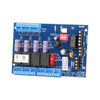
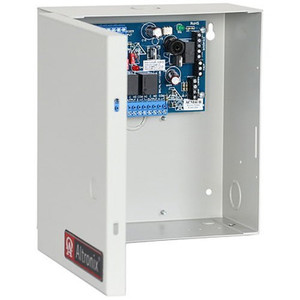
Altronix ACM4 4-Output Access Power Controller
Overview
The Altronix ACM4 is a power distribution controller purpose-built for access control installations. It accepts a single 12–24 VAC or VDC input and converts it into four independently controlled fused relay outputs, each capable of driving mag locks, electric strikes, magnetic door holders, and similar electromechanical hardware. The ACM4 eliminates the need to run separate power circuits to each access device — a real cost and labor saving on larger multi-door installations — by centralizing power conversion and control in a single UL 294–listed board.
Key Features
- Auto-sensing 12–24 VAC/VDC input: No jumpers or configuration required. Plug in power from nearly any control panel or power supply and the ACM4 adapts automatically, reducing commissioning time and the risk of installation errors on multi-site deployments.
- 4 independently fused outputs: Each output has its own fuse protection and operates as a form "C" dry contact relay. If one mag lock draws excessive current, only that output fuse trips; the other three remain live. This isolation prevents a single device failure from disabling the entire entrance.
- Fail-safe and fail-secure modes per output: Configure each output independently — some doors (e.g., emergency egress) can unlock on power loss (fail-safe), while others (e.g., secure areas) remain locked (fail-secure). No additional hardware needed; mode selection is tied to how you wire the dry contacts.
- Fire alarm disconnect selectable per output: Individual outputs can be assigned to respond to fire alarm control panel (FACP) signals. When a fire alarm triggers, designated doors unlock for emergency egress while others remain secure — critical for life safety compliance and coordination with integrated fire systems.
- LED status indicators: Relay and FACP status LEDs give technicians immediate visual feedback during commissioning and troubleshooting, cutting diagnostic time on multi-output boards.
- Open collector and dry contact trigger inputs: Accepts control signals from card readers, keypads, push buttons, PIR sensors, and standard access control system outputs. No signal conditioning or external relays needed in most cases.
Integration & Compatibility
The ACM4 integrates with any standard access control system or FACP that can output dry contacts or open collector signals. The board supports a single common power source for both control logic and locking devices, or two independent isolated sources if your installation requires isolated supplies (e.g., backup battery on one circuit, main AC on another). UL 294 listing for access control applications and cUL rating per CSA Standard C22.2 No.205-M1983 mean it meets North American fire and safety code requirements for access control power distribution.
Deployment Considerations
The 10A main fuse is sized for typical mag lock and electric strike current loads. If you plan to drive high-current devices (large electromagnetic locks, multiple solenoids from a single output), verify that the aggregate current on any single output stays under the output fuse rating — consult the ACM4 datasheet for detailed current limits and wiring diagrams. The board occupies minimal DIN rail space and mounts standard in any control cabinet alongside access control panels or power distribution equipment.
If your installation uses a legacy wired push-button or card reader system, verify that control signals are compatible with the ACM4's input sensitivity — most readers output 5–12V control signals that work directly, but some older 24V logic may require a simple pull-down resistor. The datasheet includes wiring examples for common scenarios.
When to Choose a Different Model
If your installation requires more than four independent outputs or needs programmable logic (e.g., multi-step unlock sequences, timed relay pulses), consider a higher-capacity Altronix power distribution controller from the same family. The ACM4 is a straightforward relay multiplexer; it is not a programmable control module. For simple door-by-door power distribution to standard electromechanical locks, it excels; for complex automation, you will need additional logic or a dedicated access control processor.
Frequently Asked Questions
Q: Can I use the ACM4 with a 24V DC power supply and a 12V AC transformer on the same board?
A: The ACM4 accepts a single input voltage at a time. The board auto-senses whether 12–24 VAC or VDC is applied; you cannot mix them on a single input. If your installation requires both voltage rails, use a separate ACM4 for each, or wire them to power different subsets of outputs from independent supplies.
Q: Does the ACM4 work with modern networked access control systems?
A: Yes, as long as the control system can output standard dry contacts or open collector signals. Most modern IP-based access controllers (whether cloud-hosted or on-premise) have relay outputs that interface directly with the ACM4. Networked card readers and keypads also generate standard relay-compatible signals.
Q: What happens if a mag lock draws more current than the output fuse rating?
A: The fuse protecting that individual output will blow, cutting power to that device and protecting the wiring and relay contacts. The other three outputs remain unaffected. Replace the fuse with an identical rated part and investigate why the mag lock exceeded its rated current (frozen mechanism, worn bearings, or incorrect power supply voltage).
Q: Is the ACM4 suitable for outdoor installations?
A: The ACM4 itself is a control board designed for indoor cabinet mounting. It is not rated for outdoor environmental exposure (rain, salt spray, wide temperature swings). Mount it in a weatherproof enclosure or control panel indoors, and run power and signal wiring to outdoor mag locks or strikes.
Q: Can I configure some outputs fail-safe and others fail-secure on the same ACM4?
A: Yes. Fail-safe vs. fail-secure operation is determined by how you wire the dry contact output (whether the relay contact energizes or de-energizes the locking solenoid). You can mix modes on a single board by wiring outputs differently. Consult the datasheet for wiring diagrams for each configuration.
Ted PerryPerspective based on aggregated IP Security Depot and affiliated engineering team experience.
The ACM4 is a workhorse relay multiplexer that solves a real problem on multi-door access control jobs: how to centralize power distribution and control signaling without running separate 12 or 24V circuits to every lock. The auto-sensing 12–24 VAC/VDC input is a genuine time-saver during commissioning — no jumpers, no configuration, no field mistakes. On a 10-door retrofit where you're retrofitting existing panels and power supplies, that alone buys you an afternoon.
Technical Highlights:
- 4 independently fused outputs: Each output has its own fuse protection, so a short or overload on one mag lock doesn't cascade to kill the entire system. On a large entrance suite, this isolation translates directly to uptime — one door stays accessible while you troubleshoot the failed device.
- Selectable fire alarm disconnect per output: Not all doors need to unlock during a fire alarm. The ACM4 lets you assign specific outputs to respond to FACP signals while others remain independent. This granularity keeps secure areas secure during an alarm while unlocking egress routes — essential for life safety and code compliance.
- Fail-safe and fail-secure modes on the same board: Wire outputs differently to achieve different behavior on power loss. Emergency exits can fail-safe (unlock on power loss); secure areas can fail-secure (remain locked). No additional relays or logic modules required.
Deployment Considerations:
- The 10A main fuse is appropriate for typical mag lock loads (4–8A per output under normal conditions). If you're stacking multiple solenoids or high-current devices on a single output, verify aggregate current against the datasheet spec — undersized wiring or overloaded fuses will be your field failure point.
- This is a relay multiplexer, not a programmable controller. If your project needs timed pulses, sequenced unlocks, or conditional logic, the ACM4 won't handle it alone — you'll need a dedicated access control processor or additional logic module upstream.
Deploy the ACM4 on straightforward multi-door access jobs where you need to consolidate power and relay control. Typical scenarios: multi-tenant office suites with shared entry control, warehouse loading doors, modular security additions to existing buildings. The UL 294 rating and fire alarm integration support mixed-use and commercial occupancy code requirements without extra engineering.