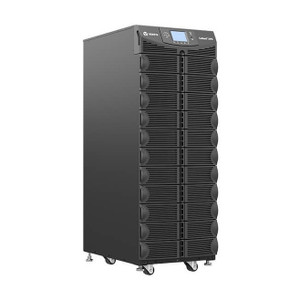
Vertiv AL4B0NHVGNNXLKB 10KVA/9KW Lithium-Ion Hot-Swappable UPS
Overview
The Vertiv AL4B0NHVGNNXLKB is a 10KVA/9.0KW lithium-ion UPS configured for 208VAC line-to-line-to-ground (LLG) input with 208/120VAC output — the configuration that fits directly into most North American three-phase commercial power environments without additional step-down transformers. At 8 minutes of runtime at full load, this unit is sized to carry critical infrastructure through brief utility interruptions and generator transfer events, not extended outages. If your facility runs a generator that transfers within 30–60 seconds, 8 minutes is a substantial safety margin. If you need sustained runtime, plan for additional battery strings before specifying this model.
The AL4B0NHVGNNXLKB runs LiFePO₄ (lithium iron phosphate) chemistry rather than conventional VRLA lead-acid. That distinction matters operationally: LiFePO₄ cells are significantly more thermally stable than other lithium chemistries and do not require the same derating in warmer equipment rooms. Where lead-acid batteries lose capacity and service life rapidly above 25°C, this unit actually performs better in elevated ambient temperatures — a real advantage in telecom closets, IDF rooms, and edge deployments where cooling is limited or intermittent.
Key Features
- LiFePO₄ Chemistry: Thermal stability is the primary reason to choose lithium iron phosphate over standard Li-ion or lead-acid in data center and security applications. LiFePO₄ has a substantially lower risk of thermal runaway, making it the chemistry of choice when the UPS sits inside a rack or enclosed cabinet rather than a dedicated battery room.
- Up to 10-Year Service Life: VRLA lead-acid batteries in similar UPS units typically require replacement every 3–5 years. A 10-year design and service life on the AL4B0NHVGNNXLKB means you eliminate at least one — likely two — battery replacement cycles over the equipment's useful life, reducing both total cost and the labor associated with scheduled battery swaps.
- Under 4.5-Hour Recharge Time: After a full discharge event, the battery returns to operational charge in under 4.5 hours. For facilities that experience rolling utility issues or multiple outages per maintenance window, faster recharge directly reduces exposure time between events.
- Advanced BMS with Cell-Level Monitoring: The battery management system monitors individual cells rather than the string as a whole. Cell-level visibility catches early degradation before it becomes a capacity or safety issue — a meaningful operational advantage over battery strings that only report aggregate voltage and temperature.
- ~46 lbs Per Battery String: At roughly 46 pounds per string, this lithium battery system is substantially lighter than equivalent lead-acid configurations. That weight reduction has real consequences for floor loading calculations, rack weight budgets, and physical installation — particularly relevant for raised-floor data centers with strict point-load limits or for roof-mounted telecom enclosures.
- Hot-Swap Capable: The HOT designation indicates the battery strings are field-replaceable under load. This means scheduled battery maintenance or end-of-life replacement does not require a planned outage or manual load transfer — critical for 24/7 operations like surveillance recording infrastructure, network operations centers, or access control head-end equipment.
- Minimal Maintenance Requirements: Unlike lead-acid systems that require periodic equalization charges and electrolyte checks, this lithium system's maintenance burden is minimal. Reduced maintenance overhead translates directly to lower total cost of ownership across the 5-year warranty period and beyond.
- 5-Year Warranty (UPS + Batteries): The 5-year warranty covers both the UPS electronics and the battery system — not just the inverter/charger hardware. Battery warranty coverage is often sold separately or excluded at shorter durations; a unified 5-year term on both components simplifies vendor accountability and service planning.
- Lower Total Cost of Ownership: The combination of 10-year service life, minimal maintenance, lighter weight (reducing installation costs), and a single long warranty period positions the lifecycle cost well below comparably sized lead-acid UPS platforms when you account for battery replacement cycles and associated labor.
Integration and Compatibility
The AL4B0NHVGNNXLKB accepts 208VAC three-phase LLG input — the standard configuration found in most North American commercial buildings, data centers, and industrial facilities fed from a 208Y/120V distribution panel. The dual-voltage 208/120VAC output simultaneously supports both three-phase loads (servers, network switches, high-draw appliances) and single-phase 120VAC loads (workstations, access control panels, IP phone systems, PoE injectors) without requiring additional distribution hardware.
For network video recorder deployments and larger IP camera infrastructure — especially in multi-building enterprise security installations — this UPS class supports the head-end equipment loads (NVRs, managed PoE switches, access control servers) that must stay online through grid disturbances. The lithium chemistry is also well-matched to edge and remote deployments where an HVAC failure or seasonal temperature spike would degrade a lead-acid battery well before its rated service interval.
Consult the Vertiv UPS and power protection catalog for compatible external battery cabinets if runtime beyond 8 minutes is required for your application. Pair with an appropriate power distribution unit to branch the 208/120VAC output to your rack loads.
Frequently Asked Questions
Q: What is the battery chemistry in the AL4B0NHVGNNXLKB, and why does it matter?
A: The AL4B0NHVGNNXLKB uses LiFePO₄ (lithium iron phosphate) chemistry. Compared to standard VRLA lead-acid or other lithium variants, LiFePO₄ offers significantly better thermal stability — reducing the risk of thermal runaway — and performs better in elevated ambient temperatures. This makes it appropriate for equipment rooms where cooling cannot be guaranteed.
Q: What is the warranty on the AL4B0NHVGNNXLKB?
A: The AL4B0NHVGNNXLKB carries a 5-year manufacturer warranty that covers both the UPS unit and the batteries. Battery coverage is included — not sold separately or offered at a shorter term.
Q: Can the batteries be replaced without taking the UPS offline?
A: Yes. The HOT designation in the product name indicates the battery strings are hot-swappable — they can be replaced under load without interrupting output power to connected equipment.
Q: How long does it take to recharge after a full discharge?
A: Recharge time is under 4.5 hours from full discharge back to operational capacity. For facilities that see recurring utility events, this limits the window of vulnerability between incidents.
Q: What is the expected service life of the batteries?
A: Vertiv rates the battery service life at up to 10 years — roughly double the typical 4–5 year replacement interval of VRLA lead-acid alternatives. This significantly reduces lifecycle replacement costs and maintenance scheduling over the equipment's useful life.
Q: How heavy are the battery strings, and does this affect rack or floor planning?
A: Each battery string weighs approximately 46 lbs. Lithium-ion configurations at this power class are substantially lighter than equivalent lead-acid strings, which simplifies rack weight budgets and floor loading calculations in raised-floor data centers or space-constrained wiring closets.
The spec I keep coming back to on the AL4B0NHVGNNXLKB is the cell-level BMS monitoring. Most UPS platforms at this power class report battery health at the string level — you get aggregate voltage and temperature, and the first sign of a problem is often an unexpected failure during an actual outage. Cell-level visibility changes that calculus: you can catch a degrading cell cluster during a routine check rather than during a live event.
Technical Highlights:
- LiFePO₄ Thermal Stability: In equipment rooms that run warm — above 25°C seasonally or persistently — lead-acid batteries lose capacity and shorten service life measurably. LiFePO₄ chemistry does not carry that penalty, which is why this unit makes sense in IDF rooms, edge closets, and any space where cooling is not tightly controlled.
- 10-Year Design Life: At a 3–5 year lead-acid replacement cycle, a typical 10KVA installation sees two battery replacements before the UPS hardware reaches end of life. The AL4B0NHVGNNXLKB eliminates both of those replacement events and their associated labor, disposal costs, and downtime exposure.
- Sub-4.5-Hour Recharge: For facilities that experience multiple utility events in a maintenance window — not uncommon in coastal storm regions or aging grid areas — a recharge time under 4.5 hours means you are back to full protection faster than most lead-acid systems at comparable capacity.
Deployment Considerations:
- The 8-minute runtime is designed for generator-transfer scenarios, not extended outages. Confirm your generator transfer time and add a buffer before committing to this runtime spec — if transfer takes longer than 2–3 minutes under load, calculate your actual runtime margin carefully at your specific connected load, not at the nameplate 10KVA.
- At ~46 lbs per battery string, installation is manageable for a two-person team, but confirm your rack's weight rating before deployment. Lithium is lighter than lead-acid at equivalent capacity, but the total system weight in a populated rack still adds up quickly.
This unit is well-positioned for enterprise security head-end rooms — specifically rack environments housing NVRs, managed PoE switches, and access control servers — where hot-swap battery maintenance, reduced floor load, and long service intervals are operationally important and where an 8-minute bridge to a facility generator is the actual design requirement.