StarTech PCIUSB7 7-Port PCI USB 2.0 Expansion Card
Overview
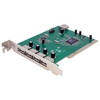
The StarTech PCIUSB7 is a standard-profile PCI expansion card that adds seven USB 2.0 ports to a desktop workstation or server through a single open PCI slot. Four Type-A ports face outward on the card bracket for external device connections, while an internal Type-A port and an IDC 10-pin header provide two more internal connection points — making it a practical choice for integrators retrofitting aging surveillance workstations or DVR hosts with inadequate native USB capacity. At 480 Mbps per the EHCI 2.0 spec, it handles the throughput demands of USB-attached storage, capture devices, and peripheral hubs without additional hardware investment.
For security and automation deployments where the host PC predates widespread onboard USB proliferation — or where available ports have been consumed by dongles, keyboard/mouse, and local storage — the PCIUSB7 closes that gap directly at the motherboard level rather than through downstream hub cascading, which can introduce latency and power contention on loaded channels.
Key Features
- 4 External USB 2.0 Type-A Ports: All four face-mounted ports are accessible from the rear of the chassis immediately after installation — no driver configuration required before connecting keyboards, card readers, USB security dongles, or enrollment peripherals. Having four discrete root-level connections (not a hub chain) keeps each device on its own bandwidth allocation.
- 1 Internal USB 2.0 Type-A + 1 IDC 10-Pin Header: The internal Type-A port supports direct attachment of internal USB storage or adapters without consuming a rear bracket port. The IDC 10-pin header can connect to a front-panel USB header on the chassis, effectively adding front-panel USB 2.0 access on systems where the motherboard's internal headers are already occupied.
- 480 Mbps Maximum Transfer Rate: USB 2.0 Hi-Speed at 480 Mbps is sufficient for biometric enrollment readers, access control hardware, USB-attached configuration dongles, and low-bandwidth surveillance accessories. It is not the right choice for USB 3.0-class bulk storage transfers — but for peripheral-class devices in a security workstation role, 480 Mbps rarely becomes the bottleneck.
- PCI / PCI-X Bus Compatibility (5V / 3.3V): Supports both 5V and 3.3V PCI signaling and is compliant with PCI 2.2, which covers the majority of legacy workstations and industrial PCs still running in access control head-end and DVR roles. If your target host has only PCIe slots, this card will not fit — verify the slot type before ordering.
- EHCI 2.0 and OHCI 1.1 Compliance: Dual-controller architecture means the card handles both Hi-Speed (480 Mbps, EHCI) and Full-Speed / Low-Speed (12 Mbps / 1.5 Mbps, OHCI) USB devices natively. Older peripherals that enumerate at Full Speed — common in legacy access hardware — work without compatibility workarounds.
- Standard Profile Form Factor: At 4.8 × 4.7 × 0.8 in (12.2 × 12.0 × 2.0 cm) and 2.6 oz (75 g), the card fits standard ATX and mid-tower chassis without a low-profile bracket swap. If the target system is a slim or small-form-factor chassis, check whether a low-profile variant is required before installation.
- 2-Year Manufacturer Warranty: A two-year warranty on a passive expansion card is a reasonable baseline for a long-term deployment — relevant when the card is installed in a head-end rack that won't be revisited frequently.
Integration and Compatibility
The PCIUSB7 installs into any open PCI 2.2-compliant slot running at 5V or 3.3V signaling. Most modern operating systems — Windows, Linux distributions — include native EHCI/OHCI drivers, so the card typically enumerates without third-party driver packages. For PCI expansion cards in surveillance and access control workstations, confirm the host OS has EHCI support enabled in BIOS before installation, as some legacy BIOS configurations default to full-speed USB only.
This card is a strong fit alongside USB hubs and peripherals in workstations running access control management software that requires multiple simultaneous USB-attached readers or credential enrollment stations. It also complements surveillance system accessories where USB-attached configuration or backup devices need dedicated bandwidth separate from the primary system bus. For integrators planning a full workstation build or upgrade, pairing this with adequate internal power supplies ensures the PCI slot receives clean 5V / 3.3V rails under load.
Note that this card does not provide USB 3.0 or USB-C connectivity. If the deployment requires SuperSpeed (5 Gbps+) data transfer — for example, streaming uncompressed video from a USB 3.0 capture device — a PCIe-based USB 3.0 expansion card is the correct tool. The PCIUSB7 is specifically optimized for high port-count peripheral expansion on PCI-bus legacy systems.
Frequently Asked Questions
Q: Does the PCIUSB7 require a separate power connector from the system PSU?
A: Based on available specifications, the PCIUSB7 draws power directly from the PCI slot (5V / 3.3V bus). No separate Molex or SATA power connector is documented as required for this card.
Q: Will the PCIUSB7 fit in a low-profile or slim desktop chassis?
A: The PCIUSB7 is a standard-profile card (4.8 × 4.7 in bracket). It will not fit slim or low-profile enclosures without a low-profile bracket. Verify your chassis form factor before ordering.
Q: What is the maximum data transfer rate supported by the PCIUSB7?
A: The PCIUSB7 supports USB 2.0 Hi-Speed at 480 Mbps maximum. It also supports Full-Speed (12 Mbps) and Low-Speed (1.5 Mbps) USB devices via its OHCI 1.1 controller, ensuring backward compatibility with older peripherals.
Q: How many total USB ports does the PCIUSB7 provide?
A: The PCIUSB7 provides 7 USB 2.0 ports total: 4 external Type-A ports on the rear bracket, 1 internal Type-A port, and 1 internal IDC 10-pin header (which can connect to a chassis front-panel USB header for additional external access).
Q: Is the PCIUSB7 compatible with PCIe slots?
A: No. The PCIUSB7 uses a legacy PCI / PCI-X bus interface compliant with PCI 2.2. It is not physically or electrically compatible with PCIe (PCI Express) slots. Check your motherboard for an open legacy PCI slot before purchasing.
Q: What is the warranty on the PCIUSB7?
A: The PCIUSB7 carries a 2-year manufacturer warranty.
When I spec the PCIUSB7 for a deployment, the conversation usually starts with a legacy access control workstation or a DVR head-end that has exhausted its native USB ports — typically a machine with two or three onboard ports already consumed by a keyboard, mouse, and a USB security dongle. The PCIUSB7 resolves that with seven USB 2.0 connections from a single PCI 2.2 slot, and the dual-controller design (EHCI 2.0 for Hi-Speed, OHCI 1.1 for Full/Low-Speed) means mixed-speed peripheral loads enumerate cleanly without manual driver workarounds.
Technical Highlights:
- 480 Mbps Hi-Speed Throughput: EHCI 2.0 compliance delivers the full USB 2.0 Hi-Speed ceiling — adequate for biometric readers, credential enrollment hardware, and USB-attached backup drives in a security operations context where sustained bulk transfer rates rarely exceed 30–40 MB/s in practice.
- 7 Total Ports Across External and Internal Headers: The split of 4 rear-bracket Type-A + 1 internal Type-A + 1 IDC 10-pin header means you can simultaneously serve rear-panel peripherals and route a connection to a front-panel chassis header — useful when the workstation is rack-mounted and front-panel USB access is preferred for enrollment tasks.
- Standard-Profile at 4.8 × 4.7 × 0.8 in, 2.6 oz: The physical footprint is compact enough to slot into any ATX or mid-tower chassis without bracket modification, and the 75g weight means there is no stress concern on the PCI slot retention mechanism during transport or vibration environments.
Deployment Considerations:
- Confirm the target host has at least one open legacy PCI (not PCIe) slot before ordering — this is the most common installation error on systems built after 2010, where PCI slots were progressively replaced by PCIe x1 slots that are physically incompatible with this card.
- The PCIUSB7 is rated for USB 2.0 only (480 Mbps max). If any connected device requires USB 3.0 SuperSpeed bandwidth — such as a USB 3.0 UPS communications adapter or a high-speed capture device — this card will throttle that device to USB 2.0 speeds or may not enumerate it at all depending on the device's backward-compatibility behavior.
The PCIUSB7 is the right specification call for a security integrator retrofitting a legacy PCI-bus access control workstation or DVR host where onboard USB ports are saturated and the system does not have available PCIe slots — particularly in industrial or government installations where replacing the host platform entirely is not an option within the project budget or timeline.