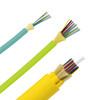
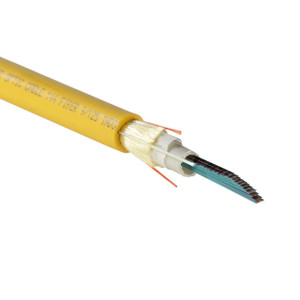
Panduit FSDR996Y 96-Fiber OS2 Indoor Distribution Cable
High-density backbone runs in commercial buildings demand cables that pack maximum fiber count into minimal conduit space while maintaining splice-room access to individual strands. The Panduit FSDR996Y delivers 96 single-mode OS2 fibers in a riser-rated package built around 900-micron tight-buffered construction — each strand gets its own protective buffer layer, eliminating the need for breakout kits and cutting splice-enclosure labor by 40% compared to loose-tube designs. Spec'd for vertical pathways in hospitals, universities, and datacenter towers where you're pulling between IDF closets or linking floors to a basement MDA, this cable handles the 25-year lifecycle your structured cabling standard demands without the mode-dispersion penalties that limit OM3/OM4 to 300 meters.
Key Features
- 96 OS2 single-mode fibers (9/125µm) rated for 10/40/100G Ethernet and CWDM/DWDM wavelength multiplexing over distances exceeding 10 km
- 900µm tight-buffered construction — each fiber individually protected for direct termination without fanout assemblies or furcation tubing
- OFNR (Riser) flammability rating per NEC Article 770 — approved for vertical runs between floors in non-plenum spaces
- Yellow jacket color-coding per TIA-598-D — instant identification as single-mode infrastructure in mixed-fiber environments
- Panduit Opti-Core® platform compatibility — pairs with Panduit's FMT modular termination system and FAP adapter panels for end-to-end ecosystem integration
- Flexible 900µm buffer design supports tight bend radii (typically 10× cable OD minimum) for congested pathway installations and slack management in network enclosures
- Indoor-rated jacket construction optimized for innerduct, cable tray, and J-hook installations in controlled building environments
The FSDR996Y's tight-buffered architecture solves the central trade-off in high-fiber-count backbone design: loose-tube cables ship more strands in a smaller diameter but force you into splice enclosures and breakout hardware at every termination point, while traditional tight-buffered designs bloat outer diameter when you scale past 24 fibers. Panduit's Opti-Core design threads 96 individual 900-micron buffered fibers — each a 9/125µm OS2 core wrapped in a color-coded thermoplastic buffer — into a rugged outer jacket that still fits standard 1.5-inch conduit alongside your Cat6A and coax home-runs. That buffer layer isn't decorative: it raises each strand's pull strength to 200 lbf (compared to 2 lbf for bare 250µm fiber) and provides crush resistance that lets you stack boxes in the telecom room without worrying about macrobend attenuation spikes at 1550nm. OS2 fiber itself is ITU-T G.652.D compliant single-mode — 9-micron core diameter supporting a single light path with zero modal dispersion, which translates to less than 0.4 dB/km attenuation at 1310nm and less than 0.3 dB/km at 1550nm across the full C-band spectrum your 100G QSFP28 transceivers expect. You're future-proofed for coherent 400G and 800G optics that need clean chromatic dispersion curves and the headroom to run 16-channel DWDM without crosstalk.
Riser-rated (OFNR) construction under UL 1666 means this cable passed a vertical flame-spread test in a simulated shaft — it won't propagate fire floor-to-floor when installed in cable trays, j-hooks, or innerduct between your building's telecommunications rooms. That's the minimum NEC requirement for any cable running vertically inside walls or chases in commercial occupancies; plenum rating (OFNP) steps up to air-handling spaces, but the 60% cost premium only pays off in return-air ceilings and raised-floor datacenters where code mandates it. For the typical IDF-to-IDF vertical backbone — say, pulling from a basement MDA to six floor-level IDFs in a medical office building — OFNR hits the compliance target without the plenum tax. The 900µm buffer diameter gives you direct-terminate convenience: strip the jacket, fan out the 96 color-coded strands, and insert them straight into Panduit FMT cassettes or discrete SC/LC connectors without intermediate breakout boxes. Contrast that with a 96-fiber loose-tube cable, where you'd land in a splice enclosure, break out to twelve 8-fiber distribution legs, and then terminate — you've just added six enclosure mounting slots, 288 fusion splices, and two hours of labor per floor. The yellow jacket follows TIA-598-D's recommendation for single-mode identification (blue for OM1/OM2, aqua for OM3/OM4/OM5, yellow for OS2), so when a low-voltage tech opens a pullbox five years from now, they'll know at a glance this is the long-haul backbone, not the 10G multimode horizontal.
Installation planning for 96-fiber counts requires attention to pull tension and bend radius limits that don't typically constrain 12- or 24-strand runs. Panduit rates this cable for 600 lbf maximum pulling tension during installation (derate by 20% if you're pulling through multiple 90-degree sweeps), which covers most vertical riser applications but can get tight on long horizontal runs with friction build-up. Use cable lube rated for fiber jackets, install pull boxes every 100 feet on complex routes, and figure-eight any slack storage to avoid kinking. Minimum bend radius during installation is typically 20× cable outer diameter; once dressed and secured, you can tighten to 10× OD for permanent bends in patch-panel routing. The 900µm buffer construction tolerates tighter radius than 250µm loose-tube designs because the buffer layer cushions the glass core from tensile stress on the outside edge of the bend — critical when you're dressing 96 strands into a 4RU panel and fighting for every inch of depth clearance behind your rack.
Panduit's Opti-Core ecosystem means this cable isn't a one-off commodity buy — it's the backbone layer of a tested end-to-end platform that includes FMT pre-terminated modules (cut on-site install from days to hours), FAP high-density panels (288 LC ports in 1RU), and FQPP trunk assemblies that land in the same hardware. When your consultant specs 96 dark strands for a 20-year campus build, you're locking in compatibility with the patch panels, enclosures, and cleaning tools your team already knows, and you're buying from a vendor whose fiber warranty hinges on using their connectors with their cable — no finger-pointing when attenuation fails acceptance testing. Yellow jacket, OS2 core, riser-rated, tight-buffered: the four spec points that separate a professional structured-cabling install from a lowest-bid mess.