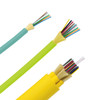
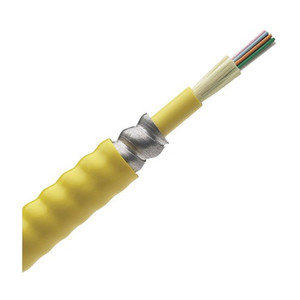
Panduit FSDP996Y 96-Fiber OS2 Plenum Indoor Distribution Cable
The Panduit FSDP996Y delivers 96 strands of OS2 single-mode fiber in a plenum-rated indoor distribution cable, engineered for high-density backbone installations where long-haul bandwidth and future scalability drive design. Each fiber carries a 900-micron buffer—thicker than tight-buffered designs—for faster, more forgiving termination in the field and better protection during pulls through congested pathways. The OFNP flame rating clears plenum air-handling spaces without conduit, and the yellow jacket follows TIA-598-C color convention for instant single-mode identification on job sites. Sold by the foot, this cable ships on reels for custom-length runs in datacenters, campus backbones, and enterprise security networks where camera counts and switch fabrics demand fiber density you won't outgrow.
Key Features
- 96 OS2 single-mode fibers — 9/125µm core/cladding for 10/40/100G+ data rates and distances beyond 10 km per strand
- 900µm buffered construction — reduces termination time, improves pull-force tolerance, and simplifies fan-out kitting versus 250µm tight-buffered designs
- Plenum OFNP rating — UL 910 / NFPA 262 compliant for unrestricted installation in return-air plenums and horizontal ceiling runs without conduit
- Yellow PVC jacket — TIA-598-C standard single-mode identifier; quick visual confirmation during trunk installation and MACs
- Opti-Core sub-brand heritage — Panduit's flagship fiber platform, specified in Fortune 500 datacenters and critical infrastructure projects worldwide
- Reel-packaged bulk cable — order by the foot; accommodates exact custom lengths for riser verticals, horizontal distribution, and inter-building runs
OS2 single-mode fiber is the only architecture that scales cleanly from 1G to 100G and beyond on the same physical strand, making the FSDP996Y a true future-proof investment for integrators designing security networks, datacenter fabrics, or campus LANs with ten-year horizons. Each of the 96 fibers supports attenuation below 0.4 dB/km at 1310 nm and below 0.3 dB/km at 1550 nm, enabling 10GBASE-LR runs beyond 10 kilometers, 40GBASE-LR4 to 10 km, and 100GBASE-LR4 to equivalent distances without repeaters—critical when you're trunking NVR arrays across buildings or backhauling edge switches to a core. The 900-micron buffer layer surrounding each fiber is three times the diameter of standard 250µm tight-buffered designs, which translates directly to faster termination: you can cleave and polish or mechanical-splice without stripping multiple jacket layers, and the extra thickness forgives minor handling errors during high-density breakout kitting. In congested riser shafts where cables jostle against steel conduit edges and sharp pathway transitions, that buffer absorbs impact and prevents microbending losses that degrade link budgets over time. Panduit publishes a minimum bend radius of ten times the cable's outside diameter during installation and twenty times at rest; with this cable's approximate 0.55-inch OD, you're working with a 5.5-inch dynamic radius and 11-inch static radius—tighter than many competitive 96-strand designs, which matters when you're navigating crowded cable trays in retrofit jobs.
In large-scale IP security deployments—think 200+ camera enterprise campuses or multi-tenant commercial properties with distributed NVRs—fiber backbone design becomes the chokepoint that either enables or throttles your surveillance architecture. A single 96-strand trunk from a core IDF to remote IDFs can fan out into 24 four-strand groups (one per 40G QSFP+ uplink), 12 eight-strand groups (redundant paths for high-availability switch stacks), or 96 individual LC connections for dense 10G SFP+ server-to-switch fabrics. This density eliminates the need for multiple cable pulls, reduces pathway congestion, and simplifies MAC work: when you need to light up another floor or add a redundant link, you're patching existing dark fiber rather than scheduling a new pull. The plenum rating is non-negotiable in commercial projects governed by NEC Article 770 and local AHJ interpretations—any cable in a return-air plenum (the space above drop ceilings in most office buildings) must meet NFPA 262 flame-spread limits or run in metallic conduit, and conduit labor often doubles installation cost. OFNP-rated cable like the FSDP996Y installs bare on cable tray or J-hooks, cutting labor hours and leaving room in pathways for future adds. The yellow jacket is more than cosmetic: TIA-598-C specifies yellow for single-mode, orange for multimode OM1/OM2, aqua for OM3/OM4, and lime green for OM5, so your day-two techs can identify the cable type from across a telecom room without tracing to a label or pulling out a fiber scope—small detail, huge time-saver during troubleshooting or after-hours MACs.
The FSDP996Y is UL listed and RoHS compliant, meeting both NFPA 262 plenum fire safety standards and California Proposition 65 material restrictions—table stakes for institutional projects with formal procurement specs and municipal permitting workflows. What sets Panduit's Opti-Core line apart is the vendor's end-to-end ecosystem approach: the same 900µm buffer diameter aligns with Panduit's FAP fiber adapter panels, FMP modular cassettes, and pre-terminated MTP trunk assemblies, so you can mix field-terminated custom lengths (FSDP996Y bulk cable) with factory-terminated plug-and-play modules in the same rack without mismatched bend-radius limits or incompatible breakout hardware. For integrators managing design-build security contracts where the fiber backbone must outlast three generations of cameras and switches, this is the spec: high strand count for growth, OS2 for infinite bandwidth scaling, plenum rating for code compliance, and a buffer size that keeps termination labor predictable even when you're training new techs mid-project.