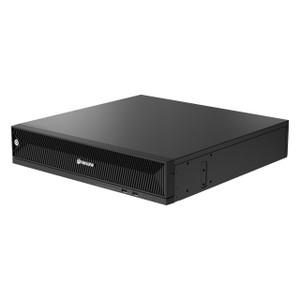
Hanwha XRN-3220B2-32TB 32-Channel Network Video Recorder
The XRN-3220B2-32TB is a 32-channel enterprise-class network video recorder built on 12th-generation Intel architecture, engineered to handle ultra-high resolution camera feeds at scale without compromise on storage efficiency or processing headroom. This unit accepts up to 32 MP resolution per channel—well beyond typical 4K or 5MP deployments—making it suitable for forensic-detail environments, critical infrastructure, and large warehouse or campus installations where resolution density drives operational decisions.
Key Features
- 32 MP camera support with fisheye dewarping: Handles the highest resolution network video recorders cameras without delegating dewarping to external systems. Dewarping occurs at the display level, preserving full archive resolution in storage—a meaningful difference when forensic review or post-incident analysis demands pixel-level detail that cannot be re-interpolated.
- H.265 compression with H.264 and MJPEG fallback: H.265 reduces storage consumption 40–60% compared to H.264 baselines, depending on scene complexity and motion activity. At 32 channels recording 24/7, this difference translates directly to cost—a year of H.265 storage often costs less than six months of H.264 on the same drive capacity. Dual-stream support lets you record one high-fidelity archive stream and one bandwidth-optimized stream per camera simultaneously, eliminating the need to re-encode for remote playback or secondary systems.
- 520 Mbps recording bandwidth (distributed mode) / 300 Mbps (normal mode): Distributed mode spreads processing load across multiple processor threads, preventing bottlenecks when all 32 channels simultaneously push high-resolution feeds—critical in control rooms where every camera must record without frame drops during peak activity. Normal mode preserves CPU headroom if your actual camera count or resolution mix is lighter, reducing power draw and heat output in smaller deployments.
- WiseStream intelligent bandwidth optimization: Automatically adjusts compression parameters based on scene activity and content complexity. Static scenes receive heavier compression; motion triggers preservation of detail. Real bitrate savings in mixed-camera environments—warehouses with fixed perimeter cameras plus active dock areas benefit measurably.
- 32TB pre-installed, expandable to 80TB across eight SATA HDD bays: Each bay accepts drives up to 10TB, eliminating day-one upgrade costs and simplifying initial deployment. Eight-bay architecture supports N+1 redundancy—if one drive fails, recording continues on the remaining seven without downtime. External iSCSI storage also supported for organizations needing warm-tier expansion without physical cabinet constraints.
- Dual HDMI outputs: 4K at 30Hz + 1080p at 60Hz: Primary display runs 4K resolution for detailed forensic review on a 55" or larger monitor; secondary output delivers Full HD at 60Hz refresh for continuous monitoring or auxiliary operator workstations. Eliminates the need for external scalers or redundant cabling to achieve true multi-monitor operations across a control room.
- 64-division clone mode, 32-division expand mode: Clone mode replicates the same camera layout across all connected displays for synchronized multi-screen monitoring. Expand mode distributes different camera feeds across displays, reducing operator cognitive load in high-channel environments by letting each screen show a dedicated function (entry points, loading docks, aisles).
- N+1 failover with Automatic Recovery Backup (ARB): Single HDD failure does not interrupt recording. ARB restores full drive redundancy automatically once a replacement drive is inserted—no manual intervention, no temporary single-drive vulnerability window. Meaningful for 24/7 critical facilities (data centers, hospitals, manufacturing) where downtime is not acceptable.
- ONVIF and SUNAPI protocol support: Integrates with Hanwha IP cameras and third-party cameras compliant with ONVIF Profile S/T/G. Flexibility to mix vendors without proprietary licensing, proprietary APIs, or gateway complexity. Web UI 2.0 supports up to 100 simultaneous web users for remote monitoring without browser plugins—reduces endpoint security risk across corporate networks.
Integration & Compatibility
The XRN-3220B2-32TB (often searched as XRN 3220B2 32TB) pairs with any ONVIF-compliant camera, making it suitable for greenfield deployments or mixed-vendor upgrades. Native SUNAPI support optimizes feature set when paired with Hanwha cameras—intelligent codec switching, camera-side motion detection, and remote zoom control execute without VMS intermediation. For organizations running Milestone XProtect, Genetec Clearos, or other enterprise VMS platforms, ONVIF ensures standard integration without custom drivers or licensing overhead.
Deployment Context
Choose this model if your deployment spans 20–32 cameras at 4K or higher resolution, or if retention policy demands 60–90 days of 24/7 recording on a single appliance. Warehouse automation environments benefit from the dual-stream capability—archive high resolution for forensic investigation; stream optimized feeds to real-time picking or sorting systems. Campus and facility management installations leverage the expandable storage and multi-display layout flexibility to scale from a 16-camera pilot to full 32-channel coverage without replacing the recorder.
When to Choose a Different Model
If your deployment is 8–16 channels at 2–5 MP resolution with 30-day retention, a smaller-capacity model in the Hanwha NVR line will deliver equivalent performance at lower cost. If you require more than 80TB of local storage or need to federate multiple recorders across a wide-area network, consider a larger appliance or warm-tier iSCSI architecture paired with this unit as a primary edge recorder.
Frequently Asked Questions
Q: What is the maximum storage capacity of the XRN-3220B2-32TB?
A: The unit arrives with 32TB pre-installed and expands to 80TB maximum across eight SATA HDD bays (up to 10TB per drive). External iSCSI storage is also supported for organizations needing additional warm-tier or archive capacity.
Q: How much network bandwidth does the XRN-3220B2-32TB consume at full load?
A: Recording bandwidth is 520 Mbps in distributed mode (optimal for simultaneous high-resolution feeds across all 32 channels) or 300 Mbps in normal mode. Actual consumption depends on resolution per camera, codec selection (H.265 vs. H.264), and scene activity. WiseStream intelligent optimization reduces bitrate during static scenes, typically keeping real-world consumption well below theoretical maximums.
Q: Can the XRN-3220B2-32TB work with non-Hanwha cameras?
A: Yes. The recorder supports ONVIF Profile S/T/G, making it compatible with any ONVIF-compliant camera from any vendor. SUNAPI support is native to Hanwha cameras but not required for integration.
Q: What happens if a hard drive fails in the XRN-3220B2-32TB?
A: Recording continues uninterrupted on the remaining seven drives. Automatic Recovery Backup (ARB) restores N+1 redundancy automatically once you insert a replacement drive—no manual intervention or temporary vulnerability window.
Q: Does the XRN-3220B2-32TB support remote monitoring over the internet?
A: Yes. The Web UI 2.0 architecture supports up to 100 simultaneous remote web users without browser plugins. Remote access requires standard network connectivity and firewall configuration; no VPN client software is mandatory.
Q: What codecs does the XRN-3220B2-32TB record?
A: The unit supports H.265, H.264, and MJPEG with dual-stream capability per camera. H.265 typically reduces storage requirements 40–60% versus H.264 for the same resolution and scene complexity, directly lowering storage hardware costs over multi-year deployments.
Ted PerryPerspective based on aggregated IPSD and affiliated engineering team experience.
The XRN-3220B2-32TB is a solid choice for any operation stepping beyond 16-channel deployments or trading up from lower-resolution appliances. The 12th-gen Intel foundation gives you real processing headroom—520 Mbps distributed-mode bandwidth doesn't sound like much until you're actually recording 32 cameras at 4K or higher, where frame drops or transcoding bottlenecks become operational failures. I've seen too many integrators undersizing recorders, only to find that peak-load scenarios (crowd events, shift changes, dock activity) cause the system to drop frames or switch to lower quality on the fly.
Technical Highlights:
- H.265 codec efficiency: 40–60% storage reduction versus H.264 is not theoretical—it's real money. On a 32TB base with eight-bay expansion, H.265 can push your retention from 60 days to 90+ days of 24/7 recording, depending on resolution and scene activity. That's a meaningful difference in forensic depth and regulatory compliance windows.
- Dual-stream per camera: Record high-resolution archive (say, H.265 at full 4K) while simultaneously capturing an optimized bandwidth stream (H.264 at 720p). Eliminates the false choice between archive quality and remote live-view performance. No re-encoding, no VMS juggling—both streams land simultaneously on the recorder.
- N+1 redundancy with ARB: Eight-bay configuration means a single drive failure leaves you with 70TB of redundant capacity. ARB restores the missing parity automatically when you hot-swap a new drive. In 24/7 operations, automatic recovery eliminates the window where a second drive failure would be catastrophic.
Deployment Considerations:
- 520 Mbps bandwidth assumes all 32 channels are actually live and recording. If you're deploying 16 cameras initially with plans to expand, you won't saturate the bandwidth, but you'll reserve headroom for future growth without appliance replacement.
- Storage expansion requires SATA drives rated for surveillance duty (7/24 continuous read/write). Standard nearline or desktop HDDs may work but won't deliver the reliability curve you need for unattended 24/7 recording. Budget for CMR drives explicitly rated for NVR use (e.g., WD Purple, Seagate SkyHawk, or equivalent).
- The dual HDMI outputs are genuinely useful—4K primary for forensics, 1080p@60Hz secondary for a continuous monitor wall. But understand that 4K playback at 60 fps will require post-processing; the recorder itself outputs at 30 Hz on 4K HDMI. Plan your monitoring displays accordingly, or accept 30 fps for forensic review on the primary display.
Deploy this unit where resolution density and retention duration are non-negotiable—warehouses with high-value SKU tracking, manufacturing floors with production QA demands, or enterprise campuses where you need 90 days of multi-angle forensics on a single appliance. Avoid it if your real requirement is 8 cameras at 2MP with 30-day retention; a smaller model will waste neither capital nor power.