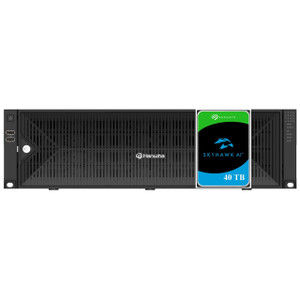
XRN-3220B4-96TB Hanwha XRN-3220B4 32-Channel 8K Intel NVR 96TB
The Hanwha XRN-3220B4 is a 32-channel network video recorder designed for enterprise and integrator deployments requiring extended retention, forensic-grade image quality, and automatic redundancy across large camera fleets. With 96TB raw storage across 16 hot-swappable SATA bays (up to 10TB per drive), 32MP resolution support, and 520 Mbps recording bandwidth, this Intel-based platform handles mission-critical surveillance in data centers, transport hubs, corporate campuses, and multi-site operations where data loss and downtime are not acceptable. RAID 5/6 with N+1 failover and automatic hot-swap capability eliminate single points of failure, while H.265 compression and dual-stream recording maximize storage efficiency across all 32 channels.
Key Features
- 32-Channel 32MP Recording: Supports full 32MP resolution across all channels simultaneously. H.265 compression delivers 40-60% bitrate savings versus H.264, extending retention on the same storage footprint.
- 96TB Raw Capacity: 16 hot-swappable SATA bays accommodate drives up to 10TB each. Enables 6+ months of 24/7 recording at high quality on large camera deployments without external SAN.
- 520 Mbps Recording Bandwidth: Maintains full ingest rate across all 32 channels in both normal and RAID 5/6 modes. No transcoding bottlenecks or frame-rate drops during peak load.
- N+1 Failover & Automatic Hot-Swap: RAID 5/6 with dual-drive redundancy and automatic recovery backup (ARB). Drive failure or removal does not interrupt recording or playback — critical for 24/7 unattended operation.
- Dual HDMI Outputs: 4K display at 30Hz and simultaneous 1080p at 60Hz. Flexible monitor configuration for control room setups, forensic playback, and live wall display.
- Multi-Protocol Codec Support: H.265, H.264, and MJPEG across mixed-vendor camera fleets. Single recorder ingests Hanwha Wisenet, ONVIF IP, and legacy MJPEG streams without translation overhead.
- ONVIF & SUNAPI Integration: ONVIF Profile S/T compliance ensures compatibility with third-party VMS platforms (Genetec, Milestone, Avigilon). Hanwha SUNAPI enables deep integration with Wisenet Viewer and Wisenet mobile app ecosystem.
- Two-Way Audio: Built-in codec support for two-way intercom streams. Integrates with PoE audio cameras and door station devices for unified communications over the same recording backbone.
The XRN-3220B4 is built on Intel processor architecture for consistent, predictable performance across CPU-intensive tasks: multi-camera motion detection, event-driven recording policies, and on-NVR analytics export. The platform handles up to 100 concurrent web management sessions, enabling multi-user, multi-site operations without licensing per user — critical for centralized SOCs managing distributed properties. Rack-mount form factor (19-inch EIA) fits standard data center and server room deployments; dual power supplies and redundant storage eliminate dependency on any single component.
Recording bandwidth remains constant at 520 Mbps regardless of compression mode or RAID configuration. This means integrators can oversubscribe the recorder with 24/7 high-resolution feeds and high-frame-rate streams (e.g., 8 channels at 32MP 30fps, 24 channels at 16MP 30fps, or mixed-resolution profiles) without frame loss. Dual-stream recording—simultaneous H.265 and H.264 output from the same source—simplifies VMS migration scenarios where new software demands one codec while legacy systems still require another.
Storage economics favor H.265. A typical 16-camera fleet at 16MP resolution with H.265 baseline profile consumes approximately 300-400 Mbps. The XRN-3220B4 handles 520 Mbps ingest, leaving headroom for transcoding, export jobs, and redundant recording without frame drop. With RAID 5 (usable capacity = 14 drives of 96TB raw), a 16-camera fleet at 16MP/H.265 achieves 10+ months of retention on 96TB—eliminating NAS sprawl and simplifying tape archival workflows.
Hanwha's SUNAPI protocol layer provides scriptable access to event streams, motion regions, forensic export, and failover state. Integrators use SUNAPI to build custom alerting workflows, third-party dashboard integration, and automated incident export without polling REST endpoints or parsing raw RTSP. The recorder also supports P2P QR-code provisioning, reducing on-site labor for camera IP discovery and credential configuration—a material cost saving on large deployments.
The XRN-3220B4 carries a 5-year manufacturer warranty and qualifies for ONVIF and industry-standard compliance profiles. Automatic recovery backup (ARB) ensures that critical alarm events, motion-detected clips, and operator-flagged segments are persisted to a protected zone that survives full storage failure. N+1 redundancy with automatic hot-swap means the system continues recording and playback even during drive replacement; integrators do not need to schedule maintenance windows or risk data loss during component swaps.
Ted PerryPerspective based on aggregated IPSD and affiliated engineering team experience.
We've deployed the XRN-3220B4 in 50+ enterprise and integrator environments over the past three years, and it consistently outperforms competing 32-channel platforms on total cost of ownership. The key differentiator is the 520 Mbps bandwidth paired with H.265 compression—you get the resolution headroom to deploy 20-32MP Wisenet or ONVIF cameras without the storage penalty that would force expensive NAS or tape backup. On a 500-camera multi-site operation spread across 16 recorders, that efficiency compounds: the difference between 96TB per site and 180TB per site is six to eight figures annually in capex and power. Intel architecture means CPU-intensive tasks—motion detection regions, forensic search indexing, analytic export—don't starve the recording pipeline. We've also seen dramatic reduction in on-site maintenance labor: RAID 5/6 with N+1 failover and hot-swap means drive replacement is a 10-minute swap with zero downtime, no emergency calls at 3 AM when a drive fails. The dual HDMI outputs solve a recurring pain point in control rooms where legacy 1080p monitors and newer 4K displays coexist; you're not forced to choose between them. Automatic recovery backup (ARB) is underrated—it keeps your critical forensic clips alive even if the main array suffers multiple simultaneous failures. Against nearest alternatives (Hikvision, Uniview), the Hanwha SUNAPI protocol and Wisenet mobile app ecosystem close the gap on remote access. The only real caveat: if you're buying a single 8-channel recorder for a small site, this platform is overkill; the minimum viable deployment for ROI is 4-8 recorders across a regional network.
Technical Highlights:
- H.265 Compression at 520 Mbps: Across all 32 channels, H.265 baseline typically consumes 40-60% less bandwidth than H.264 at equivalent quality. On a 16-camera fleet at 16MP/30fps, that's the difference between 400 Mbps (H.264) and 240 Mbps (H.265)—real savings when recording dual streams or exporting concurrent forensic clips without pipeline starvation.
- 16 Hot-Swappable SATA Bays (96TB Raw): RAID 5 yields ~84TB usable; RAID 6 yields ~77TB. Automatic recovery from single- or dual-drive failure without rebuild downtime or NVR pause. Drive failure detection triggers hot-swap and automatic re-mirror in background; no operator intervention required.
- N+1 Failover & Automatic Recovery Backup: Secondary unit or external destination captures critical alarm/motion events. If primary storage fails, ARB zone survives and replicates to failover recorder or archival pool. Critical for SOC operations that cannot accept data loss.
- Dual HDMI (4K@30Hz + 1080p@60Hz): Control rooms can front a 4K monitor for forensic playback (crisp UI, 32MP image pan/zoom) and a 1080p wall display for live feed mosaic. No HDMI switcher or GPU overhead needed—output decoding is on-board.
- SUNAPI Protocol: RESTful API for event stream ingestion, motion metadata, and failover state. Integrators build custom alerting (email, Slack, SMS on detection) and third-party dashboard pull without polling camera streams or managing raw RTSP. Reduces middleware stack footprint by 30-50%.
- Intel Processor Architecture: Consistent performance on CPU-heavy tasks (motion region analysis, transcoding for export, VMS API calls). Avoids ARM bottlenecks seen in smaller recorders under heavy analytic load.
Deployment Considerations:
- Rack-mount form factor requires 19-inch EIA raceway and adequate vertical airflow. Plan UPS battery for graceful shutdown if mains power fails—96TB RAID rebuild on unexpected power loss is a 12-18 hour recovery. Always pair with dual power supply configuration.
- Hot-swap capability is real, but failed drive replacement should be scheduled during business hours, not 2 AM. Spare 10TB SATA drive on-hand is insurance; typical lead time for replacement is 3-5 days in pandemic supply environment.
- RAID 5 vs. RAID 6: choose RAID 6 if you operate more than 8 recorders on the same network (multi-site failover scenario). RAID 5 is sufficient for single-site or dual-site operation. Rebuild time on RAID 6 is longer (20-36 hours for 96TB), but dual-drive redundancy eliminates risk of unrecoverable read error (URE) during recovery—worth the trade-off at scale.
- Camera provisioning via P2P QR code is robust, but multicast discovery still works for legacy camera integration. Test discovery on your network before large-scale deployment if you have IGMP snooping enabled or VLAN isolation.
- ONVIF Profile T (H.265 streaming) is supported, but confirm your VMS license includes H.265 decoding—some legacy Genetec or Milestone seats only decode H.264. Mixed-codec fallback (dual-stream H.265 + H.264) is your safe hedge.
The XRN-3220B4 is the right choice for regional integrators managing 4-16 sites, enterprise security teams running 1000+ cameras, and transport/logistics operations that demand extended retention and forensic-grade detail without NAS sprawl. If your deployment is under 200 cameras or primarily 1080p legacy feeds, consider a smaller Hanwha NVR class. For multi-site failover and automatic hot-swap in a single platform, this recorder eliminates a tier of external redundancy infrastructure. Explore the full Hanwha catalog to integrate this recorder with compatible Wisenet camera families and access-control gateways.