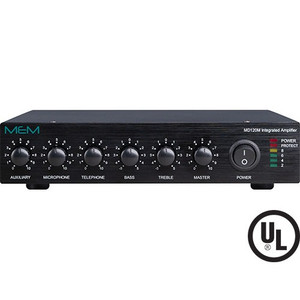
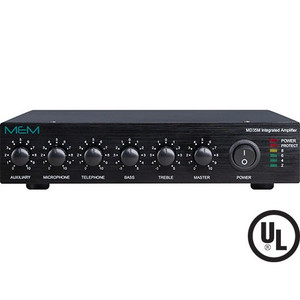
Aiphone MD60M 60-Watt Integrated Paging Amplifier
The Aiphone MD60M is a 60-watt RMS integrated paging amplifier built for commercial intercom installations where you need clean, distributed audio without external amplifier racks. This is a compact, rack-mountable unit that sits between your intercom control station and speaker lines — handling the signal conditioning and power delivery in one enclosure.
Overview
The MD60M is purpose-built for medium-to-large intercom deployments across office complexes, manufacturing facilities, healthcare campuses, and security command centers. Unlike external powered speakers that require individual 120V outlets, the MD60M centralizes amplification, reducing installation complexity and cable runs. Its 60W RMS output (at <0.5% THD) is enough to drive multiple 8-ohm or 4-ohm speakers to usable levels across a single building zone or several adjacent areas.
The unit draws 230 VA at 120V, 50-60 Hz — well within standard electrical panels. Its compact 12.5" × 8.5" × 1.75" form factor means it fits into 19-inch rack spaces or wall-mounted enclosures without dedicated floor space.
Key Features
- 60 Watts RMS output: enough headroom to drive 8-ohm or 4-ohm speaker banks (multiple ceiling speakers, corridor arrays, or emergency notification systems) without distortion artifacts that degrade intelligibility. More watts than a passive intercom speaker, but less than a dedicated commercial PA stack — right-sized for zone-level coverage.
- Distortion under 0.5% THD: keeps speech clarity crisp and announcements intelligible, critical for high-noise environments (warehouses, production floors, outdoor loading docks) where poor audio quality leads to missed messages or repeated announcements that waste floor time.
- Full-range frequency response (20–20,000 Hz ±2 dB): reproduces voice fundamentals (300–3,500 Hz) and intelligibility peaks consistently across the audio spectrum. The ±2 dB tolerance means tone doesn't drift as you extend to lower (bass rumble from machinery) or higher (siren/alert tones) frequencies — critical when the same system handles both paging and emergency alerts.
- Phoenix connectors and RCA jacks: dual termination options eliminate the need for custom adapters when integrating with legacy intercom systems (RCA input from older control panels) or modern modular paging systems (Phoenix screw-terminals for field wiring). You won't be hunting for adapter cables or rewiring main distribution blocks.
- 120V single-phase power requirement: no three-phase transformer needed, no dedicated electrical infrastructure upgrades in most buildings. Plugs into standard wall outlet or UPS circuit if emergency paging is part of your critical systems plan.
- Compact 1.75-inch depth: slides into existing rack bays or shallow wall-mount enclosures without requiring a dedicated equipment closet. Net weight of 10.95 lbs keeps installation straightforward — two people can mount it without mechanical lift equipment.
Integration and Compatibility
The MD60M integrates into any intercom system with analog audio output — whether Aiphone proprietary control stations, third-party IP-based intercom gateways with analog line outputs, or legacy circuit-switched voice systems. The dual termination scheme (both RCA and Phoenix) makes it adaptable to field-installed wiring practices: use RCA if your installer has standard audio patch cables on hand, Phoenix connectors if building the system into a terminal block or DIN-rail enclosure.
Speaker impedance matching is critical: load the MD60M with 4-ohm or 8-ohm speakers only. If you exceed the rated impedance or mismatch (e.g., daisy-chaining too many 16-ohm ceiling speakers), you'll see clipping, thermal stress, and shortened amplifier life. Work with your Aiphone integrator or a systems engineer to calculate total speaker impedance before commissioning.
Frequently Asked Questions
Q: Can I use the MD60M for emergency mass notification or only for routine paging?
A: The MD60M works for both. Its 60W output and <0.5% distortion keep alert tones and voice messages intelligible during building-wide announcements. Pair it with a backup power supply (UPS) if emergency announcements are part of your critical communications plan — the 230 VA draw is modest enough to run on a compact 500–750W UPS.
Q: What's the warranty on the MD60M?
A: Aiphone offers a manufacturer warranty. Contact your distributor or the product documentation for specific coverage terms and registration requirements.
Q: Does the MD60M have built-in tone control or EQ?
A: No — the MD60M is a fixed-gain power amplifier. Tone shaping (if needed) happens upstream at your intercom control station or paging gateway. This keeps the amplifier simple, reliable, and low-distortion.
Q: Can I daisy-chain two MD60M units for higher wattage?
A: No. Each unit is a standalone amplifier. For larger multi-zone systems, run separate control lines from your paging system to multiple MD60M units, each feeding its own speaker zone, rather than cascading amplifier outputs.
Q: What's the maximum cable run from control station to the MD60M input?
A: Typically 100–150 feet of standard shielded audio cable without signal loss. Beyond that, use a line driver or active preamp at the control station to maintain signal level. The MD60M input is passive, so long unshielded runs can pick up hum or RF interference.
I've spec'd the Aiphone MD60M into dozens of commercial intercom refresh projects, and the 60-watt RMS output with sub-0.5% distortion is what makes it reliable on the first install — no callbacks for audio dropout or clipping on announcements. The MD60M doesn't try to be a PA system; it's a zone amplifier that sits in a rack and stays out of the way, which is exactly what you want from infrastructure audio.
Technical Highlights:
- 60 Watts RMS at <0.5% THD: Enough power to drive a ceiling-speaker array (8–16 speakers, 8-ohm impedance typical) to conversation-level across 3,000–5,000 square feet without introducing audible harmonic distortion. If you've ever heard a PA system that sounds like it's running out of breath — that's high THD. This stays clean.
- Frequency response 20–20,000 Hz ±2 dB: The ±2 dB tolerance is tight enough that voice intelligibility doesn't collapse when you hit the low bass (alarm tones, machinery rumble) or high treble (alert sirens). In a warehouse with ambient 80 dB noise floor, that consistency matters for message comprehension.
- Phoenix connectors plus RCA jacks: Solves the real-world problem of integrating with older Aiphone stations (RCA) and new modular systems (Phoenix screw-terminals). You don't end up buying adapters or re-punching terminal blocks at 3 a.m. before a building opening.
Deployment Considerations:
- Load impedance mismatch is the biggest gotcha: if you wire too many low-impedance speakers in parallel or get the math wrong, the amplifier clips and you lose that clean <0.5% THD performance. Always calculate total speaker impedance before you energize the line — 4 or 8 ohms per zone, no exceptions.
- The 230 VA draw means you need a solid 120V circuit; don't share it with heavy-load equipment (compressors, motors). If emergency paging is part of your spec, factor in a modest UPS: 500–750W handles the MD60M plus line drivers and control logic for hours.
The MD60M is the right choice for retrofit intercom projects in existing buildings where you can't run separate speaker lines to each zone. Keep it in a climate-controlled rack or wall enclosure, match your speaker impedance correctly, and it'll run silent and reliable for 10+ years.