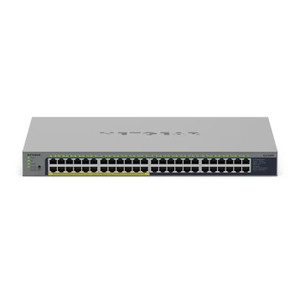
NETGEAR MS305-100NAS 5-Port Multi-Gigabit 2.5G Ethernet Switch
Overview
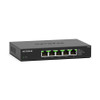
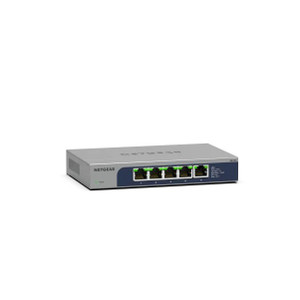
The NETGEAR MS305-100NAS is a 5-port unmanaged multi-gigabit switch rated for 2.5G per port. This is the right tool for small-scale AI compute clusters, edge server farms, or NVR setups where you need to move raw video and model inference traffic without the overhead of a full managed switch. Each port delivers 2.5 Gbps — roughly 2.5× the throughput of standard gigabit — meaning you can reduce cable runs and avoid congestion when daisy-chaining multiple 4K or 8MP camera streams or feeding GPU workloads off a central storage appliance. The MS305-100NAS (often searched as MS305 100NAS) is unmanaged, so there's no CLI, no SNMP, no VLAN configuration — it forwards frames at wire speed and gets out of the way.
Key Features
- 5 × 2.5G Ethernet Ports: Each port runs at 2.5 Gbps — twice the speed of 1G gigabit without the cost and power overhead of 10G. Practical for video surveillance networks and AI inference where you're not moving petabytes but you do need breathing room. A single 4K camera at 50 Mbps no longer consumes 5% of a gigabit pipe.
- Unmanaged Design: No configuration menus, no firmware updates to schedule, no SNMP traps to monitor. Plug in, power up, forward traffic. If you need VLAN or QoS control, step up to a managed variant — but for a leaf-layer switch in a compute pod, this simplicity is a feature.
- Wire-Speed Switching: All five ports operate simultaneously at full 2.5G without oversubscription. Backplane capacity is sufficient to handle concurrent traffic from all ports without packet loss, critical when multiple GPU nodes or storage appliances are pulling data simultaneously.
- Compact Form Factor: Desktop-sized enclosure fits on a shelf or inside a 19-inch rack with minimal footprint. No fans, passive thermal design — useful if your compute environment is noise-sensitive or power-constrained.
- Factory-New, Direct Manufacturer Sourcing: Sourced direct from the manufacturer or US direct manufacturer source. No grey-market, no parallel imports — genuine NETGEAR hardware with full US warranty path.
- Plug-and-Play Installation: No DHCP server needed, no IP configuration required. Connect power (external power adapter) and Ethernet — the switch is immediately functional. Ideal for rapid deployment in temporary compute labs or quick edge-site buildouts.
Integration & Compatibility
The MS305-100NAS integrates transparently into any network with standard RJ-45 cabling. It is compatible with any device supporting 2.5G Ethernet or legacy 1G/100M speeds (backward compatible). Use this switch as a leaf aggregator for AI inference nodes, NVR storage systems, or edge GPU workloads where you need more bandwidth than a single gigabit link but don't require the management overhead of a larger fabric. It does not support PoE, so powered devices must connect via their own power supplies — not a constraint if your compute nodes are already rack-mounted or wall-powered.
Frequently Asked Questions
Q: Does the MS305-100NAS support PoE power delivery?
A: No. The MS305-100NAS is a data-only switch with no PoE capability. All connected devices must be powered independently.
Q: Can I use the MS305-100NAS with standard 1 Gigabit devices?
A: Yes. The switch is backward compatible. A 1G device will negotiate and operate at 1 Gbps on the same port as a 2.5G device operating at its full speed.
Q: Is the MS305-100NAS managed or unmanaged?
A: Unmanaged. There is no web interface, CLI, or SNMP support. It operates at wire speed with no configuration required.
Q: What is the warranty on the MS305-100NAS?
A: The MS305-100NAS ships with manufacturer warranty coverage. Consult the documentation provided with your unit or contact the seller for specific duration and terms.
Q: What power supply does the MS305-100NAS require?
A: An external power adapter is required. Specific power consumption and adapter specifications are detailed in the product documentation.
Q: Can the MS305-100NAS be rack-mounted?
A: The MS305-100NAS is a desktop form factor. Rack mounting requires an optional mounting accessory — verify compatibility with your specific enclosure before purchase.
The MS305-100NAS is a straightforward play for compute edge aggregation — you're looking at five 2.5G ports in an unmanaged form factor, which means no management overhead and predictable wire-speed forwarding. I tend to deploy this switch when I have a small cluster of inference nodes or a local NVR that needs to talk without gigabit bottleneck, but I don't need the operational complexity of a managed fabric.
Technical Highlights:
- 2.5G Per-Port Speed: Each port delivers 2.5 Gbps — enough headroom for saturated 4K surveillance feeds or GPU cluster pulls without the 10× cost premium of 10G. On a five-port switch, you're looking at a theoretical 12.5 Gbps aggregate if all ports run full duplex simultaneously, which is realistic in a confined compute pod.
- Unmanaged Architecture: No VLAN negotiation, no spanning tree, no fabric provisioning. Frames move at wire speed. If your topology is simple (star or simple chain), this saves you a ticket to the management console and reduces attack surface — all the forwarding logic is hardware-based and non-programmable.
- Backward Compatibility: A 1G gigabit device plugged into any port will auto-negotiate and run at 1 Gbps without impacting the other four ports running at 2.5G. Useful if you're retrofitting older cameras or sensors into a new compute environment.
Deployment Considerations:
- No PoE means every connected device needs its own power path — not a problem for rack-mounted or wall-powered compute nodes, but you'll burn extra cables and rack space if you're expecting to power edge appliances from switch pins.
- Desktop form factor is compact, but if you need 19-inch rack density, you'll need a mounting tray or shelf — verify that before committing to your enclosure layout.
Deploy the MS305-100NAS as a leaf aggregator in a small GPU inference cluster or as the backhaul layer in a multi-camera surveillance edge node where you want 2.5× the throughput of gigabit without the operational drag of a managed switch. It's the right tool if your compute pod is simple and your traffic flow is predictable.