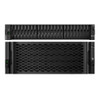
Lenovo 7Y77A00AWW ThinkSystem 4U60 Hybrid Storage Array Controller
Overview
The Lenovo 7Y77A00AWW is the 8GB-per-controller variant of the ThinkSystem Storage 4U60 chassis — a 4U rack-mounted hybrid storage array built for enterprise SAN environments that need high capacity, redundant data paths, and flexible RAID protection without forklift upgrades. At up to 3.375 PB raw capacity across 192 large-form-factor drives, this is a platform for primary storage consolidation, backup targets, and surveillance or media archives where capacity density matters. If you're evaluating Lenovo ThinkSystem storage for a data center or edge deployment, the 4U60 family is the high-density tier in the lineup.
Key Features
- Dual active-active controllers with automatic load balancing: Both controllers handle I/O simultaneously — no hot standby sitting idle. If one controller fails, the other takes the full workload without manual intervention. For storage environments that can't afford unplanned downtime, active-active is the architecture to spec, not active-passive.
- Up to 3.375 PB raw capacity (192x 18 TB LFF HDDs): The 4U60 form factor packs 60 large-form-factor bays into a 4U footprint — among the highest capacity-per-rack-unit ratios available in this class of enterprise storage arrays. Whether you're consolidating multiple aging arrays or building out a new archive tier, this scales without adding enclosures for most mid-to-large deployments.
- 8 GB per controller (16 GB system total) with flash-backed cache: Cache is mirrored between controllers, so a write acknowledged to cache is protected even if a controller loses power. The battery-backed destage-to-flash mechanism means you get write-back cache performance without the data integrity risk that makes some architects nervous about caching. If your workload demands higher cache, the 32 GB per-controller variant (7Y77A00BWW) is the upgrade path within the same chassis.
- RAID 0, 1, 3, 5, 6, 10 plus Dynamic Disk Pools: Standard RAID levels cover the typical protection profiles, but Dynamic Disk Pools (DDP) is the operational differentiator — DDP spreads data and parity across all drives in a pool, which dramatically reduces rebuild times after a drive failure compared to traditional RAID 6. For large-capacity deployments where a 12+ TB drive rebuild on RAID 6 could take 24–48 hours, DDP is worth understanding before you finalize your protection strategy. Note: RAID 3 is CLI-only configuration.
- Redundant hot-swap 2325 W Platinum AC power supplies (200–240 V): The 4U60 enclosure uses higher-wattage PSUs than the 2U siblings (which run 913 W at 100–240 V) — plan your PDU and circuit sizing accordingly. Both PSUs are hot-swap, so replacement during normal operation doesn't require a maintenance window.
- Fully hot-swappable components: Controllers, I/O modules, drives, power supplies, cooling modules, and SFP+/SFP28 transceivers are all field-replaceable without powering down the enclosure. For 24/7 production environments, this eliminates most planned maintenance windows for hardware service.
- Standard software: snapshots (up to 128 targets), thin provisioning, SSD read cache, encryption: Snapshots are included at base — 128 targets covers most use cases without an additional license. Encryption requires optional FIPS-certified drives; if your compliance framework mandates data-at-rest encryption, verify drive selection before ordering. Thin provisioning is DDP-only, so pool design decisions affect which software features are available.
- Optional: synchronous and asynchronous mirroring, expanded snapshot targets (512): Site-to-site replication is licensed optionally. For disaster recovery architectures requiring RPO near zero, synchronous mirroring keeps a second site in lockstep. Async mirroring suits longer RPO tolerances and WAN-connected secondaries where synchronous replication would introduce latency into the primary I/O path.
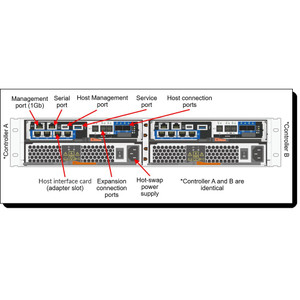
- Out-of-band management via dedicated 1 GbE RJ-45 per controller: Each controller has its own management port — isolate management traffic on a dedicated VLAN as standard practice. Serial console access (RJ-45 and Micro-USB) provides a fallback path when the network management interface is unreachable.
- Security: SSL, SSH, RBAC, LDAP authentication: Role-based access control and LDAP integration let you tie storage administration into your existing directory services rather than managing local accounts. For environments with audit requirements, RBAC means you can restrict junior operators to read-only views while preserving full control for senior admins.
Integration and Compatibility
The 7Y77A00AWW supports Microsoft Windows Server, Red Hat Enterprise Linux (RHEL), SUSE Linux Enterprise Server (SLES), and VMware vSphere as host operating systems — covering the majority of enterprise virtualization and bare-metal server environments. Management integrates with the System Manager web GUI, SAN Manager standalone GUI, SSH CLI, SMI-S Provider for third-party management frameworks, and SNMP/syslog/email alerting. Optional Lenovo XClarity integration extends unified infrastructure management to the storage tier alongside compute nodes for shops already running XClarity as their infrastructure management plane.
The 4U60 chassis sits alongside the 2U12 and 2U24 form factors in the ThinkSystem Storage family — all sharing the same controller and software architecture. If your rack space or capacity requirements fit the smaller footprint, the 2U enclosure variants use the same management interface and RAID feature set, making mixed-enclosure environments operationally consistent. For power planning, connect these arrays to rack PDUs rated for the 2325 W per-PSU draw at 200–240 V input — standard 100–120 V North American circuits are not supported on the 4U60 PSUs.
Frequently Asked Questions
Q: What is the maximum storage capacity of the 7Y77A00AWW 4U60 chassis?
A: Up to 3.375 PB raw capacity using 192 large-form-factor drives at 18 TB each. This is the maximum supported drive count for the 4U60 enclosure.
Q: What is the difference between the 7Y77A00AWW and the 7Y77A00BWW?
A: Both are controllers for the ThinkSystem Storage 4U60 chassis. The 7Y77A00AWW provides 8 GB of cache per controller (16 GB system total), while the 7Y77A00BWW provides 32 GB per controller (64 GB system total). Higher cache benefits workloads with larger working sets or heavier random-write profiles.
Q: Does the 4U60 support Dynamic Disk Pools (DDP)?
A: Yes. DDP is a standard included software feature. It distributes data and parity across all drives in a pool, which significantly reduces rebuild times after a drive failure compared to traditional RAID 5 or 6 — an important consideration when working with high-capacity drives where rebuild windows can span days.
Q: What host operating systems are supported?
A: Microsoft Windows Server, Red Hat Enterprise Linux (RHEL), SUSE Linux Enterprise Server (SLES), and VMware vSphere are the documented supported host operating systems.
Q: Are the power supplies compatible with standard North American 120 V circuits?
A: No. The 4U60 enclosure uses 2325 W power supplies rated for 200–240 V input only. Standard 100–120 V North American circuits are not supported. Plan your rack power infrastructure accordingly before installation.
Q: Is data-at-rest encryption supported?
A: Encryption is a standard software feature, but it requires optional FIPS-certified drives. The feature is not activated by inserting standard drives — verify that your drive selection includes FIPS-certified models if encryption is a compliance requirement.
The 7Y77A00AWW is the 8 GB controller configuration of the ThinkSystem Storage 4U60, and it's the entry point into the platform's dual active-active architecture — 16 GB of mirrored, flash-backed cache across both controllers handling I/O simultaneously. That's the spec I look at first on any active-active array, because cache mirroring without a flash-backed destage path is a liability at scale.
Technical Highlights:
- Flash-backed cache with battery destage: Write acknowledgment to cache is protected against power loss — the battery ensures cache contents are written to flash before full power-down. For environments running 24/7 write-intensive workloads, this is the difference between a recoverable and unrecoverable event on a power interruption.
- Dynamic Disk Pools vs. traditional RAID: DDP spreads parity across all drives rather than confining it to a fixed parity drive. On a pool of 60 drives at 18 TB each, a RAID 6 rebuild could take 48+ hours — DDP compresses that window significantly by parallelizing reconstruction across the full drive set, reducing the exposure window for a second failure.
- 2325 W Platinum PSUs at 200–240 V only: Both PSUs are hot-swap Platinum-rated, which keeps efficiency high under sustained load. The 200–240 V requirement is non-negotiable for the 4U60 — unlike the 2U siblings which accept 100–240 V. Confirm your rack PDU voltage before deployment; this catches integrators who assume universal input.
Deployment Considerations:
- Thin provisioning is DDP-only — if you configure a volume group using traditional RAID instead of DDP, thin provisioning is unavailable regardless of what the GUI shows. Design your pool architecture before provisioning LUNs to avoid having to rebuild pools post-deployment.
- RAID 3 configuration requires CLI access — it cannot be configured through the System Manager or SAN Manager GUIs. If your runbook calls for RAID 3, factor SSH CLI familiarity into your deployment team requirements or switch to RAID 5/6/DDP before you're on-site.
For a high-capacity archive or primary SAN tier in a VMware vSphere environment — especially one already running Lenovo XClarity for compute management — this chassis gives you a consistent management plane across compute and storage without adding a separate storage management tool to the stack.