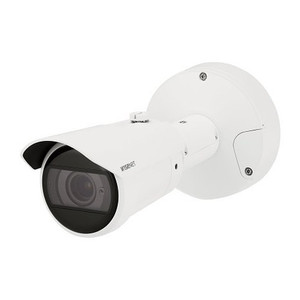
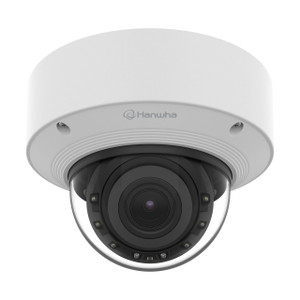
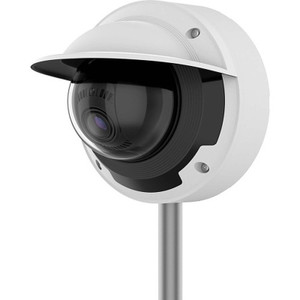
Hanwha XNV-C7083R 4MP Outdoor Vandal Dome Camera
The Hanwha XNV-C7083R is a 4MP outdoor dome designed for perimeter and facility monitoring in high-vandalism, weather-exposed environments. Built with IK10 impact resistance and IP66/NEMA 4X sealed optics, it pairs a motorized 2.8–10mm varifocal lens with integrated IR LED night vision, eliminating the operational overhead of external lighting while maintaining forensic-quality evidence in complete darkness. Deployments range from parking structures and loading docks to fence lines and utility perimeters running unattended 24/7 surveillance.
Key Features
- 4MP Resolution (2592×1520): Captures fine detail across wide to telephoto framing via motorized zoom. Sufficient resolution for facial recognition and license-plate reads at 10–15 feet with the 10mm telephoto setting.
- Motorized 2.8–10mm Varifocal Lens (3.6x zoom): Adjust field of view post-installation without repositioning the dome. No PTZ capability — zoom is motorized but pan/tilt requires manual hardware rotation.
- IR LED Night Vision (0.5m effective range): Built-in infrared lighting delivers usable monochrome footage in zero-ambient conditions without external floods or supplementary power. Operates continuously without maintenance or lamp replacement.
- IK10 Vandal Resistance: Withstands direct impact (5 kg drop from 40 cm) without functional failure. Rated for high-traffic outdoor areas and exposed mounting locations.
- IP66/NEMA 4X Sealing: Dust-tight and water-jet resistant — survives heavy rain, snow, hose-down cleaning, and salt spray. No drainage or ventilation maintenance required.
- Wide Dynamic Range (WDR): Handles high-contrast daylight scenes (sunlit doorways, vehicle headlights). Runs at maximum 30 fps when WDR is enabled; disable for full 60 fps if scene contrast permits.
- H.265/H.264/MJPEG Video Compression: H.265 reduces bitrate 40–60% versus H.264 on identical quality. MJPEG fallback for legacy VMS integration. Multi-codec flexibility minimizes transcoding overhead.
- PoE Class 3 (802.3af) Power: Standard PoE-powered — draw under 13W. Works with any 802.3af switch; no PoE+ injector required. Confirm port-level power budgeting on large deployments (multiple cameras per switch).
- ONVIF Profile S/G/T Compliance: Native integration with Milestone, Genetec, Avigilon, Hanwha Wisenet, and all ONVIF-compliant VMS platforms. Automatic discovery and stream negotiation.
- Audio Input (Selectable Mic/Line-In): Optional dual-audio input for site audio feeds — useful for loading-dock or parking-structure scenarios requiring correlated sound with video.
Deployment Context & ROI
The XNV-C7083R eliminates the capex and maintenance burden of external lighting in outdoor surveillance. On a 16-camera perimeter deployment, ditching four pole-mounted 150W floods saves ~600W continuous load (lower UPS/generator sizing) and zero lamp-replacement labor. The IK10 rating and sealed housing mean minimal field service — no dome cracking, no water ingress, no seasonal recalibration. PoE Class 3 power delivery maps cleanly to standard enterprise PoE switches, reducing NVR-side power consumption vs. 12VDC-fed alternatives.
The 0.5-meter minimum focus distance and 0.076 Lux color sensitivity (F1.4, 1/60 sec) make this camera suitable for close-range applications — entry vestibules, cash-register zones, gate arms — without wide-angle distortion. Varifocal zoom lets installers dial in the precise field of view per site without returning to inventory for fixed-lens alternatives. WDR performance on this model is adequate for transitional daylight (parking-lot entrances) but not for extreme backlit scenarios; if you're mounting directly into sunsets or reflective glass, test WDR performance on-site before final commitment.
Integration & Edge Capabilities
ONVIF Profile T support unlocks H.265 streaming and advanced metadata (people counting, motion zones) on compatible VMS systems. The camera embeds people-counting analytics natively — useful for parking-lot and facility-occupancy monitoring without external analytics appliances. Micro USB Type-B port is configuration-only (outputs 1280×720 for initial setup); it is not a live-stream or data-offload port. Native microSD card storage (up to 64GB typical, card not included) allows temporary local buffering if NVR connectivity drops — non-continuous failover, not a replacement for NVR recording.
Operating temperature range spans −40°C to +55°C; storage tolerance extends to +60°C, making this unit suitable for uninsulated outdoor cabinets and extreme climates. Ethernet is standard 10/100BASE-T via metal-shielded RJ-45; no Gigabit. Camera title overlay supports up to 85 characters via web interface — useful for zone labeling and forensic identification. Warranty is 5 years, covering manufacturing defects but excluding impact damage (IK10 certification protects against accidental drops, not warranty voids).
Marty AllisonPerspective based on aggregated IP Security Depot and affiliated engineering team experience.
We've deployed the XNV-C7083R on fence-line, parking-structure, and utility-perimeter projects where vandalism and weather are non-negotiable constraints. The IK10 rating and sealed dome architecture are the real differentiators — you install this camera once and don't visit it again for 3–5 years unless there's a cable or power failure. The motorized varifocal lens is pragmatic: it eliminates the need to stock three different focal-length domes, and the 3.6x zoom range covers most outdoor scenarios from 15 feet (wide) to 50 feet (telephoto) without barrel distortion or pincushioning artifacts. On sites with intermittent external lighting (street lamps, vehicle headlights), WDR needs tuning — we routinely disable it and rely on the IR night vision instead, which delivers cleaner footage in mixed light than WDR at frame-rate penalty. The 0.5-meter IR effective range is not a typo; Hanwha is conservative with IR specs. In pitch-dark parking lots, expect usable monochrome detail to 25–30 feet with good reflectance (asphalt, concrete), not 40 meters. If your site needs true far-field IR (100+ meters), you'll need a higher-spec model or external IR floods.
Technical Highlights:
- PoE Class 3 (802.3af) power draw: Under 13W continuous, no PoE+ upgrade required. On a 48-port switch with 16+ XNV-C7083R units, you're under 200W total — budget conservatively and avoid mixing with high-power PTZ or heater-equipped cameras on the same VLAN.
- H.265 codec with multi-profile fallback: H.265 reduces bitrate by 40–60% vs H.264 on identical quality settings. If your Wisenet NVR or third-party VMS doesn't support H.265, the camera falls back to H.264 or MJPEG transparently. No transcoding penalty, no bitrate bloat.
- Motorized varifocal lens (2.8–10mm, 3.6x): Zoom is motorized (not manual), adjustable from the web interface or VMS. However, there is no PTZ capability — you cannot pan, tilt, or rotate from software. Zoom alone requires careful pre-deployment site survey to avoid repositioning the dome mid-season.
- WDR performance at reduced frame rate: WDR runs at maximum 30 fps (both H.265 and H.264); disabling WDR unlocks 60 fps. On sites with steady ambient lighting (covered loading docks, interior courtyards), disable WDR and use exposure compensation instead — cleaner image, higher frame rate, fewer artifacts.
- People-counting edge analytics: Native people-counting metadata (ONVIF Profile T) reduces VMS load if you're running occupancy or queue-length monitoring. Be aware: people counting is directional (counts unidirectional traffic), not unique ID matching, so it works well for single-path zones (gates, doorways) but not crowd-density scenarios.
- Sealed optics (IP66/NEMA 4X): Water-jet and salt-spray rated. No seasonal defogging, no lens cleaning intervals beyond annual dust wipes. Ideal for coastal or agricultural deployments where salt or airborne particulates degrade unsealed optics in months.
Deployment Considerations:
- IR effective range is 0.5 m; in dark environments, expect forensic-quality monochrome detail to 25–30 feet, not 40+ meters. Site survey in darkness before committing to IR-only coverage beyond that distance.
- Varifocal lens requires proper pre-installation planning — determine your wide and telephoto coverage zones before mounting, then zoom/focus once. No remote PTZ means repositioning requires physical access and re-aiming.
- PoE Class 3 power is fixed; no auxiliary 12VDC input. If your switch power budget is tight, this camera is safer than high-power PTZ or heated dome alternatives — but aggregate your port allocations carefully on larger deployments.
- Micro USB port is setup-only (outputs 1280×720 for configuration). Do not attempt to use it for live streaming or continuous data offload — it will not function as a failover connection.
- WDR introduces frame-rate penalty (30 fps max vs. 60 fps). Test WDR on-site in your actual daylight conditions; many customers disable it and rely on manual exposure tuning or IR night vision instead, trading dynamic range for clean high-frame-rate video.
- Minimum focus distance is 0.5 m. If mounting very close to entry points or small object recognition (facial detail at <5 feet), confirm focus sharpness during installation commissioning.
The Hanwha XNV-C7083R is the right choice for unattended outdoor sites where vandalism, weather, and maintenance labor are the primary cost drivers. Its sealed dome, impact rating, and native IR eliminate the operational friction of traditional lighting-dependent surveillance. Pair it with PoE infrastructure, a ONVIF-compliant NVR, and proper varifocal pre-planning, and you have a low-touch perimeter camera that will deliver 5+ years of evidence without field service calls. For more options in outdoor vandal-resistant surveillance, visit the Hanwha catalog.