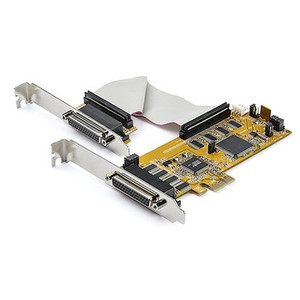
StarTech PEX4S953 4-Port PCIe RS-232 Serial Adapter Card
Overview
The StarTech PEX4S953 is a PCIe x1 serial adapter that adds four independent RS-232 DB-9 ports to any desktop or server with an available PCI Express slot. Built around the Asix AX99100A chipset paired with a 16950 UART, it targets integrators and IT architects who need reliable legacy-serial connectivity for access control panels, industrial PLCs, point-of-sale peripherals, or serial-attached IP devices in environments where USB-to-serial dongles introduce too much latency or driver instability. If your deployment depends on deterministic serial communication at scale, this card eliminates the adapter-chain problem at the hardware level.
Key Features
- Asix AX99100A Chipset with 16950 UART: The AX99100A is a proven PCIe-to-serial bridge that avoids the driver instability common in generic USB-serial adapters. The 16950 UART designation means each port carries its own independent UART engine — critical when you need all four ports active simultaneously without arbitration delays.
- 256-Byte FIFO Per Port: A 256-byte FIFO buffer is sixteen times larger than the classic 16550 UART's 16-byte buffer. In practice this means the host CPU gets more time between interrupts, reducing dropped characters at higher baud rates — directly relevant when polling multiple access control readers or industrial controllers in a tight timing loop.
- 921.6 Kbps Maximum Baud Rate: At nearly 1 Mbps, this card handles the fastest RS-232 devices on the market. Most legacy serial equipment tops out at 115.2 Kbps, so the PEX4S953 leaves substantial headroom for faster industrial protocols or high-throughput diagnostic interfaces without requiring a hardware swap later.
- Full Flow Control Options: Supports hardware RTS/CTS, software XON/XOFF, and no-flow-control modes. Hardware flow control matters when connecting to devices that cannot throttle their own transmit rate — serial barcode scanners, receipt printers, and certain access panels depend on RTS/CTS to avoid data loss at sustained transfer rates.
- Flexible Data Framing: Data bits configurable from 5 to 9 bits with stop bits of 1, 1.5, or 2, covers every RS-232 framing variant in the field. Unusual 9-bit framing is specifically used in multi-drop RS-232 networks (node addressing) and some industrial protocols — rarely supported on budget cards.
- PCIe x1 Standard Profile: A PCIe x1 interface provides far more bandwidth than the card's four serial ports will ever consume, meaning the slot bottleneck is never an issue. Standard profile form factor fits full-height desktop towers and server chassis; the card does not require a low-profile bracket swap for standard deployments.
- Internal LP4 Power Connector: The single internal LP4 (legacy 4-pin Molex) connector provides 12V DC and 5V DC directly from the system PSU. This matters in builds where the PCIe slot's 25W power budget needs to stay clean — the serial hardware draws its own power rail rather than loading the slot.
- Windows and Linux Support: Both major enterprise OS families are supported, making this card viable in Linux-based NVR servers, Windows-based access control hosts, and cross-platform automation appliances. No need to qualify a different SKU for mixed-OS environments.
- -10°C to 80°C Operating Range: An 80°C upper operating limit means this card can run in poorly ventilated industrial enclosures or server rooms with marginal cooling without thermal throttling or failure — more thermal headroom than most PCIe peripherals rated to 70°C.
- Lifetime Warranty: The manufacturer covers this card for its operational lifetime, which removes the typical 2–3 year hardware refresh risk from the cost model. For installations where serial infrastructure is hard to access for replacement, the lifetime warranty is a meaningful lifecycle planning factor.
Integration and Compatibility
The PEX4S953 installs into any standard PCIe x1, x4, x8, or x16 slot — PCIe is backward and forward lane-compatible, so slot availability is rarely a constraint on modern server motherboards. The AX99100A chipset has broad driver support across Windows and Linux kernel builds, which means it integrates cleanly into platforms like Windows Server running access control middleware, or Linux-based appliances running serial-driven automation stacks. The four DB-9 ports map as standard COM ports under Windows or ttyS/ttyUSB-equivalent nodes under Linux, so no application-layer changes are needed — the card presents as native serial hardware to the OS.
The internal LP4 connector requires a free LP4 power lead from the system PSU. In modern builds that have migrated entirely to SATA power connectors, an LP4 adapter may be needed — confirm PSU connector inventory before ordering. The serial adapter card category includes related PCIe and PCI serial options if port count or form factor requirements differ.
Frequently Asked Questions
Q: What chipset does the PEX4S953 use, and why does it matter?
A: The PEX4S953 uses the Asix AX99100A chipset paired with a 16950 UART. The AX99100A provides a stable, driver-supported PCIe bridge with wide OS compatibility. The 16950 UART gives each port an independent engine and a 256-byte FIFO buffer, which reduces CPU interrupt load and prevents character loss at higher baud rates compared to older 16550-based cards.
Q: What is the maximum baud rate supported?
A: The PEX4S953 supports up to 921.6 Kbps per port — well above the 115.2 Kbps ceiling of most legacy RS-232 devices. This gives you room to connect faster industrial interfaces or diagnostic equipment without a hardware change.
Q: Does the PEX4S953 work in a low-profile chassis?
A: The PEX4S953 ships in standard (full-height) profile. It is not documented as including a low-profile bracket. If you need to install in a slim or low-profile chassis, confirm bracket availability separately before ordering.
Q: What flow control modes are supported?
A: The card supports three flow control modes: none, XON/XOFF (software), and RTS/CTS (hardware). RTS/CTS hardware flow control is the most reliable option for devices that transmit at high rates without self-throttling — access control panels and industrial PLCs commonly require it.
Q: What operating systems are compatible?
A: The PEX4S953 supports Windows and Linux. This covers the majority of enterprise access control, industrial automation, and server platforms. Specific driver version compatibility should be confirmed against your OS build prior to deployment.
Q: What is the warranty on the PEX4S953?
A: StarTech provides a lifetime warranty on the PEX4S953, covering the card for its operational lifespan. This is notably longer than the 2–3 year coverage typical of PCIe peripheral cards and is a meaningful factor for hard-to-access infrastructure installations.
When I spec serial infrastructure for access control or industrial automation projects, the detail I look at first is FIFO depth — and the PEX4S953 stands out with its 256-byte FIFO per port, which is a meaningful step up from the 16-byte FIFO on commodity 16550-based cards. In polling environments where the host is managing multiple serial devices simultaneously, that buffer depth directly reduces missed interrupts and character loss without any application-layer tuning.
Technical Highlights:
- AX99100A + 16950 UART: The combination of a stable PCIe bridge chipset and independent per-port UART engines means all four ports can run at full throughput concurrently — no shared UART arbitration degrading performance on busy ports.
- 921.6 Kbps Max Baud Rate: Eight times the 115.2 Kbps ceiling of standard legacy serial devices, giving this card genuine longevity for installations where serial standards may evolve or faster industrial protocols get introduced.
- -10°C to 80°C Operating Range: The 80°C upper limit means this card survives in poorly ventilated industrial enclosures that would thermally stress a standard 70°C-rated peripheral — an important margin in server rooms with inconsistent cooling.
Deployment Considerations:
- The internal LP4 power connector requires a free legacy Molex lead from the system PSU. In newer builds that have moved entirely to SATA power, budget for an LP4 adapter — confirm before rack assembly to avoid a site visit.
- The standard profile form factor means this card will not fit a low-profile or slim chassis without a bracket swap that is not confirmed as included. Verify chassis clearance before ordering for dense rack appliances.
The PEX4S953 is the right call for physical security integrators deploying Windows- or Linux-based access control hosts that need to drive four RS-232 panels or serial readers from a single internal card — particularly where uptime requirements make the lifetime warranty a genuine operational asset rather than a footnote.